EUR/USD remains vulnerable with all eyes on the FOMC minutes
- The Euro keeps wavering below 1.1600 after hitting fresh weekly lows at 1.1565.
- Eurozone CPI data revealed that inflation drew closer to the 2% ECB target in October.
- Risk aversion is underpinning the US Dollar, despite the weak US labour data seen on Tuesday.

EUR/USD is trading practically flat near 1.1585 ahead of Wednesday's US session opening, after having hit fresh weekly lows at.1.1565 following the release of Eurozone inflation figures. The risk-averse mood is acting as a tailwind for the safe-haven US Dollar (USD) as markets await the release of the minutes of October's Federal Reserve (Fed) meeting, due later on the day.
Figures released by Eurostat earlier on Wednesday confirmed that the Eurozone Harmonised Index of Consumer Prices accelerated to 0.2% in October from 0.1% in September, but yearly inflation eased to 2.1% from the previous month's 2.2% rate, drawing closer to the European Central Bank's (ECB) 2% target. The core HICP grew 0.3% on the month and 2.4% year-on-year, from 0.1% and 2.4% respectively in September.
On Tuesday, US economic data was far from supportive for the Greenback. US Initial Jobless Claims grew beyond expectations in the week of October 18, and the US ADP Employment Change weekly report showed that businesses shed an average of 2,500 jobs per week in the four weeks ending on November 1. All in all, figures reflect a weakening labour market.
Bets of a Federal Reserve (Fed) interest rate cut in December have inched higher, but the Richmond Fed President, Thomas Barkin, affirmed on Tuesday that committee members might need more data to decide on the next monetary policy steps..
Later on Wednesday, the focus will shift to the minutes of the October Fed meeting, which are due to be released at 19:00 GMT. Market volatility, however, is likely to remain subdued ahead of the all-important US Nonfarm Payrolls report, due on Thursday.
Euro Price Today
The table below shows the percentage change of Euro (EUR) against listed major currencies today. Euro was the strongest against the New Zealand Dollar.
| USD | EUR | GBP | JPY | CAD | AUD | NZD | CHF | |
|---|---|---|---|---|---|---|---|---|
| USD | -0.01% | 0.20% | 0.45% | 0.18% | 0.30% | 0.55% | 0.28% | |
| EUR | 0.00% | 0.21% | 0.45% | 0.18% | 0.30% | 0.57% | 0.29% | |
| GBP | -0.20% | -0.21% | 0.25% | -0.03% | 0.09% | 0.37% | 0.08% | |
| JPY | -0.45% | -0.45% | -0.25% | -0.27% | -0.15% | 0.11% | -0.16% | |
| CAD | -0.18% | -0.18% | 0.03% | 0.27% | 0.12% | 0.38% | 0.09% | |
| AUD | -0.30% | -0.30% | -0.09% | 0.15% | -0.12% | 0.27% | -0.05% | |
| NZD | -0.55% | -0.57% | -0.37% | -0.11% | -0.38% | -0.27% | -0.29% | |
| CHF | -0.28% | -0.29% | -0.08% | 0.16% | -0.09% | 0.05% | 0.29% |
The heat map shows percentage changes of major currencies against each other. The base currency is picked from the left column, while the quote currency is picked from the top row. For example, if you pick the Euro from the left column and move along the horizontal line to the US Dollar, the percentage change displayed in the box will represent EUR (base)/USD (quote).
Daily digest market movers: The Euro remains vulnerable in risk-off markets
- The Euro keeps trading sideways, showing a lack of clear bias near weekly lows, as the sour market mood underpins the safe-haven US Dollar. The sell-off on global equity markets has triggered a rush for safety, which is keeping risk-sensitive assets like the EUR on the back foot.
- In the US, Initial Jobless Claims rose to 232,000 and Continuing Claims rose to 1,957 million, both for the week ending in October 18, and from 219,000 and 1,926 million respectively in the week of September 19 – this was the last week figures were released ahead of the US government shutdown.
- US ADP employment data revealed that businesses shed an average of 2,500 jobs per week in the four weeks ending on November 1. This is a better figure than the 11,250 average posted the previous week, but still reflects a weakening labour market and adds pressure on the Fed to cut interest rates further at upcoming meetings.
- On the positive side, US Factory Orders delayed data revealed a 1.4% increase in August, in line with market consensus, to offset the 1.3% decline seen in the previous month. The impact of this figure on the US Dollar, however, was minimal.
- During the US session, the minutes of the last Fed meeting are likely to provide further insight into the central bank's monetary policy, although the highlight this week will be the release of September's delayed Nonfarm Payrolls report, due on Thursday.
Technical Analysis: EUR/USD remains under pressure below 1.1600
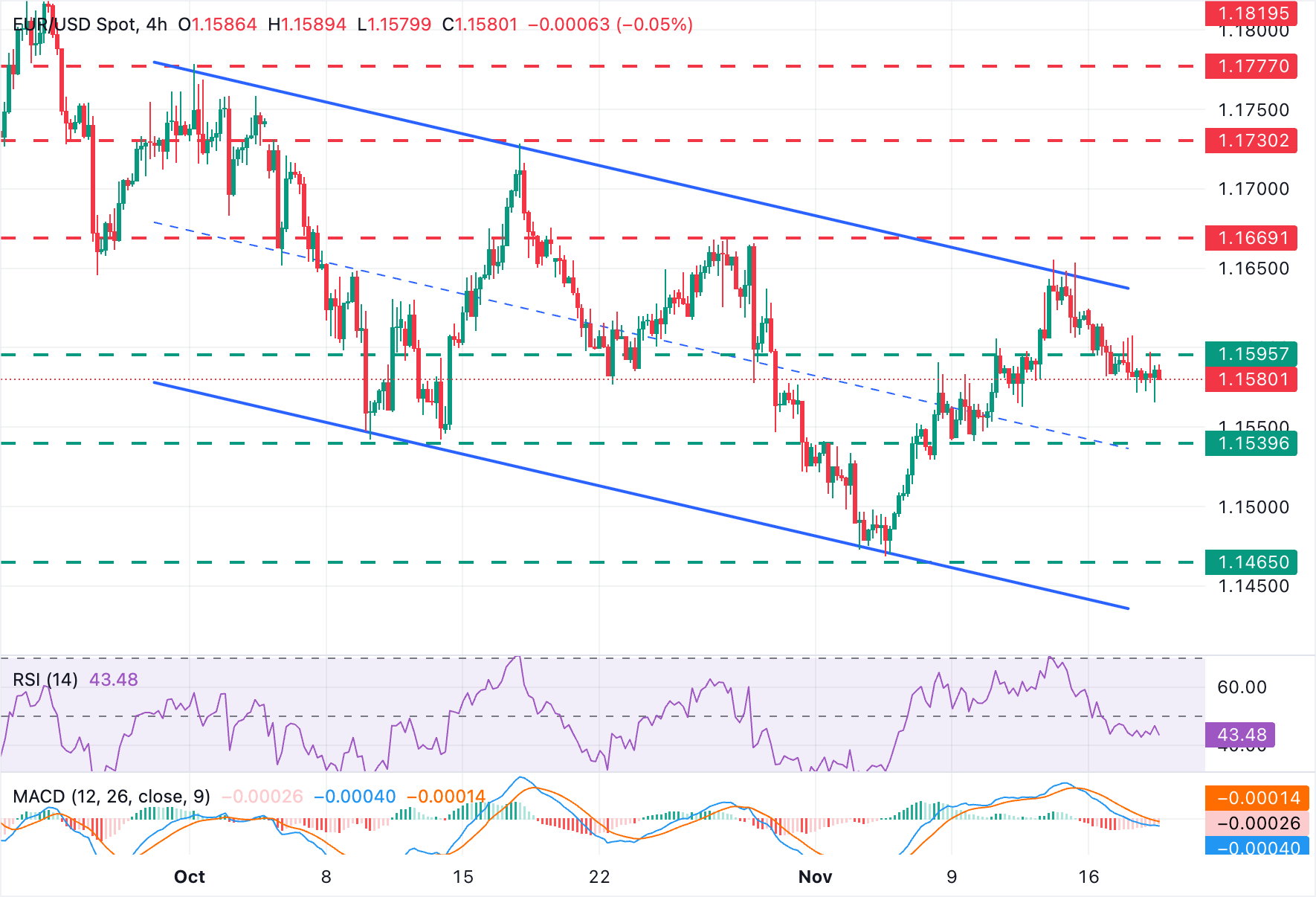
There are no relevant changes in the EUR/USD technical picture. The pair remains trading sideways below 1.1600 with the bearish trend from 1.1650 in play. The mild recovery attempt from weekly lows near 1.1570 seems fragile, and technical indicators remain within negative territory.
The 4-hour Relative Strength Index (RSI) momentum indicator is below the 50 level, and the Moving Average Convergence Divergence (MACD) keeps posting red histogram bars. However, the MACD line is turning flat, suggesting a weaker bearish momentum.
Tuesday's low near 1.1570 is still at a short distance and below there, the November 7, 10, and 11 lows in the 1.1535-1.1545 area, and the November 5 lows, near 1.1470, emerge as the next bearish targets. To the upside, Tuesday's high, around 1.1610, is likely to challenge bulls ahead of the top of the bearish channel, which now lies around 1.1635. Further up, the October 28 and 29 highs, near 1.1670, would come into focus.
Fed FAQs
Monetary policy in the US is shaped by the Federal Reserve (Fed). The Fed has two mandates: to achieve price stability and foster full employment. Its primary tool to achieve these goals is by adjusting interest rates. When prices are rising too quickly and inflation is above the Fed’s 2% target, it raises interest rates, increasing borrowing costs throughout the economy. This results in a stronger US Dollar (USD) as it makes the US a more attractive place for international investors to park their money. When inflation falls below 2% or the Unemployment Rate is too high, the Fed may lower interest rates to encourage borrowing, which weighs on the Greenback.
The Federal Reserve (Fed) holds eight policy meetings a year, where the Federal Open Market Committee (FOMC) assesses economic conditions and makes monetary policy decisions. The FOMC is attended by twelve Fed officials – the seven members of the Board of Governors, the president of the Federal Reserve Bank of New York, and four of the remaining eleven regional Reserve Bank presidents, who serve one-year terms on a rotating basis.
In extreme situations, the Federal Reserve may resort to a policy named Quantitative Easing (QE). QE is the process by which the Fed substantially increases the flow of credit in a stuck financial system. It is a non-standard policy measure used during crises or when inflation is extremely low. It was the Fed’s weapon of choice during the Great Financial Crisis in 2008. It involves the Fed printing more Dollars and using them to buy high grade bonds from financial institutions. QE usually weakens the US Dollar.
Quantitative tightening (QT) is the reverse process of QE, whereby the Federal Reserve stops buying bonds from financial institutions and does not reinvest the principal from the bonds it holds maturing, to purchase new bonds. It is usually positive for the value of the US Dollar.
Author

Guillermo Alcala
FXStreet
Graduated in Communication Sciences at the Universidad del Pais Vasco and Universiteit van Amsterdam, Guillermo has been working as financial news editor and copywriter in diverse Forex-related firms, like FXStreet and Kantox.














