EUR/USD wavers near weekly lows ahead of US inflation, PMI releases
- The Euro remains trading sideways between 1.1620 and 1.1580 against the US Dollar.
- Eurozone HCOB PMI figures beat expectations with services activity expanding at its fastest rate in the last 12 months.
- The US yearly CPI is expected to accelerate beyond the 3% threshold in September.

EUR/USD remains trading within previous ranges, unable to find acceptance above 1.1620, despite the upbeat German and Eurozone business activity figures released earlier on Friday. The pair changes hands at 1.1615, at the time of writing, practically unchanged on daily charts, with all eyes on the US Consumer Price Index (CPI) release, due later on the day.
Eurozone's HCOB Purchasing Managers Index (PMI) data revealed an unexpected expansion of the manufacturing sector's activity in October and a stronger-than-expected growth in the Services sector, which has shown the strongest activity in the last 12 months. These figures improve the outlook of the Eurozone's economy and endorse the European Central Bank's (ECB) hawkish side, dampening hopes of further monetary easing in the coming months.
The common currency, however, has remained on the back foot this week as US President Donald Trump soured market sentiment, threatening new restrictions on software exports to China on Thursday, ahead of next week's meeting with Chinese President Xi Jinping.
Trade issues remain in the spotlight on Friday, as President Trump revived frictions, this time with Canada, publishing a post on social media assuring that trade negotiations with his northern neighbour have "terminated", apparently due to an advert that featured former US president Ronald Reagan speaking negatively about tariffs.
Euro Price Today
The table below shows the percentage change of Euro (EUR) against listed major currencies today. Euro was the strongest against the Australian Dollar.
| USD | EUR | GBP | JPY | CAD | AUD | NZD | CHF | |
|---|---|---|---|---|---|---|---|---|
| USD | 0.03% | 0.02% | 0.21% | 0.19% | 0.23% | 0.17% | 0.09% | |
| EUR | -0.03% | -0.01% | 0.18% | 0.17% | 0.20% | 0.14% | 0.06% | |
| GBP | -0.02% | 0.01% | 0.18% | 0.17% | 0.21% | 0.14% | 0.07% | |
| JPY | -0.21% | -0.18% | -0.18% | -0.03% | 0.02% | -0.06% | -0.12% | |
| CAD | -0.19% | -0.17% | -0.17% | 0.03% | 0.03% | -0.03% | -0.12% | |
| AUD | -0.23% | -0.20% | -0.21% | -0.02% | -0.03% | -0.06% | -0.14% | |
| NZD | -0.17% | -0.14% | -0.14% | 0.06% | 0.03% | 0.06% | -0.07% | |
| CHF | -0.09% | -0.06% | -0.07% | 0.12% | 0.12% | 0.14% | 0.07% |
The heat map shows percentage changes of major currencies against each other. The base currency is picked from the left column, while the quote currency is picked from the top row. For example, if you pick the Euro from the left column and move along the horizontal line to the US Dollar, the percentage change displayed in the box will represent EUR (base)/USD (quote).
Daily digest market movers: Upbeat Eurozone PMIs provide some support to the Euro
- The Euro has picked up from lows following better-than-expected preliminary Eurozone PMIs for October. The HCOB Manufacturing PMI improved to 50.0 from 49.8 in September against the market consensus of a slight decline to 49.5. The HCOB Services PMI rose to 52.6 from 51.3, again, beating expectations of a slowdown to 51.1.
- Somewhat earlier, German PMI figures showed a slight improvement in the manufacturing activity to 49.6 from last month's 49.5, while the Services sector's activity accelerated to 54.5 from 51.5 in September, also beating expectations of a slowdown to 51.0.
- The US Dollar (USD), however, is moving within recent ranges, on track for a moderate weekly advance as fresh trade woes have kept risk appetite subdued this week. Investors are awaiting US inflation data release due later on Friday, although the main focus remains on the Trump-Xi meeting and the Fed's monetary policy decision next week.
- The highlight of the week is the release of September's US CPI, which is expected to have risen at a steady 0.4% pace in the month, and 3.1% year-on-year, up from August's 2.9% reading., The core CPI, however, is seen growing at the same pace as in the previous month, at a 3.1% yearly rate.
- These figures will frame next week's Fed decision, although investors are practically fully pricing a quarter-point rate cut. The CME Group's Fed Watch tool shows a 98.9% chance that the central bank will trim its benchmark interest rate by 25 basis points on Wednesday and a 91% chance of another such cut in December.
Technical Analysis: EUR/USD treads water around 1.1600
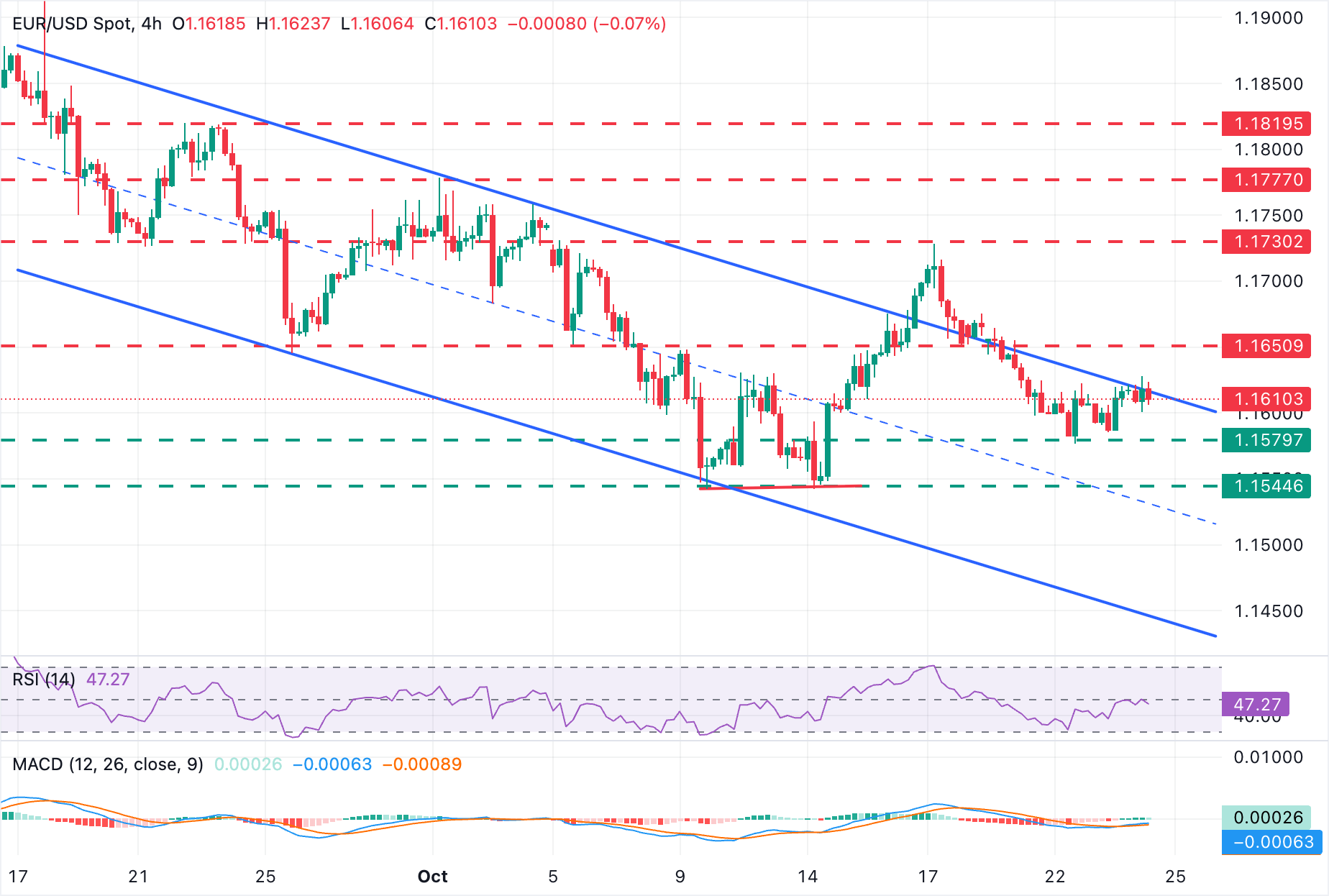
EUR/USD remains trading within a descending channel, with rallies finding sellers. Recent price action has remained trapped within a narrow range between 1.1620 and the support area at 1.1580, with investors looking for fundamental drivers to determine the pair's near-term direction.
Technical indicators are pointing lower on the 4-hour chart, with the Relative Strength Index (RSI) unable to regain the 50 level. Bears, however, would need to confirm below the mentioned 1.1580 support to clear the way towards the October 9 and 14 lows, in the area of 1.1545. Further down, the 1.1500 round level appears as a potential target ahead of the channel bottom, now around 1.1450.
Bullish attempts have remained capped below 1.1620, where Thursday's high meets the channel top. A successful breach of this level would shift the focus towards the October 21 high, around 1.1650, ahead of the October 17 high, at 1.1728.
Economic Indicator
Consumer Price Index (YoY)
Inflationary or deflationary tendencies are measured by periodically summing the prices of a basket of representative goods and services and presenting the data as The Consumer Price Index (CPI). CPI data is compiled on a monthly basis and released by the US Department of Labor Statistics. The YoY reading compares the prices of goods in the reference month to the same month a year earlier.The CPI is a key indicator to measure inflation and changes in purchasing trends. Generally speaking, a high reading is seen as bullish for the US Dollar (USD), while a low reading is seen as bearish.
Read more.Next release: Fri Oct 24, 2025 12:30
Frequency: Monthly
Consensus: 3.1%
Previous: 2.9%
Source: US Bureau of Labor Statistics
The US Federal Reserve (Fed) has a dual mandate of maintaining price stability and maximum employment. According to such mandate, inflation should be at around 2% YoY and has become the weakest pillar of the central bank’s directive ever since the world suffered a pandemic, which extends to these days. Price pressures keep rising amid supply-chain issues and bottlenecks, with the Consumer Price Index (CPI) hanging at multi-decade highs. The Fed has already taken measures to tame inflation and is expected to maintain an aggressive stance in the foreseeable future.
Economic Indicator
Consumer Price Index ex Food & Energy (YoY)
Inflationary or deflationary tendencies are measured by periodically summing the prices of a basket of representative goods and services and presenting the data as the Consumer Price Index (CPI). CPI data is compiled on a monthly basis and released by the US Department of Labor Statistics. The YoY reading compares the prices of goods in the reference month to the same month a year earlier. The CPI Ex Food & Energy excludes the so-called more volatile food and energy components to give a more accurate measurement of price pressures. Generally speaking, a high reading is bullish for the US Dollar (USD), while a low reading is seen as bearish.
Read more.Next release: Fri Oct 24, 2025 12:30
Frequency: Monthly
Consensus: 3.1%
Previous: 3.1%
Source: US Bureau of Labor Statistics
The US Federal Reserve has a dual mandate of maintaining price stability and maximum employment. According to such mandate, inflation should be at around 2% YoY and has become the weakest pillar of the central bank’s directive ever since the world suffered a pandemic, which extends to these days. Price pressures keep rising amid supply-chain issues and bottlenecks, with the Consumer Price Index (CPI) hanging at multi-decade highs. The Fed has already taken measures to tame inflation and is expected to maintain an aggressive stance in the foreseeable future.
Author

Guillermo Alcala
FXStreet
Graduated in Communication Sciences at the Universidad del Pais Vasco and Universiteit van Amsterdam, Guillermo has been working as financial news editor and copywriter in diverse Forex-related firms, like FXStreet and Kantox.