EUR/USD hovers at 1.1600 as muted CPI data fails to alter Fed stance
- EUR/USD steady, set for 0.21% weekly loss but holding three-day streak above key support.
- US CPI misses forecasts, reinforcing 96% odds of October Fed rate cut.
- Eurozone PMIs beat expectations, but Moody’s cuts France outlook to negative on fiscal, political risks.

EUR/USD is poised to finish the week with losses of 0.21% yet it remains above the 1.16 figure for the third straight day, capped on the upside by key resistance levels after US data might not deter the Fed from cutting rates.
Euro supported by upbeat PMIs; Moody’s warning on France limits upside momentum
Inflation data in the US would not move the needle in favor of Fed hawks, missing estimates to the downside, though it remains far from the central bank 2% goal. After that, S&P Global showed that the economy shows signs of strength as manufacturing and services flash PMIs, expanded in October.
Meanwhile, the University of Michigan (UoM) closed the docket for the day amid the US government shutdown reaching its twentieth fourth day, revealing that US consumers are growing slightly pessimistic, while estimating that prices could continue to rise.
Of late, the Greenback trimmed some of its gains as the Trump administration launched a trade investigation whether China complied with a limited trade agreement reached in 20202 during President Donald Trump’s first term, revealed Bloomberg.
In Europe, HCOB Flash Purchasing Managers Indices (PMIs) in October, improved from 49.8 to 50, and from 51.3 to 52.6, respectively. Both prints exceeded forecasts, an indication that business activity is picking up as demand jumps.
As of writing, Moody's Ratings changed France's outlook to negative, affirms aa3 ratings, mentioned “France's political instability risks hampering ability to address key policy challenges like elevated fiscal deficit, rising debt burden.”
Daily market movers: EUR/USD holds firm despite solid US PMI data
- The US Dollar Index (DXY), which tracks the performance of the buck’s value against a basket of its rivals, is up 0.03% at 98.94, capping the EUR/USD’s advance.
- US Consumer Price Index (CPI) rose 3.0% in the 12 months through September, coming in just below forecasts of 3.1% and slightly higher than August’s 2.9% reading. The core CPI — which excludes food and energy — increased 3.0% year-over-year, down a tenth from the previous month.
- US business activity accelerated in October, marking the second-fastest pace so far this year, according to preliminary “flash” PMI data from S&P Global. The report also highlighted the strongest increase in new business seen in 2025 to date, underscoring continued resilience in private-sector output. The S&P Global Manufacturing PMI rose to 52.2 in October from 52.0 in September, signaling continued expansion in the sector. The Services PMI climbed to 55.2 from 54.2, marking a three-month high and underscoring solid momentum in business activity.
- The University of Michigan’s consumer sentiment index was revised down to 53.6 in October from the preliminary reading of 55.0, missing expectations of 55.1. One-year inflation expectations eased slightly to 4.6% from 4.7% in September, while the five-year outlook edged higher to 3.9% from 3.7%.
- The US central bank is expected to cut rates 25 basis points to the 3.75% - 4% range, with traders already pricing an additional 0.25% reduction for the December meeting.
Technical outlook: EUR/USD consolidates, but slightly bullish
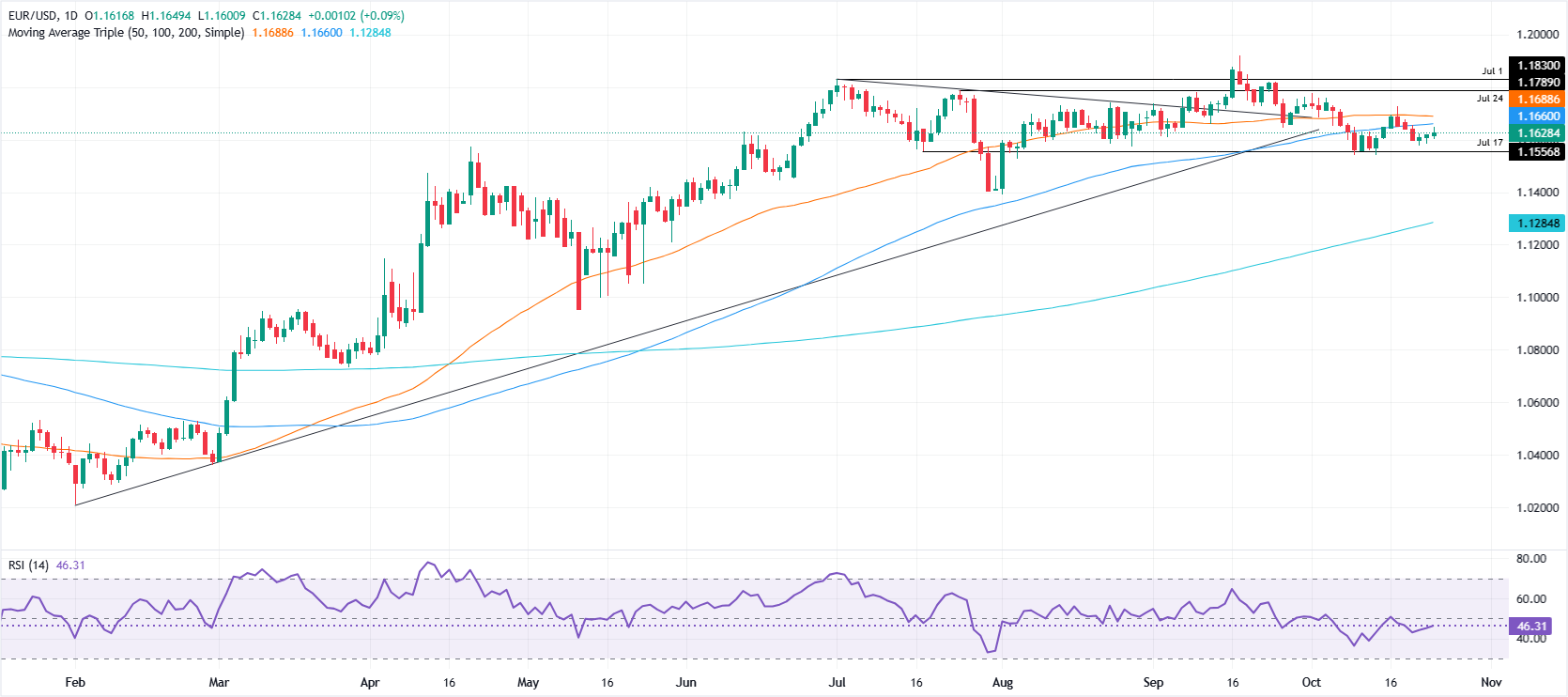
EUR/USD’s technical outlook has modestly improved but remains neutral as the pair trades beneath the confluence of the 20-day and 100-day Simple Moving Averages (SMAs) at 1.1653 and 1.1658, respectively. The Relative Strength Index (RSI) has slipped below the neutral 50 mark, suggesting growing bearish momentum.
Immediate support is seen at 1.1600, followed by 1.1550 and 1.1500. A clear break below this zone would expose the August 1 cycle low around 1.1391. On the upside, resistance remains aligned with the 20- and 100-day SMAs, while a decisive move above 1.1700 would open the way toward 1.1800 and the July 1 high at 1.1830.
Euro FAQs
The Euro is the currency for the 19 European Union countries that belong to the Eurozone. It is the second most heavily traded currency in the world behind the US Dollar. In 2022, it accounted for 31% of all foreign exchange transactions, with an average daily turnover of over $2.2 trillion a day. EUR/USD is the most heavily traded currency pair in the world, accounting for an estimated 30% off all transactions, followed by EUR/JPY (4%), EUR/GBP (3%) and EUR/AUD (2%).
The European Central Bank (ECB) in Frankfurt, Germany, is the reserve bank for the Eurozone. The ECB sets interest rates and manages monetary policy. The ECB’s primary mandate is to maintain price stability, which means either controlling inflation or stimulating growth. Its primary tool is the raising or lowering of interest rates. Relatively high interest rates – or the expectation of higher rates – will usually benefit the Euro and vice versa. The ECB Governing Council makes monetary policy decisions at meetings held eight times a year. Decisions are made by heads of the Eurozone national banks and six permanent members, including the President of the ECB, Christine Lagarde.
Eurozone inflation data, measured by the Harmonized Index of Consumer Prices (HICP), is an important econometric for the Euro. If inflation rises more than expected, especially if above the ECB’s 2% target, it obliges the ECB to raise interest rates to bring it back under control. Relatively high interest rates compared to its counterparts will usually benefit the Euro, as it makes the region more attractive as a place for global investors to park their money.
Data releases gauge the health of the economy and can impact on the Euro. Indicators such as GDP, Manufacturing and Services PMIs, employment, and consumer sentiment surveys can all influence the direction of the single currency. A strong economy is good for the Euro. Not only does it attract more foreign investment but it may encourage the ECB to put up interest rates, which will directly strengthen the Euro. Otherwise, if economic data is weak, the Euro is likely to fall. Economic data for the four largest economies in the euro area (Germany, France, Italy and Spain) are especially significant, as they account for 75% of the Eurozone’s economy.
Another significant data release for the Euro is the Trade Balance. This indicator measures the difference between what a country earns from its exports and what it spends on imports over a given period. If a country produces highly sought after exports then its currency will gain in value purely from the extra demand created from foreign buyers seeking to purchase these goods. Therefore, a positive net Trade Balance strengthens a currency and vice versa for a negative balance.
Author

Christian Borjon Valencia
FXStreet
Markets analyst, news editor, and trading instructor with over 14 years of experience across FX, commodities, US equity indices, and global macro markets.


![How Wall Street rigs the game [Video]](https://editorial.fxsstatic.com/images/i/market-chaos-01.jpg)