EUR/USD holds steady near 1.1570 as markets digest Fed outlook
- EUR/USD trades flat at 1.1573, despite weak EU services PMI prints and soft US ISM data.
- Trump confirms Scott Bessent declined to be considered for Fed Governor role after Kugler’s resignation.
- Eurozone PMIs mixed; Germany and Spain services improve, France and Italy disappoint.
- Traders eye upcoming Fed speakers and key EU data: German Factory Orders and Eurozone Retail Sales.

The EUR/USD holds firm during the North American session on Tuesday, with traders still digesting the latest employment figures in the United States (US) and the release of further US data. Across the pond, HCOB Flash PMI numbers were mixed across the European Union (EU) yet failed to push the Euro higher against the US Dollar. At the time of writing, the pair trades at 1.1573, unchanged.
Further developments, during the session, revealed that US President Donald Trump was considering nominating the US Treasury Secretary Scott Bessent to the vacant spot on the Federal Reserve, following Adriana Kugler's resignation as Fed Governor, effective on August 8. Nevertheless, Bessent asked not to be considered for the position.
On the data front, the Institute for Supply Management (ISM) revealed that business activity in the services sector is stagnating. Earlier, the US Commerce Department announced that the trade deficit shrank to an almost 2-year low in June, while China’s trade gap narrowed.
Following the data release, the EUR/USD remained within familiar levels, as the prints hovered around economists' estimates, with the PMI dipping, though expanding.
In the EU, the HCOB Services PMI for the whole bloc showed some signs of softening, down from 51.2 as expected in July, to 51. Figures in France and Italy followed suit, with the former dropping to 48.5 from 49.7 in the previous month, and estimates, with the latter rising from 52.1 to 52.3, but below estimates.
The outliers were Spain and Germany, as both countries showed an improvement in the services sector, yet the prints maintained the status quo, as seen by the EUR/USD’s reaction.
The US economic docket will feature Fed speakers, with traders awaiting Boston Fed Susan Collins, Governor Lisa Cook, and San Francisco Fed Mary Daly. Across the pond, Germany's Factory Orders and the Retail Sales of the EU are expected to provide cues about the economic status of the Eurozone.
Daily digest market movers: Euro shrugs off mixed EU PMI, traders focus on Fed policy signals
- The ISM Services PMI fell to 50.1 in July from 50.8 in June, missing expectations for an increase to 51.6. Earlier data also revealed that the US trade deficit narrowed to its lowest level in nearly two years, signaling improving trade dynamics despite softer domestic demand.
- The US Goods and Services Trade Balance in June printed a deficit of $-60.2 billion, below May’s $-71.7 billion, and below forecasts of $-61.6 billion. The trade gap with China shrank to its lowest level in almost 21 years, according to the Bureau of Economic Analysis (BEA).
- On Monday, San Francisco Fed President Mary Daly leaned dovish, saying that the bank “can’t wait forever” to reduce rates, as the labor market shows signs of weakening. Daly´s dovish comments seem to convince market players that the Fed would resume its easing cycle at the upcoming meeting. The CME FedWatch Tool shows that the odds for a 25-bps rate cut in September are at 90%, up from 80% on Monday and 60% last week, near Friday’s close.
- Goldman Sachs foresees three 25 basis points cuts before the end of the year, which means one cut at every meeting, and contemplates a 50 basis points cut in September if the US labor market shows further signs of deterioration.
Technical outlook: EUR/USD struggles at 1.1600 as momentum remains weak
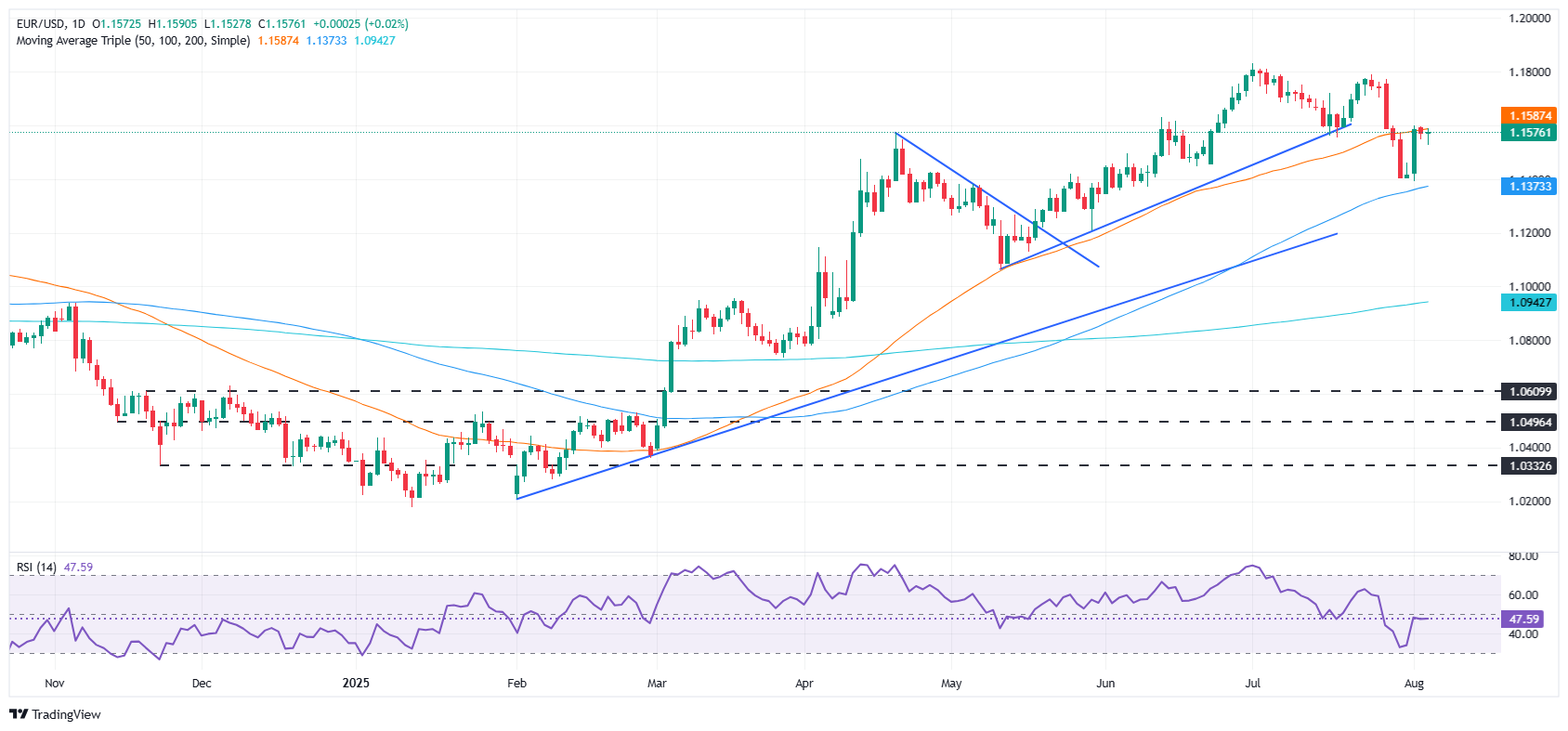
EUR/USD continues to consolidate below the 1.1600 barrier, with upside momentum still limited. The Relative Strength Index (RSI) remains in bearish territory but is edging toward the neutral line, suggesting some buying interest is emerging.
A decisive move above 1.1600 could open the door for a test of the 20-day Simple Moving Average (SMA) at 1.1630, followed by resistance at 1.1650 and 1.1700. Conversely, a break below the 50-day SMA at 1.1576 would expose 1.1550, with further losses potentially extending toward 1.1500 and August’s low at 1.1391.
Euro FAQs
The Euro is the currency for the 19 European Union countries that belong to the Eurozone. It is the second most heavily traded currency in the world behind the US Dollar. In 2022, it accounted for 31% of all foreign exchange transactions, with an average daily turnover of over $2.2 trillion a day. EUR/USD is the most heavily traded currency pair in the world, accounting for an estimated 30% off all transactions, followed by EUR/JPY (4%), EUR/GBP (3%) and EUR/AUD (2%).
The European Central Bank (ECB) in Frankfurt, Germany, is the reserve bank for the Eurozone. The ECB sets interest rates and manages monetary policy. The ECB’s primary mandate is to maintain price stability, which means either controlling inflation or stimulating growth. Its primary tool is the raising or lowering of interest rates. Relatively high interest rates – or the expectation of higher rates – will usually benefit the Euro and vice versa. The ECB Governing Council makes monetary policy decisions at meetings held eight times a year. Decisions are made by heads of the Eurozone national banks and six permanent members, including the President of the ECB, Christine Lagarde.
Eurozone inflation data, measured by the Harmonized Index of Consumer Prices (HICP), is an important econometric for the Euro. If inflation rises more than expected, especially if above the ECB’s 2% target, it obliges the ECB to raise interest rates to bring it back under control. Relatively high interest rates compared to its counterparts will usually benefit the Euro, as it makes the region more attractive as a place for global investors to park their money.
Data releases gauge the health of the economy and can impact on the Euro. Indicators such as GDP, Manufacturing and Services PMIs, employment, and consumer sentiment surveys can all influence the direction of the single currency. A strong economy is good for the Euro. Not only does it attract more foreign investment but it may encourage the ECB to put up interest rates, which will directly strengthen the Euro. Otherwise, if economic data is weak, the Euro is likely to fall. Economic data for the four largest economies in the euro area (Germany, France, Italy and Spain) are especially significant, as they account for 75% of the Eurozone’s economy.
Another significant data release for the Euro is the Trade Balance. This indicator measures the difference between what a country earns from its exports and what it spends on imports over a given period. If a country produces highly sought after exports then its currency will gain in value purely from the extra demand created from foreign buyers seeking to purchase these goods. Therefore, a positive net Trade Balance strengthens a currency and vice versa for a negative balance.
Author

Christian Borjon Valencia
FXStreet
Markets analyst, news editor, and trading instructor with over 14 years of experience across FX, commodities, US equity indices, and global macro markets.

















