EUR/USD holds steady as weak US jobs data offsets shutdown risks
- EUR/USD remains subdued after US private hiring slumped in September, exposing labor market weakness.
- Fitch Ratings says shutdown trims U.S. GDP growth by 0.1–0.2% weekly but leaves debt credit rating outlook unchanged.
- Eurozone PMI beat expectations and inflation ticked higher, yet ECB seen holding policy steady after Lagarde’s cautious tone.

EUR/USD is steady late during the North American session as investors digest a soft jobs report and shrugs off the shutdown of the US government. The lack of an agreement between the White House and Democrats would prolong the shutdown and delay US economic data releases. The pair trades at 1.1720 unchanged.
Euro trades flat near 1.1720 with investors balancing soft ADP print, government funding stalemate, and steady Eurozone data
US ADP National Employment Change in September was dismal and highlighted the weakness of the labor market. Business activity in the manufacturing sector in the US, improved but contracted for the seventh straight month.
Regarding political turmoil in the US, Vice-President JD Bance said that he does not think the shutdown will last long, vowing to do everything possible in the coming weeks to ensure people receive essential services.
Meanwhile, Fitch Ratings said that a government shutdown does not have near-term impact on the “AA+ stable” creditworthiness of US debt. The agency revealed that the shutdown is estimated to reduce GDP growth by 0.1-0.2% per week.
In the Eurozone, the HCOB Manufacturing PMI for September exceeded estimates, while the Harmonized Index of Consumer Prices (HICP) for the bloc ticked up. Despite this, the European Central Bank (ECB) is expected to remain on hold after President Christine Lagarde said that the risks to inflation “appear quite contained in both directions.”
Daily market movers: Fed’s Goolsbee hawkish stance, to cap Euro’s advance
- Chicago’s Fed President Austan Goolsbee said that he is worried about inflation, which remains above the central bank’s 2% target and added that the shutdown does not help as key economic data would be delayed.
- ADP reported that private sector employment unexpectedly contracted by 32,000 in September, following August’s downwardly revised loss of 3,000 jobs. Markets had anticipated an increase of at least 50,000 positions.
- Meanwhile, the ISM Manufacturing PMI edged up to 49.1 from August’s 48.7, slightly above the 49.0 forecast. Still, September marked the seventh straight month of contraction in the sector.
- Fitch Ratings said the US Dollar’s status as the world’s leading reserve currency is expected to remain intact despite heightened policy uncertainty and added that reversing previously enacted Medicaid cuts would have little effect on near-term deficit projections, with most of the fiscal impact not expected until after 2028.
- Europe HICP expanded by 2.2% in September, as expected but registered above 2% in August. Core HICP was steady at 2.3% YoY, aligned with estimates. At the same time, the Eurozone HCOB Manufacturing PMI rose from 49.5 to 49.8 in September as expected.
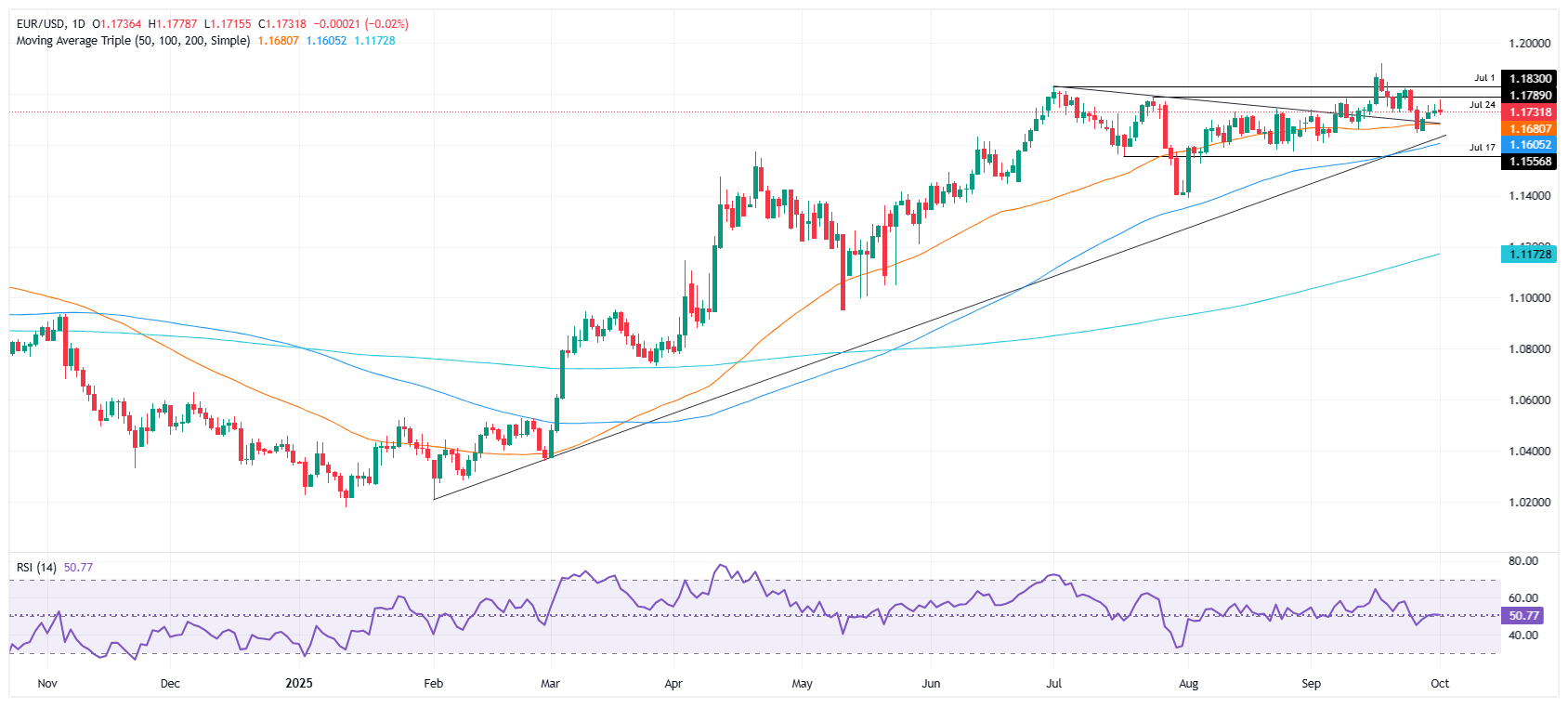
Technical outlook: EUR/USD steadies at around 1.1730 awaiting a fresh catalyst
EUR/USD has held firm above the 1.1700 level for four consecutive sessions but continues to struggle below 1.1750, keeping upside momentum in check. The Relative Strength Index (RSI) is flattening near the neutral 50 mark, signaling indecision.
If EUR/USD breaks above 1.1740, it would expose resistance at 1.1800, followed by the yearly peak at 1.1918. On the downside, a drop below 1.1700 would target 1.1650, with further support at the 100-day SMA near 1.1611.
Euro FAQs
The Euro is the currency for the 19 European Union countries that belong to the Eurozone. It is the second most heavily traded currency in the world behind the US Dollar. In 2022, it accounted for 31% of all foreign exchange transactions, with an average daily turnover of over $2.2 trillion a day. EUR/USD is the most heavily traded currency pair in the world, accounting for an estimated 30% off all transactions, followed by EUR/JPY (4%), EUR/GBP (3%) and EUR/AUD (2%).
The European Central Bank (ECB) in Frankfurt, Germany, is the reserve bank for the Eurozone. The ECB sets interest rates and manages monetary policy. The ECB’s primary mandate is to maintain price stability, which means either controlling inflation or stimulating growth. Its primary tool is the raising or lowering of interest rates. Relatively high interest rates – or the expectation of higher rates – will usually benefit the Euro and vice versa. The ECB Governing Council makes monetary policy decisions at meetings held eight times a year. Decisions are made by heads of the Eurozone national banks and six permanent members, including the President of the ECB, Christine Lagarde.
Eurozone inflation data, measured by the Harmonized Index of Consumer Prices (HICP), is an important econometric for the Euro. If inflation rises more than expected, especially if above the ECB’s 2% target, it obliges the ECB to raise interest rates to bring it back under control. Relatively high interest rates compared to its counterparts will usually benefit the Euro, as it makes the region more attractive as a place for global investors to park their money.
Data releases gauge the health of the economy and can impact on the Euro. Indicators such as GDP, Manufacturing and Services PMIs, employment, and consumer sentiment surveys can all influence the direction of the single currency. A strong economy is good for the Euro. Not only does it attract more foreign investment but it may encourage the ECB to put up interest rates, which will directly strengthen the Euro. Otherwise, if economic data is weak, the Euro is likely to fall. Economic data for the four largest economies in the euro area (Germany, France, Italy and Spain) are especially significant, as they account for 75% of the Eurozone’s economy.
Another significant data release for the Euro is the Trade Balance. This indicator measures the difference between what a country earns from its exports and what it spends on imports over a given period. If a country produces highly sought after exports then its currency will gain in value purely from the extra demand created from foreign buyers seeking to purchase these goods. Therefore, a positive net Trade Balance strengthens a currency and vice versa for a negative balance.
Author

Christian Borjon Valencia
FXStreet
Markets analyst, news editor, and trading instructor with over 14 years of experience across FX, commodities, US equity indices, and global macro markets.














