EUR/USD holds steady as US PCE softens, trade tensions offset USD weakness
- EUR/USD is lifted by softer US PCE, but core inflation remains sticky between 2%–3%.
- Trump reignites China tensions, appeals tariff ruling; “Sell America” trade gains traction.
- German retail sales plunge, while ECB rate cut odds rise ahead of June 5 policy meeting.

The Euro (EUR) remains steady against the US Dollar (USD) on Friday after a softer-than-expected US Personal Consumption Expenditures (PCE) Price Index, which was close to the Federal Reserve’s (Fed) 2% goal, lifted the pair from daily lows of 1.1312. EUR/USD is trading at 1.1361, virtually unchanged on the day.
Market mood remains fragile, shifted between optimism and pessimism, keeping US equities pressured due to tariffs and trade news. The US Court of International Trade ruled that tariffs were illegal and ordered Washington to lift them within ten days. Nevertheless, the Trump administration appealed the decision in a Federal Court, which reinstated most of the duties imposed on April 2 “Liberation Day.”
President Donald Trump sparked a shift in sentiment after stating that China is not committed to fulfilling the terms of the Switzerland trade agreement. However, he said that he would speak with Chinese President Xi Jinping to expedite negotiations between Washington and Beijing.
Besides trade policy, the passage of Trump’s “Big Beautiful Bill,” expected to add trillions of Dollars to an already high fiscal deficit, keeps traders leaning on assets outside the US in the so-called “Sell America” trade.
Data-wise, the US schedule revealed that PCE figures are moving in the right direction, but not so the core PCE inflation, which remained stalled in the midpoint between the 2% and 3% range. Meanwhile, an improvement in Consumer Sentiment, as revealed by the University of Michigan (UoM), suggests that American households are shifting slightly optimistic about the economy despite forecasting a jump in inflation.
Across the pond, German Retail Sales plunged on a monthly basis. Inflation in Germany and Spain remains within the confines of the European Central Bank's (ECB) 2% goal, which could increase the chances of an ECB rate cut at the June 5 meeting.
EUR/USD daily market movers: Advance halts on US Dollar recovery
- US PCE rose by 2.1% YoY, below March’s 2.3% rise. Nonetheless, the Fed’s preferred inflation measure, the Core PCE, reflected the evolution of the disinflation process, with the print coming at 2.5% YoY in April, down from 2.6%.
- The UoM Consumer Sentiment in May improved from 50.8 to 52.2, exceeding estimates on its final reading. It is worth noting that inflation expectations fell. For the 12 months ahead, expectations fell from 7.3% to 6.6%, and for the next five years, they dropped from 4.6% to 4.2%.
- Federal Reserve officials stated on Thursday that monetary policy remains appropriately positioned, noting it will take time to assess shifts in the balance of risks tied to their dual mandate of maximum employment and price stability.
- German Retail Sales plunged -1.1% MoM in April, below March’s 0.9% increase and estimates of 0.2%. Regarding inflation, the Harmonized Index for Consumer Prices (HICP) for May came at 2.1% YoY, below April’s 2.2%, approaching the ECB’s 2% goal.
- Spain HICP Flash print for May slid from 2.2% to 1.9% YoY, beneath the ECB’s target.
- Financial market players had fully priced in the expectation that the ECB would reduce its Deposit Facility Rate by 25 basis points (bps) to 2% at the upcoming monetary policy meeting.
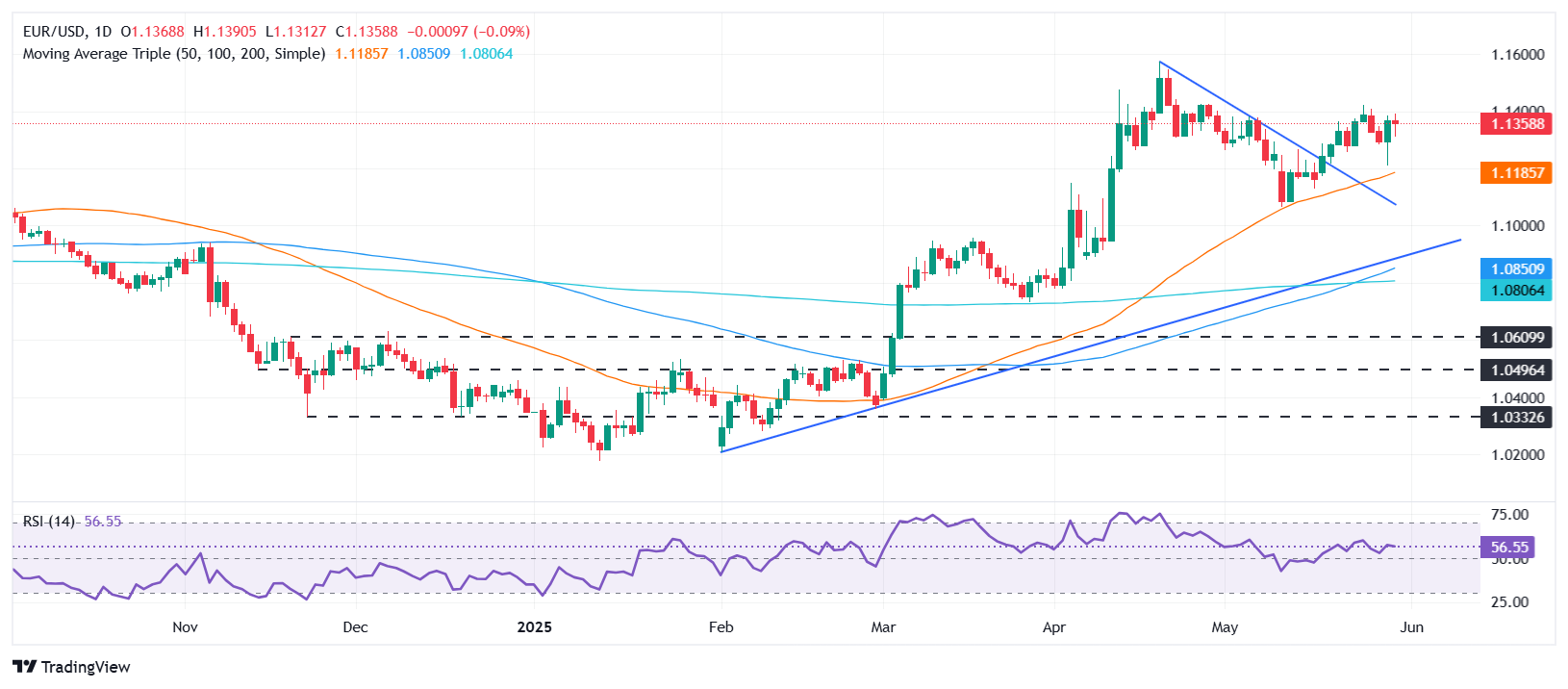
EUR/USD technical outlook: Hovers around 1.1350 directionless
EUR/USD remains upwardly biased, but the trend has halted ahead of the weekend. Bulls seem to have lost some momentum due to failure to conquer the 1.14 figure, which could have driven prices to challenge the April 22 high of 1.1547, ahead of the year-to-date (YTD) peak of 1.1572.
Although the Relative Strength Index (RSI) indicates that buyers are in control, the RSI is edging lower, poised to reach a lower trough below its 50-neutral line.
Therefore, if EUR/USD achieves a daily close below 1.1350, the pair could drift towards 1.1300. On further weakness, the next floor level will be the 20-day Simple Moving Average (SMA) at 1.1272, followed by the 50-day SMA at 1.1193.
Euro FAQs
The Euro is the currency for the 19 European Union countries that belong to the Eurozone. It is the second most heavily traded currency in the world behind the US Dollar. In 2022, it accounted for 31% of all foreign exchange transactions, with an average daily turnover of over $2.2 trillion a day. EUR/USD is the most heavily traded currency pair in the world, accounting for an estimated 30% off all transactions, followed by EUR/JPY (4%), EUR/GBP (3%) and EUR/AUD (2%).
The European Central Bank (ECB) in Frankfurt, Germany, is the reserve bank for the Eurozone. The ECB sets interest rates and manages monetary policy. The ECB’s primary mandate is to maintain price stability, which means either controlling inflation or stimulating growth. Its primary tool is the raising or lowering of interest rates. Relatively high interest rates – or the expectation of higher rates – will usually benefit the Euro and vice versa. The ECB Governing Council makes monetary policy decisions at meetings held eight times a year. Decisions are made by heads of the Eurozone national banks and six permanent members, including the President of the ECB, Christine Lagarde.
Eurozone inflation data, measured by the Harmonized Index of Consumer Prices (HICP), is an important econometric for the Euro. If inflation rises more than expected, especially if above the ECB’s 2% target, it obliges the ECB to raise interest rates to bring it back under control. Relatively high interest rates compared to its counterparts will usually benefit the Euro, as it makes the region more attractive as a place for global investors to park their money.
Data releases gauge the health of the economy and can impact on the Euro. Indicators such as GDP, Manufacturing and Services PMIs, employment, and consumer sentiment surveys can all influence the direction of the single currency. A strong economy is good for the Euro. Not only does it attract more foreign investment but it may encourage the ECB to put up interest rates, which will directly strengthen the Euro. Otherwise, if economic data is weak, the Euro is likely to fall. Economic data for the four largest economies in the euro area (Germany, France, Italy and Spain) are especially significant, as they account for 75% of the Eurozone’s economy.
Another significant data release for the Euro is the Trade Balance. This indicator measures the difference between what a country earns from its exports and what it spends on imports over a given period. If a country produces highly sought after exports then its currency will gain in value purely from the extra demand created from foreign buyers seeking to purchase these goods. Therefore, a positive net Trade Balance strengthens a currency and vice versa for a negative balance.
Author

Christian Borjon Valencia
FXStreet
Markets analyst, news editor, and trading instructor with over 14 years of experience across FX, commodities, US equity indices, and global macro markets.