EUR/USD drifts lower on risk aversion, ongoing French political woes
- The Euro retraces previous gains, dips back below 1.1600, and turns negative on daily charts.
- Fears that the US trade rift with China might escalate into a trade war are weighing on risk appetite.
- In Europe, investors remain cautious, awaiting news from France's new cabinet.

EUR/USD has returned below 1.1600 in the early European session on Monday and is trading at 1.1590 at the time of writing. Investors' concern about the consequences of a trade war between the US and China has dampened risk appetite, while the doubts about the chances of success of France's new cabinet remain weighing on the Euro (EUR).
The US Dollar dropped on Friday after US President Donald Trump threatened 100% tariffs on Chinese imports to begin on November 1, after the Asian country announced curbs on rare earths' exports. Trump, however, softened his tone on social media on Sunday, suggesting that the additional levies will not come into effect, which has calmed fears somewhat.
Meanwhile, in Europe, the focus remains in France, where President Emmanuel Macron reappointed Sébastien Lecornu as Prime Minister, one week after his resignation. Lecornu has named Macron's close ally, Roland Lescure, as Finance Minister, who will have the challenging task of passing a belt-tightening budget through the parliament.
Trading volumes might be somewhat lower on Monday as the US markets are closed for the Columbus Day holiday. In the economic calendar, a slew of central banks' policymakers, including European Central Bank (ECB) President Christine Lagarde, will provide the fundamental guidance.
Euro Price Today
The table below shows the percentage change of Euro (EUR) against listed major currencies today. Euro was the strongest against the New Zealand Dollar.
| USD | EUR | GBP | JPY | CAD | AUD | NZD | CHF | |
|---|---|---|---|---|---|---|---|---|
| USD | 0.33% | 0.10% | 0.08% | 0.07% | -0.01% | 0.31% | 0.29% | |
| EUR | -0.33% | -0.24% | -0.23% | -0.28% | -0.26% | -0.03% | -0.06% | |
| GBP | -0.10% | 0.24% | 0.04% | -0.04% | -0.04% | 0.21% | 0.16% | |
| JPY | -0.08% | 0.23% | -0.04% | -0.05% | -0.13% | 0.27% | 0.17% | |
| CAD | -0.07% | 0.28% | 0.04% | 0.05% | -0.11% | 0.25% | 0.20% | |
| AUD | 0.00% | 0.26% | 0.04% | 0.13% | 0.11% | 0.25% | 0.14% | |
| NZD | -0.31% | 0.03% | -0.21% | -0.27% | -0.25% | -0.25% | -0.05% | |
| CHF | -0.29% | 0.06% | -0.16% | -0.17% | -0.20% | -0.14% | 0.05% |
The heat map shows percentage changes of major currencies against each other. The base currency is picked from the left column, while the quote currency is picked from the top row. For example, if you pick the Euro from the left column and move along the horizontal line to the US Dollar, the percentage change displayed in the box will represent EUR (base)/USD (quote).
Daily digest market movers: Concerns about a trade war have dented the US Dollar's recovery
- Trump's Friday announcement to impose 100% tariffs on Chinese goods from November 1 revived fears of a new trade war escalation, triggering a moderate reversal in the US Dollar and allowing the Euro to recover from its lows. The US president calmed fears on Sunday with a soothing comment on social media, but the Chinese authorities remain firm and have shown their willingness to retaliate if export levies are increased.
- China has defended its restrictions on rare earths' trade to Western countries and the military industry, and the Commerce Ministry said they were introduced in the talks held in Madrid last month. The ministry also added that they are not afraid of a possible trade war and that they will introduce countermeasures if the 100% levies announced by Trump are finally applied.
- On Sunday, US President Trump wrote on Truth Social: "Don't worry about China, it will all be fine! Highly respected President Xi just had a bad moment.". These comments have eased concerns of a full-blown trade war, but markets are likely to remain cautious, awaiting further developments.
- On Friday, the US Michigan Consumer Sentiment Index posted a 55.0 reading for October, slightly below September's 55.1, yet above the market expectations of further deterioration to 54.2. The US Dollar reacted positively to the news.
- The economic calendar is light on Monday. The most relevant event will be a meeting of G20 finance ministers and central bankers, where ECB President Lagarde will participate, at the IMF/World Bank annual meeting in Washington.
Technical Analysis: EUR/USD is under bearish pressure below 1.1600
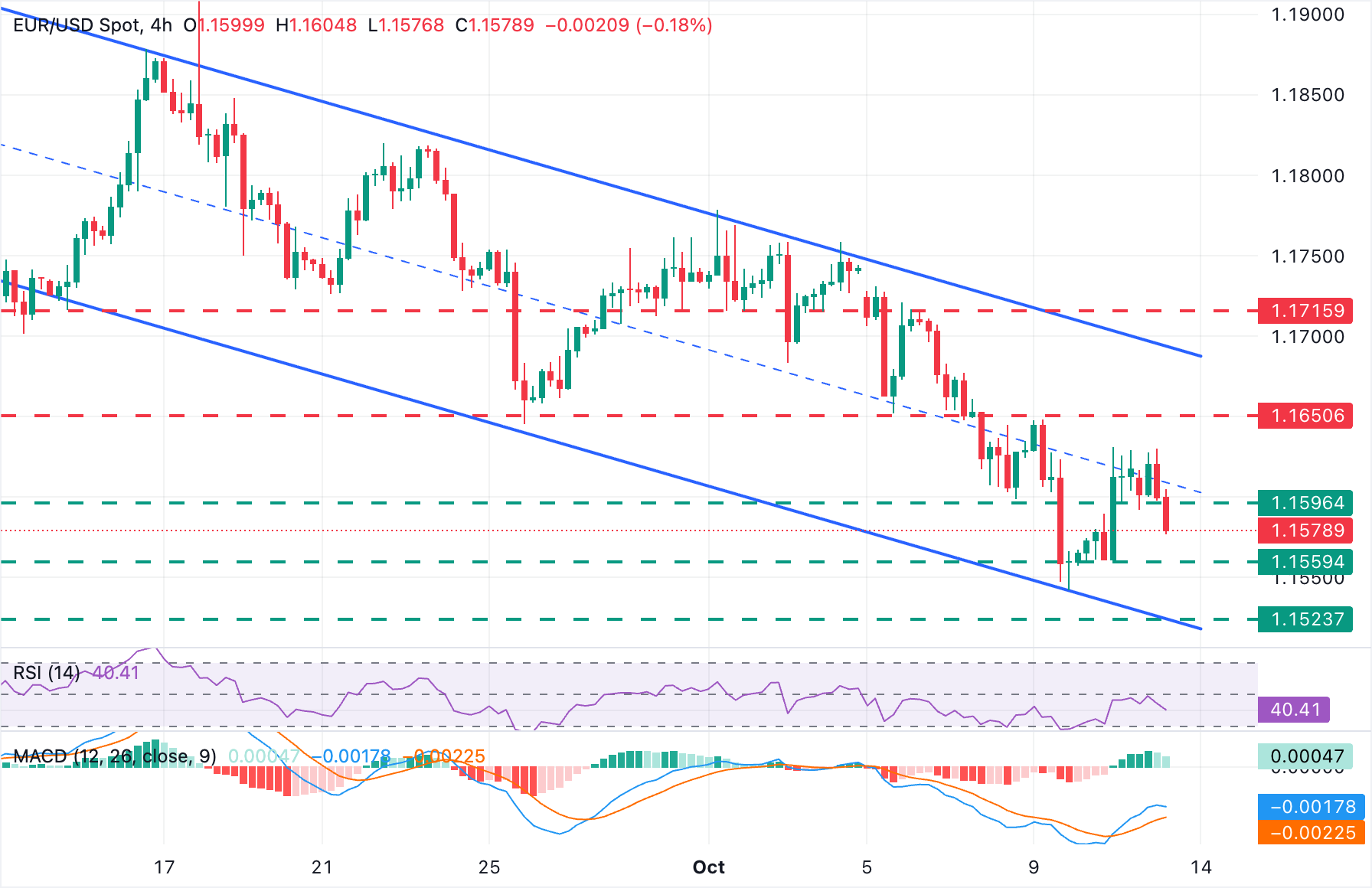
EUR/USD has failed to remain above the 1.1600 level and is under bearish pressure again. The Relative Strength Index (RSI) on the 4-hour chart has been capped below the 50 level, and the Moving Average Convergence Divergence (MACD) is now turning lower, which suggests that the rebound from Friday's lows has lost steam.
A confirmation below the previous intraday lows around 1.1590 increases pressure towards the October 9 and 10 lows in the area between 1.1645 and 1.1660 ahead of the base of the descending channel, at the 1.1525 area. To the upside, resistance is at the mentioned intraday high of 1.1630. Further up, the top of the descending channel comes at the 1.1690 area, and next is the area between 1.1720 and 1.1730, where price action was capped on October 6.
Euro FAQs
The Euro is the currency for the 19 European Union countries that belong to the Eurozone. It is the second most heavily traded currency in the world behind the US Dollar. In 2022, it accounted for 31% of all foreign exchange transactions, with an average daily turnover of over $2.2 trillion a day. EUR/USD is the most heavily traded currency pair in the world, accounting for an estimated 30% off all transactions, followed by EUR/JPY (4%), EUR/GBP (3%) and EUR/AUD (2%).
The European Central Bank (ECB) in Frankfurt, Germany, is the reserve bank for the Eurozone. The ECB sets interest rates and manages monetary policy. The ECB’s primary mandate is to maintain price stability, which means either controlling inflation or stimulating growth. Its primary tool is the raising or lowering of interest rates. Relatively high interest rates – or the expectation of higher rates – will usually benefit the Euro and vice versa. The ECB Governing Council makes monetary policy decisions at meetings held eight times a year. Decisions are made by heads of the Eurozone national banks and six permanent members, including the President of the ECB, Christine Lagarde.
Eurozone inflation data, measured by the Harmonized Index of Consumer Prices (HICP), is an important econometric for the Euro. If inflation rises more than expected, especially if above the ECB’s 2% target, it obliges the ECB to raise interest rates to bring it back under control. Relatively high interest rates compared to its counterparts will usually benefit the Euro, as it makes the region more attractive as a place for global investors to park their money.
Data releases gauge the health of the economy and can impact on the Euro. Indicators such as GDP, Manufacturing and Services PMIs, employment, and consumer sentiment surveys can all influence the direction of the single currency. A strong economy is good for the Euro. Not only does it attract more foreign investment but it may encourage the ECB to put up interest rates, which will directly strengthen the Euro. Otherwise, if economic data is weak, the Euro is likely to fall. Economic data for the four largest economies in the euro area (Germany, France, Italy and Spain) are especially significant, as they account for 75% of the Eurozone’s economy.
Another significant data release for the Euro is the Trade Balance. This indicator measures the difference between what a country earns from its exports and what it spends on imports over a given period. If a country produces highly sought after exports then its currency will gain in value purely from the extra demand created from foreign buyers seeking to purchase these goods. Therefore, a positive net Trade Balance strengthens a currency and vice versa for a negative balance.
Author

Guillermo Alcala
FXStreet
Graduated in Communication Sciences at the Universidad del Pais Vasco and Universiteit van Amsterdam, Guillermo has been working as financial news editor and copywriter in diverse Forex-related firms, like FXStreet and Kantox.