EUR/USD hovers near 1.1800 as disappoint ADP report lifts Fed cut odds
- EUR/USD pares gains despite weak ADP jobs print ahead of the NFP report.
- US ADP data shows first private payroll drop in two years, pressuring the US Dollar.
- ECB officials remain cautious as Eurozone unemployment edges unexpectedly higher.


The Euro (EUR) posts minimal losses of 0.08% against the US Dollar (USD), trading below the 1.1800 figure on Wednesday. A worse-than-expected US jobs report increased speculation that the Federal Reserve (Fed) might cut interest rates amid growing recession fears in the world's largest economy. At the moment, the EUR/USD pair is trading at 1.1795, virtually unchanged.
On Wednesday, Automatic Data Processing (ADP) announced that private payrolls decreased in June, marking the first decline in two years. Although the US Dollar initially weakened, it recovered some ground, dragging EUR/USD back below 1.1800 as traders brace for the release of the latest employment figures.
Nonfarm Payrolls (NFP) in the US are expected to come at 110K, below May’s 139K. The Unemployment Rate is forecast to be 4.3%, up from 4.2%, but well below the 4.4% projected by the Federal Reserve for the end of the year.
A weaker-than-expected US jobs report might increase the odds for further easing by the Fed. Recently, Richmond Fed President Thomas Barkin stated that there's no urgency to change policy at the moment, noting that a significant amount of incoming data is expected ahead of the July meeting.
In the Eurozone, the latest Unemployment Rate report rose from 6.2% to 6.3% in May, exceeding estimates aligned with the previous reading.
Meanwhile, Policymakers from the European Central Bank (ECB) made headlines. Mario Centeno said that the central bank remains cautious about the rate path, while Olli Rehn added that they should be mindful of the risk of inflation persistently standing below the 2% target. Pierre Wunsch said he’s not uncomfortable with market rate expectations.
Daily digest market movers: EUR/USD advance pauses ahead of Nonfarm Payrolls
- The recovery of the Greenback caps the EUR/USD advance. The US Dollar Index (DXY), which tracks the advance of the buck against a basket of six currencies, is up 0.13% at 96.78.
- The ADP Employment Change report revealed that private sector employment in the US fell by 33K jobs in June, a stark miss compared to expectations for a 95K job gain. The decline was driven primarily by service-providing industries, which shed 66K positions, mainly due to a pullback in professional and business services.
- The approval of US President Donald Trump's “One Big Beautiful Bill” is in doubt as House Republican Hardliners are eyeing modifications to the bill, which Trump wants signed by July 4.
- Trade news revealed that Trump announced a trade deal with Vietnam, under which US products could be exported with 0% tariffs. In contrast, the US imposed a 20% tariff on Vietnam's goods and 40% duties on transshipment.
- Fed Chair Jerome Powell commented that monetary policy remains “modestly restrictive” and declined to commit to a rate cut in July, stating it’s too soon to say, while not ruling it out. He added that absent President Trump’s tariffs, the Fed likely would have lowered rates further.
- The EU Trade Commissioner Sefcovic will visit China in August, said SCMP, citing sources. Chinese investment within Europe is seen as a potential area for discussion. On this, the SCMP piece references EVs and battery plants.
Euro technical outlook: EUR/USD to consolidate near 1.1800 in the near-term
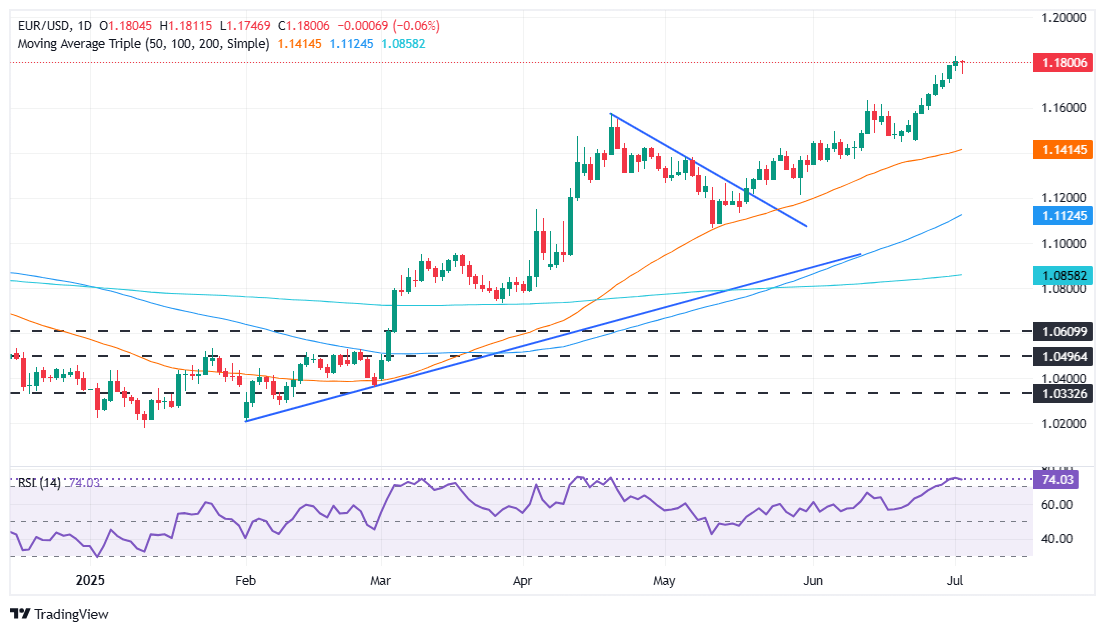
EUR/USD remains upwardly biased, after hitting a two-day low of 1.1746. Despite this, momentum remains bullish as portrayed by the Relative Strength Index (RSI). With that said, if the pair clears 1.1800, look for a test of the yearly high of 1.1829. If surpassed, the next key supply zone would be 1.1850 and 1.1900.
On the other hand, if EUR/USD falls below 1.1750, a further decline to 1.1700 can be expected. Key support lies below the latter, at the June 26 daily low of 1.1653 and 1.1600.
ECB FAQs
The European Central Bank (ECB) in Frankfurt, Germany, is the reserve bank for the Eurozone. The ECB sets interest rates and manages monetary policy for the region. The ECB primary mandate is to maintain price stability, which means keeping inflation at around 2%. Its primary tool for achieving this is by raising or lowering interest rates. Relatively high interest rates will usually result in a stronger Euro and vice versa. The ECB Governing Council makes monetary policy decisions at meetings held eight times a year. Decisions are made by heads of the Eurozone national banks and six permanent members, including the President of the ECB, Christine Lagarde.
In extreme situations, the European Central Bank can enact a policy tool called Quantitative Easing. QE is the process by which the ECB prints Euros and uses them to buy assets – usually government or corporate bonds – from banks and other financial institutions. QE usually results in a weaker Euro. QE is a last resort when simply lowering interest rates is unlikely to achieve the objective of price stability. The ECB used it during the Great Financial Crisis in 2009-11, in 2015 when inflation remained stubbornly low, as well as during the covid pandemic.
Quantitative tightening (QT) is the reverse of QE. It is undertaken after QE when an economic recovery is underway and inflation starts rising. Whilst in QE the European Central Bank (ECB) purchases government and corporate bonds from financial institutions to provide them with liquidity, in QT the ECB stops buying more bonds, and stops reinvesting the principal maturing on the bonds it already holds. It is usually positive (or bullish) for the Euro.
Author
Christian Borjon Valencia
FXStreet
Markets analyst, news editor, and trading instructor with over 14 years of experience across FX, commodities, US equity indices, and global macro markets.

















