EUR/USD holds near 1.1660 as Fed Minutes clash with Trump’s pressure
- EUR/USD retreats from daily highs of 1.1672 after Fed Minutes release.
- Fed Minutes: Officials see inflation risk outweighing employment, hinting rates not far above neutral.
- Breaking news: Trump urges Fed Governor Lisa Cook to resign following mortgage fraud allegations.

EUR/USD advances steadily during the North American session as the Federal Reserve (Fed) unveils its latest Meeting Minutes. At the time of writing, the pair trades at around 1.1660 and clings to minimal gains of 0.13%.
Hawkish Fed Minutes caps Euro’s advance; Trump presses Fed governor to resign amid fraud probe
The Minutes of the Fed’s August meeting showed that the majority of the board “saw inflation risk outweighing employment risk,” and that several officials said, “that the current rate may not be far above neutral.” This contradicts what US Treasury Secretary Scott Bessent argued in a Bloomberg interview, that interest rates should be lower by 150 to 175 basis points (bps).
After the release of Minutes, the EUR/USD retreated from around daily highs of 1.1672 to 1.1660, which seems to be a hawkish reaction by market participants.
Meanwhile, the White House continues to pressure Fed officials to reduce interest rates, as breaking news revealed that “Trump presses Fed’s Cook to quit after mortgage fraud allegation.”
Earlier, a Bloomberg article revealed that the Federal Housing Finance Agency Director Bill Pulte alleged that Fed Governor Lisa Cook “falsified bank documents and property records to acquire more favorable loan terms, potentially committing mortgage fraud under the criminal statute.”
Across the pond, July’s inflation in the Eurozone remained steady at around the European Central Bank's (ECB) 2% target.
Daily digest market movers: EUR/USD clings to gains on soft US Dollar
- Digging deeper into the Federal Open Market Committee (FOMC) Meeting Minutes, several officials noted concerns about high asset valuations and that “Many (officials) noted full effect of tariffs could take some time.” Several Fed policymakers commented that they expect “companies would pass tariffs to customers,” and that “some participants said it would not be feasible or appropriate to wait for complete clarity on the tariff’s effects on inflation before adjusting monetary policy.”
- The European Union (EU) Harmonized Index of Consumer Prices (HICP) rose by 2% YoY as expected in July. Core HICP figures came at 2.3% YoY as expected and unchanged from June’s print.
- ECB’s President Christine Lagarde said that recent trade deals have alleviated but not eliminated uncertainty. She added that the European economy remains resilient in the face of a challenging global environment. Despite this, September projections for the Euro area suggest that growth would slow in Q3 2025.
- The direction of EUR/USD is influenced by safe-haven demand and monetary policy divergence between the Fed and ECB. Expectations that the Fed will reduce rates at the September meeting remain high at around 82%. Across the Atlantic, the ECB is expected to hold rates unchanged, with odds standing at 91% odds for the central bank to keep rates unchanged, and a slim 8% chance of a 25-basis-point (bps) rate cut.
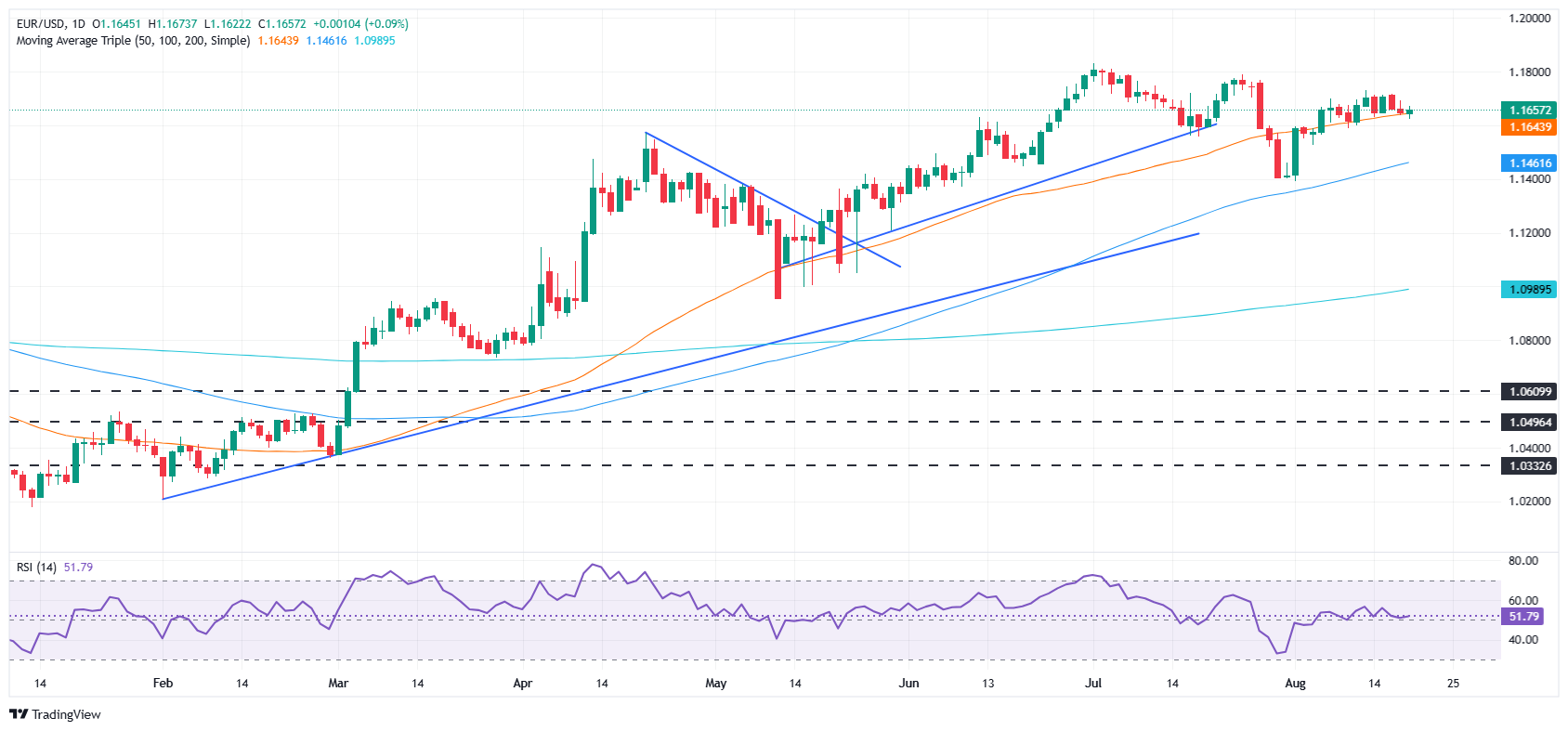
Euro’s technical outlook: EUR/USD looms around 1.1650, directionless
EUR/USD's neutral bias stays in place as depicted by two technical signals: price action with no clear direction and almost flat short-term daily Simple Moving Averages (SMAs); and the Relative Strength Index (RSI) meandering around its neutral line.
If the EUR/USD climbs above the August 19 high of 1.1692, a move toward 1.1700 is on the cards. Further gains await once cleared, as the July 24 high of 1.1788 emerges as key resistance, followed by 1.1800 and the year-to-date high at 1.1829.
On the flip side, if EUR/USD tumbles below the confluence of the 50-day and 20-day Simple Moving Averages (SMA) at 1.1643/29, it could trigger a move toward 1.1600, with the 100-day SMA at 1.1460 as the next downside target.
Euro FAQs
The Euro is the currency for the 19 European Union countries that belong to the Eurozone. It is the second most heavily traded currency in the world behind the US Dollar. In 2022, it accounted for 31% of all foreign exchange transactions, with an average daily turnover of over $2.2 trillion a day. EUR/USD is the most heavily traded currency pair in the world, accounting for an estimated 30% off all transactions, followed by EUR/JPY (4%), EUR/GBP (3%) and EUR/AUD (2%).
The European Central Bank (ECB) in Frankfurt, Germany, is the reserve bank for the Eurozone. The ECB sets interest rates and manages monetary policy. The ECB’s primary mandate is to maintain price stability, which means either controlling inflation or stimulating growth. Its primary tool is the raising or lowering of interest rates. Relatively high interest rates – or the expectation of higher rates – will usually benefit the Euro and vice versa. The ECB Governing Council makes monetary policy decisions at meetings held eight times a year. Decisions are made by heads of the Eurozone national banks and six permanent members, including the President of the ECB, Christine Lagarde.
Eurozone inflation data, measured by the Harmonized Index of Consumer Prices (HICP), is an important econometric for the Euro. If inflation rises more than expected, especially if above the ECB’s 2% target, it obliges the ECB to raise interest rates to bring it back under control. Relatively high interest rates compared to its counterparts will usually benefit the Euro, as it makes the region more attractive as a place for global investors to park their money.
Data releases gauge the health of the economy and can impact on the Euro. Indicators such as GDP, Manufacturing and Services PMIs, employment, and consumer sentiment surveys can all influence the direction of the single currency. A strong economy is good for the Euro. Not only does it attract more foreign investment but it may encourage the ECB to put up interest rates, which will directly strengthen the Euro. Otherwise, if economic data is weak, the Euro is likely to fall. Economic data for the four largest economies in the euro area (Germany, France, Italy and Spain) are especially significant, as they account for 75% of the Eurozone’s economy.
Another significant data release for the Euro is the Trade Balance. This indicator measures the difference between what a country earns from its exports and what it spends on imports over a given period. If a country produces highly sought after exports then its currency will gain in value purely from the extra demand created from foreign buyers seeking to purchase these goods. Therefore, a positive net Trade Balance strengthens a currency and vice versa for a negative balance.
Author

Christian Borjon Valencia
FXStreet
Markets analyst, news editor, and trading instructor with over 14 years of experience across FX, commodities, US equity indices, and global macro markets.