EUR/USD nurses gains with US ADP jobs, government funding on focus
- The Euro appreciates above 1.1570, but remains trapped within the last two days' trading range.
- German Economic Sentiment Index deteriorated against expectations in November.
- Later in the day, the US 4-week average ADP employment and US funding developments will drive markets.

EUR/USD has retraced previous losses and turned positive on the day. The pair trades at 1.1572 at the time of writing, after bouncing from 1.1545. The downbeat German ZEW Economic Sentiment Report has passed practically unnoticed, and the pair advances within the previous days' range, supported by a moderate risk-appetite following a deal to end the US government shutdown.
November's ZEW survey, released earlier on Tuesday, revealed that German investors remain pessimistic about the economic outlook in November, while their assessment of the current economic situation improved below expectations. The sentiment about the whole Eurozone economy, on the other hand, improved beyond expectations.
On Monday US Senate approved a funding package on Monday that would allow for the reopening of the government after a 35-day closure, its longest in history. The law will now be sent to Congress, where it is expected to be approved as early as Wednesday to be signed by US President Donald Trump.
Later in the day, the focus will shift to the US ADP 4-week employment report, although traders will keep an eye on the progress of the US bill to resume government funding.
Euro Price Today
The table below shows the percentage change of Euro (EUR) against listed major currencies today. Euro was the strongest against the British Pound.
| USD | EUR | GBP | JPY | CAD | AUD | NZD | CHF | |
|---|---|---|---|---|---|---|---|---|
| USD | -0.09% | 0.29% | 0.14% | 0.10% | 0.22% | 0.02% | -0.35% | |
| EUR | 0.09% | 0.38% | 0.21% | 0.19% | 0.31% | 0.11% | -0.26% | |
| GBP | -0.29% | -0.38% | -0.14% | -0.19% | -0.09% | -0.27% | -0.63% | |
| JPY | -0.14% | -0.21% | 0.14% | -0.04% | 0.08% | -0.12% | -0.48% | |
| CAD | -0.10% | -0.19% | 0.19% | 0.04% | 0.13% | -0.07% | -0.44% | |
| AUD | -0.22% | -0.31% | 0.09% | -0.08% | -0.13% | -0.20% | -0.61% | |
| NZD | -0.02% | -0.11% | 0.27% | 0.12% | 0.07% | 0.20% | -0.37% | |
| CHF | 0.35% | 0.26% | 0.63% | 0.48% | 0.44% | 0.61% | 0.37% |
The heat map shows percentage changes of major currencies against each other. The base currency is picked from the left column, while the quote currency is picked from the top row. For example, if you pick the Euro from the left column and move along the horizontal line to the US Dollar, the percentage change displayed in the box will represent EUR (base)/USD (quote).
Daily digest market movers: US Dollar ticks up on government funding deal
- News of a deal to reopen the US government has given a marginal push to the Dollar against a basket of its main currency peers, but they have also lifted market sentiment, providing support to risk-related assets like the Euro. This leaves the EUR/USD pair trading sideways without a clear bias.
- The German ZEW Survey disappointed market expectations. The sentiment about the German economic outlook declined to 38.5 in November from 39.3 in October, against expectations of an improvement to 40.0. The current Situation has improved to -78.7 from -80.0, yet short of the market expectations of a -77.5 reading.
- ECB council member and Austrian National Bank Governor Martin Kocher reiterated that the bank's monetary policy is in a good position and that there is no need for further adjustments in the near term, which provided some support to the Euro.
- During the US session, the focus will be on the US ADP Employment Change 4-week average. Last week, a better-than-expected 42K net increase in employment eased some of the worst fears of a sharp deterioration of the US Labour market.
- On Monday, a batch of Federal Reserve (Fed) speakers reflected the divergences among the committee, with Governor Stephen Miran calling for further interest rate cuts, while St. Louis Fed President Alberto Mussalem and San Francisco Fed President Mary Daly are showing a more cautious view on monetary policy.
Technical Analysis: EUR/USD consolidating between 1.1540 and 1.1580
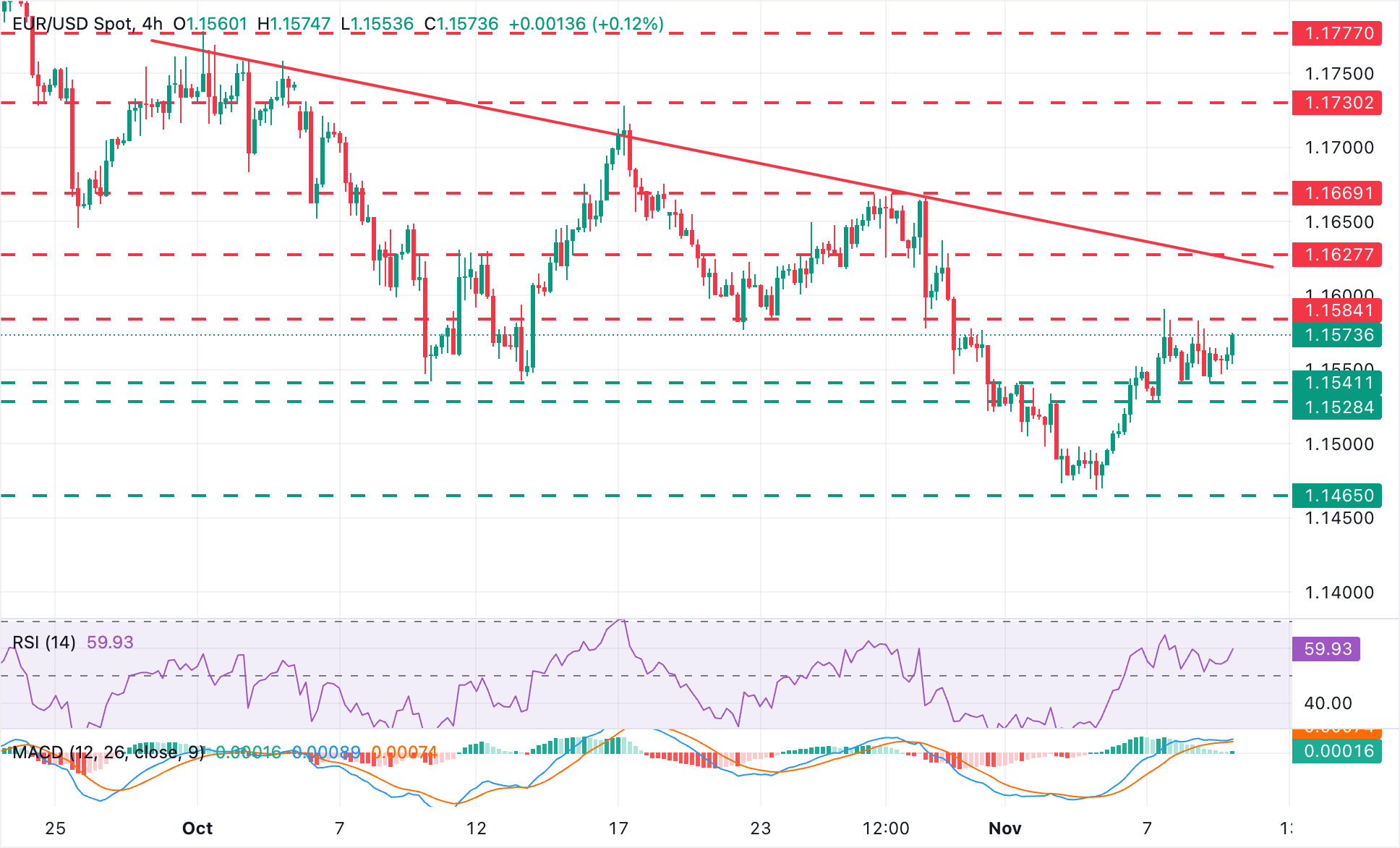
The EUR/USD pair is in a consolidation phase, following the recovery from 1.1470 lows last week. Bulls have been capped at the 1.1580 area, while downside attempts remain contained above 1.1540. The 4-hour Relative Strength Index (RSI) is remains relatively close to the 50 level, highlighting a neutral market.
Bulls would have to breach the 1.1580-1.1590 area (November 7, 10 highs) to shift the focus towards the resistance area around 1.1615, where the October 27 low meets a trendline resistance from early October highs. Further up, the target is the October 28 and 29 highs near the area of 1.1670.
Downsie attempts, on the other hand, have found support at the 1.1530-1.1540 area (near November 7,10 lows) ahead of the 1.1500 psychological level and the key support at the November 5 low around 1.1470.
Employment FAQs
Labor market conditions are a key element to assess the health of an economy and thus a key driver for currency valuation. High employment, or low unemployment, has positive implications for consumer spending and thus economic growth, boosting the value of the local currency. Moreover, a very tight labor market – a situation in which there is a shortage of workers to fill open positions – can also have implications on inflation levels and thus monetary policy as low labor supply and high demand leads to higher wages.
The pace at which salaries are growing in an economy is key for policymakers. High wage growth means that households have more money to spend, usually leading to price increases in consumer goods. In contrast to more volatile sources of inflation such as energy prices, wage growth is seen as a key component of underlying and persisting inflation as salary increases are unlikely to be undone. Central banks around the world pay close attention to wage growth data when deciding on monetary policy.
The weight that each central bank assigns to labor market conditions depends on its objectives. Some central banks explicitly have mandates related to the labor market beyond controlling inflation levels. The US Federal Reserve (Fed), for example, has the dual mandate of promoting maximum employment and stable prices. Meanwhile, the European Central Bank’s (ECB) sole mandate is to keep inflation under control. Still, and despite whatever mandates they have, labor market conditions are an important factor for policymakers given its significance as a gauge of the health of the economy and their direct relationship to inflation.
Author

Guillermo Alcala
FXStreet
Graduated in Communication Sciences at the Universidad del Pais Vasco and Universiteit van Amsterdam, Guillermo has been working as financial news editor and copywriter in diverse Forex-related firms, like FXStreet and Kantox.