EUR/USD fluctuates within previous ranges awaiting the Fed
- The Euro gives away earlier gains and remains practically flat, near 1.1650.
- Lukewarm investors' confidence data put some pressure on the Euro on Monday
- The US Dollar remains on the defensive, with markets bracing for a Fed rate cut on Wednesday.

EUR/USD shows marginal gains on Monday, trading near 1.1650, after giving away most ot the daily gains during the European morning session. A moderate improvement in the Eurozone Sentix Investors' confidence failed to lift the Euro, which is going through an "inside day" as the US Federal Reserve (Fed) remains front and center this week.
The Fed is widely expected to cut rates by 25 basis points on Wednesday, with Chairman Jerome Powell highly likely to show a hawkish stance, pressured by the sticky inflation levels. The Federal Open Market Committee (FOMC), however, is expected to show an unusual amount of dissenters on both sides of the spectrum, which muddies the central bank's path forward.
In the Eurozone, the Sentix investor confidence Index has shown a mild improvement in December, but it remains at negative levels. Earlier in the day, hawkish comments by the European Central Bank's Executive Board member Isabel Schnabel and the positive surprise in the German Industrial Production release provided some support to the common currency.
In the US, the calendar is practically void on Monday. On Tuesday, the weekly ADP Employment Report and the JOLTS Job Openings data are likely to provide further context to the Fed's decision, considering that November's Nonfarm Payrolls report will not be released until next week.
Euro Price Today
The table below shows the percentage change of Euro (EUR) against listed major currencies today. Euro was the strongest against the British Pound.
| USD | EUR | GBP | JPY | CAD | AUD | NZD | CHF | |
|---|---|---|---|---|---|---|---|---|
| USD | -0.07% | 0.11% | 0.09% | -0.07% | 0.00% | -0.20% | -0.03% | |
| EUR | 0.07% | 0.18% | 0.18% | -0.01% | 0.08% | -0.13% | 0.04% | |
| GBP | -0.11% | -0.18% | -0.02% | -0.18% | -0.11% | -0.34% | -0.14% | |
| JPY | -0.09% | -0.18% | 0.02% | -0.17% | -0.09% | -0.30% | -0.13% | |
| CAD | 0.07% | 0.00% | 0.18% | 0.17% | 0.08% | -0.13% | 0.05% | |
| AUD | -0.00% | -0.08% | 0.11% | 0.09% | -0.08% | -0.21% | -0.03% | |
| NZD | 0.20% | 0.13% | 0.34% | 0.30% | 0.13% | 0.21% | 0.17% | |
| CHF | 0.03% | -0.04% | 0.14% | 0.13% | -0.05% | 0.03% | -0.17% |
The heat map shows percentage changes of major currencies against each other. The base currency is picked from the left column, while the quote currency is picked from the top row. For example, if you pick the Euro from the left column and move along the horizontal line to the US Dollar, the percentage change displayed in the box will represent EUR (base)/USD (quote).
Daily Digest Market Movers: Fed easing hopes keep the US Dollar on the defensive
- The Euro is on a bullish trend from mid-November lows, buoyed mainly by generalised weakness in the US Dollar. Investors are almost fully pricing a quarter-point rate cut by the Fed on Wednesday and a few more in 2026. Meanwhile, the rest of the world's major central banks, including the ECB, are at the end of this easing cycle.
- Futures markets are pricing an 88% chance that the Fed will cut rates by 25 basis points on Wednesday, according to the CME Group's Fed Watch Tool. The odds for further easing in January are only 24%, which suggests that Chairman Powell might deliver a hawkish message, underscoring the upside risks to inflation.
- The Eurozone Sentix Investors Sentiment Index improved in December to -6.2 from -7.4 in November. The index measuring investors' sentiment about the current economic situation rose to -16.5 from -17.5 in the previous month, with the economic expectations showing the largest improvement, to 4.8, from 3.3 in November.
- ECB board member Isabel Schnabel affirmed earlier on Monday that she feels comfortable with investors' bets that the central bank's next move will be a rate hike, but the Latvian Central Bank Governour and ECB board member Martins Kazaks confirmed that the rate hike will not take place in December.
- Later on, German Industrial Production data has endorsed Schnabel's comments. Factory Output grew by 1.8% in October, beating market expectations of a 0.4% contraction and following a 1.1% rise in September. These figures ease concerns about the momentum of the region's leading economy and provide further support to the common currency.
- Earlier on Monday, data from China revealed that exports grew 5.9% in November, following an unexpected contraction in October, which shows that the world's second-largest economy is coping well with US tariffs. These figures have boosted market sentiment during the Asian session, adding pressure on the safe-haven USD.
Technical Analysis: EUR/USD consolidates gains around 1.1650
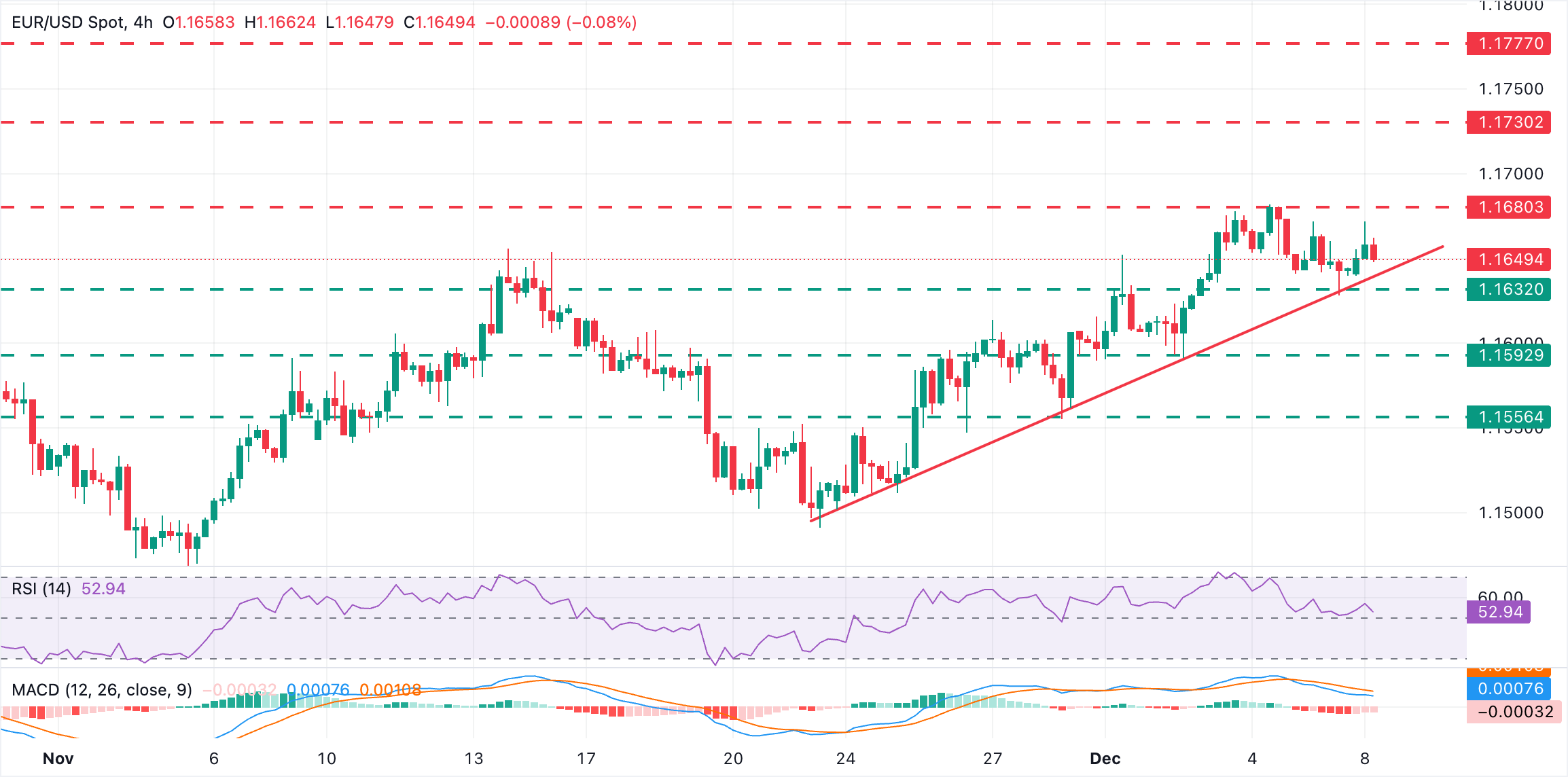
EUR/USD's immediate trend is bullish. The pair remains supported by the ascending trendline from November 20 lows, yet with the 1.1680 resistance area holding bulls. The 4-hour Relative Strength Index (RSI) remains steady above the 50 level, although the Moving Average Convergence Divergence (MACD) is below the signal line, indicating a mild negative momentum.
Bulls need to breach the December high at 1.1682 to extend their rally towards the October 17 high, near 1.1730, ahead of the October 1 high at 1.1778.
On the downside, immediate support is at the confluence of trendline support, now at 1.1640, and Friday's low at 1.1630. Further down, December 1 and 2 lows around 1.1590 are likely to be retested ahead of the November 26 and 28 lows in the 1.1550-1.1555 area.
Central banks FAQs
Central Banks have a key mandate which is making sure that there is price stability in a country or region. Economies are constantly facing inflation or deflation when prices for certain goods and services are fluctuating. Constant rising prices for the same goods means inflation, constant lowered prices for the same goods means deflation. It is the task of the central bank to keep the demand in line by tweaking its policy rate. For the biggest central banks like the US Federal Reserve (Fed), the European Central Bank (ECB) or the Bank of England (BoE), the mandate is to keep inflation close to 2%.
A central bank has one important tool at its disposal to get inflation higher or lower, and that is by tweaking its benchmark policy rate, commonly known as interest rate. On pre-communicated moments, the central bank will issue a statement with its policy rate and provide additional reasoning on why it is either remaining or changing (cutting or hiking) it. Local banks will adjust their savings and lending rates accordingly, which in turn will make it either harder or easier for people to earn on their savings or for companies to take out loans and make investments in their businesses. When the central bank hikes interest rates substantially, this is called monetary tightening. When it is cutting its benchmark rate, it is called monetary easing.
A central bank is often politically independent. Members of the central bank policy board are passing through a series of panels and hearings before being appointed to a policy board seat. Each member in that board often has a certain conviction on how the central bank should control inflation and the subsequent monetary policy. Members that want a very loose monetary policy, with low rates and cheap lending, to boost the economy substantially while being content to see inflation slightly above 2%, are called ‘doves’. Members that rather want to see higher rates to reward savings and want to keep a lit on inflation at all time are called ‘hawks’ and will not rest until inflation is at or just below 2%.
Normally, there is a chairman or president who leads each meeting, needs to create a consensus between the hawks or doves and has his or her final say when it would come down to a vote split to avoid a 50-50 tie on whether the current policy should be adjusted. The chairman will deliver speeches which often can be followed live, where the current monetary stance and outlook is being communicated. A central bank will try to push forward its monetary policy without triggering violent swings in rates, equities, or its currency. All members of the central bank will channel their stance toward the markets in advance of a policy meeting event. A few days before a policy meeting takes place until the new policy has been communicated, members are forbidden to talk publicly. This is called the blackout period.
Author

Guillermo Alcala
FXStreet
Graduated in Communication Sciences at the Universidad del Pais Vasco and Universiteit van Amsterdam, Guillermo has been working as financial news editor and copywriter in diverse Forex-related firms, like FXStreet and Kantox.















