EUR/USD faces pressure on ECB dovish bets, Trump tariff fears
- EUR/USD struggles for a firm footing near 1.0800 as the USD Index clings to gains near a three-week high of 104.40.
- Investors await the US PCE inflation data on Friday for fresh interest rate guidance.
- ECB Villeroy supports a further decline in key borrowing rates.

EUR/USD remains on their toes as the outlook of the Euro (EUR) is uncertain amid growing expectations that the European Central Bank (ECB) would cut interest rates again. The Eurozone economy is expected to face significant downside economic risks after the imposition of reciprocal tariffs by US President Trump.
Trump had signaled plenty of times that he will impose tariffs on the Eurozone for not buying enough American goods. Such a scenario will be negative for the old continent. Historically, economies move to strengthen their domestic economy by lowering interest rates when external conditions are not conducive.
The German economy has already shown its support to strengthen the economy by pumping more Euros into circulation. Last week, German leaders voted to stretch the borrowing limit to boost defense spending and the creation of an infrastructure fund worth 500 billion Euros.
ECB President Christine Lagarde has also dialled back fears of persistent inflationary pressures due to a potential US-Eurozone trade war. Lagarde said last week that the inflationary impact of the trade war is temporary as the effect would “ease in the medium term” due to “lower economic activity dampening inflationary pressures”.
On Tuesday, ECB Governing Council member and Bank of France Governor François Villeroy de Galhau said that there is still room to “lower interest rates further”, and the 2.5% Deposit Facility Rate could “fall to 2% by the end of the summer”.
Daily digest market movers: EUR/USD trades with caution as US Dollar stabilizes
- EUR/USD struggles to gauge ground after a five-day losing streak near 1.0800 during North American trading hours on Wednesday. The outlook of the major currency pair is uncertain as the US Dollar (USD) holds onto recent gains, with the US Dollar Index (DXY) clinging to gains near an almost three-week high at 104.40, amid expectations that less disruptive Unites States (US) President Donald Trump’s tariff agenda will have lesser impact on the US economic outlook.
- On Monday, President Trump said at the White House that all impending levies will not be imposed as he may give a "lot of countries" breaks on tariffs. It seems that various leaders of US trading partners have managed to negotiate deals with Trump. Though a Trump-led trade war is widely anticipated to result in an economic slowdown globally, a war with fewer nations will limit the scope of economic turmoil.
- Still, the confidence of US consumers is declining as Trump’s tariffs will lead to a significant decline in households’ purchasing power. On Tuesday, the Conference Board reported a sharp decline in the Consumer Confidence data for March, a leading sentiment indicator that anticipates consumer behaviour. The sentiment data came in at 92.9, significantly lower than the 100.1 seen in February.
- Going forward, the major trigger for the US Dollar will be the US Personal Consumption Expenditures Price Index (PCE) data for February, which will be released on Friday. Economists expect the US core PCE inflation, which is the Federal Reserve’s (Fed) preferred inflation gauge, to have grown at a faster pace of 2.7% year-on-year, compared to the 2.6% increase seen in January.
- In last week's policy meeting, the Fed revised its forecast for the core Personal Consumption Expenditures Price Index (PCE) for this year to 2.8%, up from the 2.5% projected in the December meeting.
- During North American trading hours, US Durable Goods Orders data for February has come in stronger than expected. New orders for Durable Goods rose by 0.9%, while it was expected to have declined by 1%. In January, the economic data rose by 3.3%, revised higher from 3.1%.
Technical Analysis: EUR/USD wobbles around 1.0800
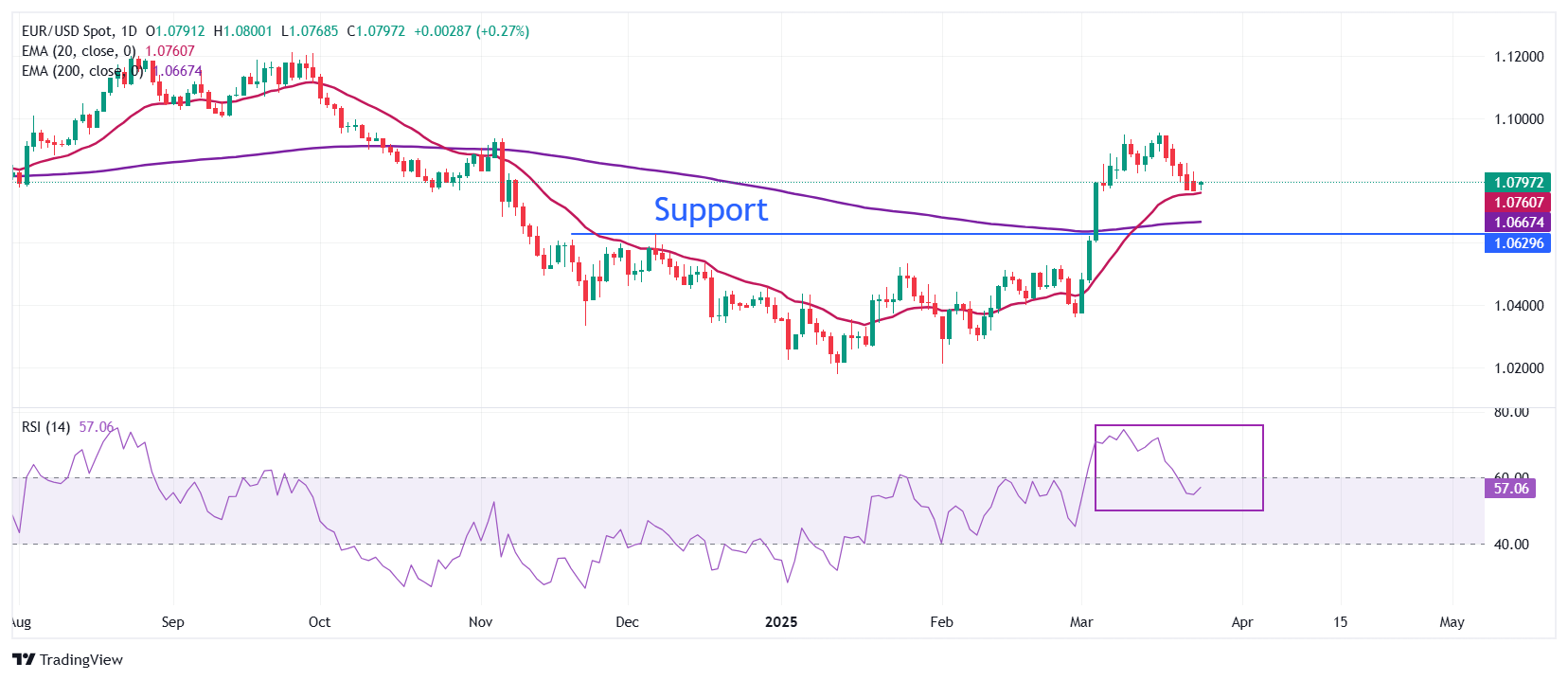
EUR/USD extended its correction from the five-month high of 1.0955 to near the 20-day Exponential Moving Average (EMA), which trades around 1.0760. However, the long-term outlook of the major currency pair is still bullish as it holds above the 200-day EMA, which oscillates around 1.0667.
The 14-day Relative Strength Index (RSI) cools down below 60.00, suggesting that the bullish momentum is over, but the upside bias is intact.
Looking down, the December 6 high of 1.0630 will act as the major support zone for the pair. Conversely, the psychological level of 1.1000 will be the key barrier for the Euro bulls.
Economic Indicator
Core Personal Consumption Expenditures - Price Index (YoY)
The Core Personal Consumption Expenditures (PCE), released by the US Bureau of Economic Analysis on a monthly basis, measures the changes in the prices of goods and services purchased by consumers in the United States (US). The PCE Price Index is also the Federal Reserve’s (Fed) preferred gauge of inflation. The YoY reading compares the prices of goods in the reference month to the same month a year earlier. The core reading excludes the so-called more volatile food and energy components to give a more accurate measurement of price pressures." Generally, a high reading is bullish for the US Dollar (USD), while a low reading is bearish.
Read more.Next release: Fri Mar 28, 2025 12:30
Frequency: Monthly
Consensus: 2.7%
Previous: 2.6%
Source: US Bureau of Economic Analysis
After publishing the GDP report, the US Bureau of Economic Analysis releases the Personal Consumption Expenditures (PCE) Price Index data alongside the monthly changes in Personal Spending and Personal Income. FOMC policymakers use the annual Core PCE Price Index, which excludes volatile food and energy prices, as their primary gauge of inflation. A stronger-than-expected reading could help the USD outperform its rivals as it would hint at a possible hawkish shift in the Fed’s forward guidance and vice versa.
Author

Sagar Dua
FXStreet
Sagar Dua is associated with the financial markets from his college days. Along with pursuing post-graduation in Commerce in 2014, he started his markets training with chart analysis.