EUR/USD gains as Fed's Waller supports July rate cut, US sentiment improves
- Fed’s Waller supports July rate cut, pulling Treasury yields and Dollar lower.
- UoM survey shows improved sentiment and easing inflation expectations in the US.
- ECB decision, EU PMIs, and US macro data in focus for the week ahead.

The EUYR/USD finished Friday’s session with gains of over 0.26% amid a weaker US Dollar, following dovish comments by Fed Governor Christopher Waller, which weighed on US Treasury yields. Still, an improvement in Consumer Sentiment capped the Euro’s gains, with the pair trading at 1.1626 at the time of writing.
Wall Street ended the session on a higher note, as investors cheered comments by Waller, who favors a rate cut in July. Despite this, recent comments by Chicago Fed President Austan Goolsbee showed that he has moderated his dovish stance, stating that he’s wary due to the latest CPI report, which shows the first signs of tariffs pushing up goods inflation.
In the data front, the University of Michigan (UoM) Consumer Sentiment in July showed that households grew optimistic about their financial situation and also expect inflation to edge lower. Aside from this, housing data also showed signs of improvement, as the European economic docket remained scarce, with investors seeking cues about a trade agreement between the European Union (EU) and the United States (US).
Next week, the EU’s economic docket will feature Consumer Confidence, Flash PMIs for July and the European Central Bank (ECB) monetary policy decision. Across the pond, the US schedule will announce US housing data, S&P Global Flash PMIs, Initial Jobless Claims and Durable Goods Orders.
Daily digest market movers: EUR/USD reclaims 1.1600 despite strong US data
- The University of Michigan’s preliminary Consumer Sentiment Index rose to 61.8 in July, up from 60.7 in June and slightly above the expected reading of 61.5. Joanne Hsu, the director of the survey, said, "Consumers are unlikely to regain their confidence in the economy unless they feel assured that inflation is unlikely to worsen, for example, if trade policy stabilizes for the foreseeable future."
- The University of Michigan survey also showed a decline in inflation expectations. Long-term inflation (5-year outlook) was revised down to 3.6% from 4%, while one-year expectations dropped to 4.4% from the previous 5%.
- Separately, Fed Governor Christopher Waller acknowledged that while the labor market remains stable overall, conditions in the private sector are less robust. Although he expressed support for a potential rate cut in July, he emphasized that he would not commit ahead of the meeting, stating he prefers to “hear all sides” before making a final decision.
- Chicago’s Fed Austal Goolsbee said that the new round of tariffs doesn’t help to fight inflation, so they (the Fed) could understand the impact on prices. Although he favors rate cuts, he said they have to wait longer to adjust policy if price pressures pick up.
- Recent US economic data painted a mixed picture of inflation. While the Consumer Price Index (CPI) edged closer to the 3% mark, the Producer Price Index (PPI) showed signs of easing. However, stronger-than-expected Retail Sales suggested that much of the increase was driven by higher prices linked to newly imposed tariffs, rather than underlying demand.
- Since last week, several ECB policymakers have voiced their views on the monetary policy outlook. Mario Centeno joined De Guindos, Vujčić, and Villeroy in signaling support for a pause or potential rate cut. Fabio Panetta also backed easing, citing increasing downside risks to growth.
- In contrast, Isabel Schnabel argued that current rates are appropriately positioned, advocating for a hold—an opinion echoed by Robert Holzmann, who emphasized the need to wait for more data before making any adjustments.
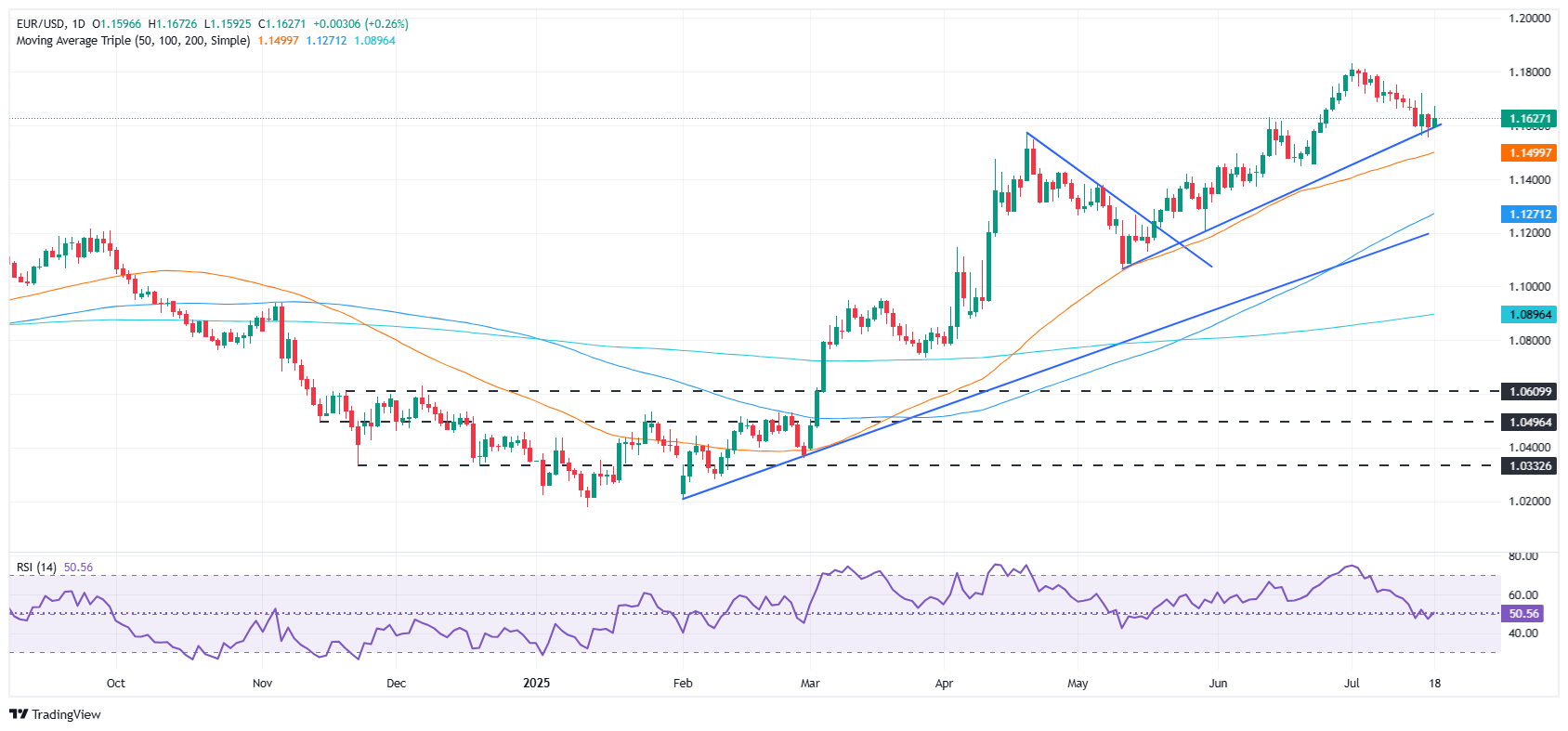
EUR/USD technical outlook: Consolidates within the 20 and 50-day SMA, above 1.1600
The EUR/USD is trading sideways, despite being upward biased from a market structure perspective. However, the Relative Strength Index (RSI) indicates bearishness, suggesting that neither buyers nor sellers are in control.
Therefore, if EUR/USD climbs past 1.1650, this clears the path to test the 20-day Simple Moving Average (SMA) at 1.1692. Once cleared, the following targets are 1.1700 and 1.1800.
On the other hand, if the EUR/USD falls below 1.1600, the next support level would be the 1.1550 mark, followed by the 50-day SMA at 1.1497. Once those demand zones are surpassed, the following line of defense for bulls would be the 100-day SMA at 1.1266.
Euro FAQs
The Euro is the currency for the 19 European Union countries that belong to the Eurozone. It is the second most heavily traded currency in the world behind the US Dollar. In 2022, it accounted for 31% of all foreign exchange transactions, with an average daily turnover of over $2.2 trillion a day. EUR/USD is the most heavily traded currency pair in the world, accounting for an estimated 30% off all transactions, followed by EUR/JPY (4%), EUR/GBP (3%) and EUR/AUD (2%).
The European Central Bank (ECB) in Frankfurt, Germany, is the reserve bank for the Eurozone. The ECB sets interest rates and manages monetary policy. The ECB’s primary mandate is to maintain price stability, which means either controlling inflation or stimulating growth. Its primary tool is the raising or lowering of interest rates. Relatively high interest rates – or the expectation of higher rates – will usually benefit the Euro and vice versa. The ECB Governing Council makes monetary policy decisions at meetings held eight times a year. Decisions are made by heads of the Eurozone national banks and six permanent members, including the President of the ECB, Christine Lagarde.
Eurozone inflation data, measured by the Harmonized Index of Consumer Prices (HICP), is an important econometric for the Euro. If inflation rises more than expected, especially if above the ECB’s 2% target, it obliges the ECB to raise interest rates to bring it back under control. Relatively high interest rates compared to its counterparts will usually benefit the Euro, as it makes the region more attractive as a place for global investors to park their money.
Data releases gauge the health of the economy and can impact on the Euro. Indicators such as GDP, Manufacturing and Services PMIs, employment, and consumer sentiment surveys can all influence the direction of the single currency. A strong economy is good for the Euro. Not only does it attract more foreign investment but it may encourage the ECB to put up interest rates, which will directly strengthen the Euro. Otherwise, if economic data is weak, the Euro is likely to fall. Economic data for the four largest economies in the euro area (Germany, France, Italy and Spain) are especially significant, as they account for 75% of the Eurozone’s economy.
Another significant data release for the Euro is the Trade Balance. This indicator measures the difference between what a country earns from its exports and what it spends on imports over a given period. If a country produces highly sought after exports then its currency will gain in value purely from the extra demand created from foreign buyers seeking to purchase these goods. Therefore, a positive net Trade Balance strengthens a currency and vice versa for a negative balance.
Author

Christian Borjon Valencia
FXStreet
Markets analyst, news editor, and trading instructor with over 14 years of experience across FX, commodities, US equity indices, and global macro markets.