EUR/USD falls towards 1.1750 as strong US data offsets ECB hold
- Euro slips after upbeat US jobless claims and Trump’s Fed visit stir rate cut uncertainty.
- US S&P Global Services PMI strengthens, while Manufacturing PMI contracts.
- ECB holds rates steady; Eurozone PMIs improve, but manufacturing remains in contraction zone.


The EUR/USD drops over 0.20% on Thursday after solid economic data from the United States (US) weighed on the shared currency, which benefited from the European Central Bank (ECB) holding rates unchanged. At the time of writing, the pair trades at 1.1749, having reached a daily high of 1.1789.
The US Department of Labor (DoL) reported that the number of Americans filing for unemployment benefits fell below estimates, which is a positive sign for a healthy labor market. However, Continuing Claims were mostly unchanged, showing that unemployed people are struggling to get a new job.
The S&P Global Manufacturing PMI contracted after reaching its highest level in 37 months, according to the survey. However, the Services PMI index improved.
The visit of US President Donald Trump to the Federal Reserve (Fed) generated some angst during the latter part of the trading day, as he pressured Fed Chair Jerome Powell to reduce interest rates while touring the building's renovations.
In the Eurozone, the ECB held its three main reference interest rates unchanged, opting instead for a meeting-by-meeting approach amid a split division between doves and hawks in the Governing Council. Data-wise, HCOB Flash PMIs improved, though manufacturing activity remained in contractionary territory.
Euro PRICE This week
The table below shows the percentage change of Euro (EUR) against listed major currencies this week. Euro was the strongest against the US Dollar.
| USD | EUR | GBP | JPY | CAD | AUD | NZD | CHF | |
|---|---|---|---|---|---|---|---|---|
| USD | -1.05% | -0.66% | -0.68% | -0.53% | -1.18% | -1.02% | -0.79% | |
| EUR | 1.05% | 0.47% | 0.40% | 0.50% | -0.18% | -0.16% | 0.21% | |
| GBP | 0.66% | -0.47% | -0.30% | 0.09% | -0.61% | -0.41% | -0.05% | |
| JPY | 0.68% | -0.40% | 0.30% | 0.15% | -0.48% | -0.41% | 0.04% | |
| CAD | 0.53% | -0.50% | -0.09% | -0.15% | -0.59% | -0.49% | -0.31% | |
| AUD | 1.18% | 0.18% | 0.61% | 0.48% | 0.59% | 0.09% | 0.53% | |
| NZD | 1.02% | 0.16% | 0.41% | 0.41% | 0.49% | -0.09% | 0.35% | |
| CHF | 0.79% | -0.21% | 0.05% | -0.04% | 0.31% | -0.53% | -0.35% |
The heat map shows percentage changes of major currencies against each other. The base currency is picked from the left column, while the quote currency is picked from the top row. For example, if you pick the Euro from the left column and move along the horizontal line to the US Dollar, the percentage change displayed in the box will represent EUR (base)/USD (quote).
Daily digest market movers: ECB’s decision fails to boost the Euro
- Initial Jobless Claims for the week ending July 19 fell to 217K from the 221K registered the previous week, below expectations for a 227K increase. This marks the lowest level since mid-April. However, Continuing Claims remained elevated at 1.96 million—near the highest levels since 2021—highlighting ongoing difficulties for unemployed individuals in finding new jobs.
- The S&P Global Manufacturing PMI contracted, falling from 52 to 49.5 in July, missing the forecast of 52.5. The Services PMI rose to 55.2, surpassing expectations of 53.0 and increasing from 52.9 in June, signaling strong momentum in the service sector.
- The HCOB Manufacturing PMI improved from 49.5 to 49.8 as expected, while the Services PMI expanded by 51.2, up from 50.5, above forecasts of 50.8. The Composite index rose from 50.6 to 51.
- Trade news had not shown an advance, following Wednesday’s rumors spurred by the FT’s article, which revealed that the US and the EU were close to a deal that would set tariffs of 15% on EU goods imported to the US. The article mentioned that “Both sides would waive tariffs on some products, including aircraft, spirits and medical devices, the people said.”
- Despite this, EU member states are set to vote on EUR 93 billion of counter-tariffs on US goods on Thursday, and a broad majority of EU members would support using the anti-coercion instrument in the event of no US trade deal and US tariffs of 30%.
- The ECB kept rates unchanged at 2% as foreseen, with the statement highlighting that data have come broadly in line with the previous assessment, while adding that due to uncertainty, their approach would be meeting by meeting.
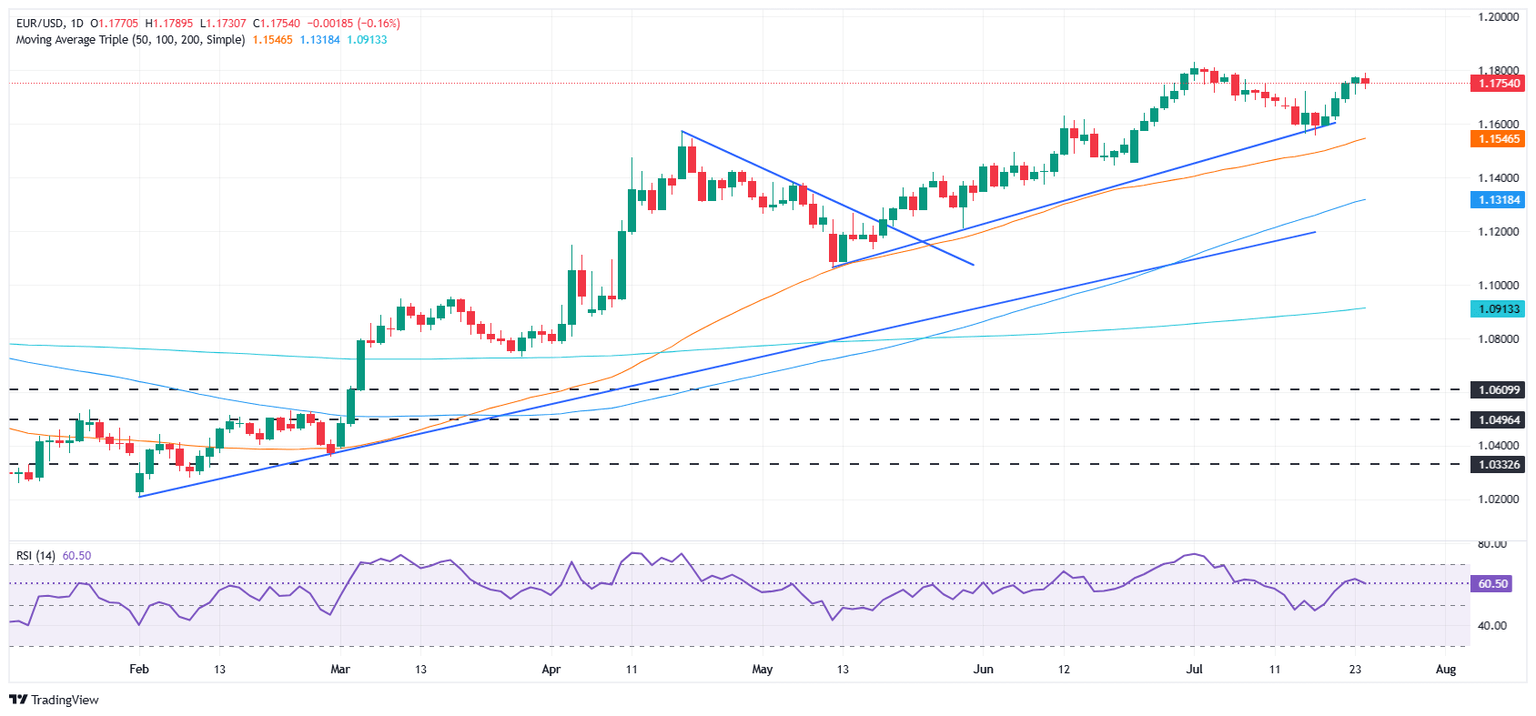
Technical outlook: EUR/USD hovers around 1.1750 directionless
The EUR/USD is consolidating after reaching a weekly high of 1.1788, falling short of testing the 1.1800 mark. The Relative Strength Index (RSI) remains bullish; however, buyers appear to be losing momentum as the index approaches its neutral line.
If EUR/USD drops below the 20-day SMA at 1.1714, look for a test of 1.1700. Once cleared, the next stop would be the 50-day SMA at 1.1556. Conversely, if the pair climbs past 1.1800, a test of the year-to-date (YTD) high is seen at 1.1829, followed by 1.1850.
Euro FAQs
The Euro is the currency for the 19 European Union countries that belong to the Eurozone. It is the second most heavily traded currency in the world behind the US Dollar. In 2022, it accounted for 31% of all foreign exchange transactions, with an average daily turnover of over $2.2 trillion a day. EUR/USD is the most heavily traded currency pair in the world, accounting for an estimated 30% off all transactions, followed by EUR/JPY (4%), EUR/GBP (3%) and EUR/AUD (2%).
The European Central Bank (ECB) in Frankfurt, Germany, is the reserve bank for the Eurozone. The ECB sets interest rates and manages monetary policy. The ECB’s primary mandate is to maintain price stability, which means either controlling inflation or stimulating growth. Its primary tool is the raising or lowering of interest rates. Relatively high interest rates – or the expectation of higher rates – will usually benefit the Euro and vice versa. The ECB Governing Council makes monetary policy decisions at meetings held eight times a year. Decisions are made by heads of the Eurozone national banks and six permanent members, including the President of the ECB, Christine Lagarde.
Eurozone inflation data, measured by the Harmonized Index of Consumer Prices (HICP), is an important econometric for the Euro. If inflation rises more than expected, especially if above the ECB’s 2% target, it obliges the ECB to raise interest rates to bring it back under control. Relatively high interest rates compared to its counterparts will usually benefit the Euro, as it makes the region more attractive as a place for global investors to park their money.
Data releases gauge the health of the economy and can impact on the Euro. Indicators such as GDP, Manufacturing and Services PMIs, employment, and consumer sentiment surveys can all influence the direction of the single currency. A strong economy is good for the Euro. Not only does it attract more foreign investment but it may encourage the ECB to put up interest rates, which will directly strengthen the Euro. Otherwise, if economic data is weak, the Euro is likely to fall. Economic data for the four largest economies in the euro area (Germany, France, Italy and Spain) are especially significant, as they account for 75% of the Eurozone’s economy.
Another significant data release for the Euro is the Trade Balance. This indicator measures the difference between what a country earns from its exports and what it spends on imports over a given period. If a country produces highly sought after exports then its currency will gain in value purely from the extra demand created from foreign buyers seeking to purchase these goods. Therefore, a positive net Trade Balance strengthens a currency and vice versa for a negative balance.
Author
Christian Borjon Valencia
FXStreet
Markets analyst, news editor, and trading instructor with over 14 years of experience across FX, commodities, US equity indices, and global macro markets.