EUR/USD declines as traders scale back Fed large rate cut bets
- EUR/USD dives below 1.1050 as the US Dollar strengthens on expectations that the Fed will opt for a small-size interest rate cut this month.
- Investors await the US CPI on Wednesday for fresh guidance on interest rates.
- The ECB is expected to cut interest rates this week.

EUR/USD extends its downside below 1.1050 in Monday’s North American session. The major currency pair declines as the US Dollar (USD) strengthens after mixed cues over current labor market health from Friday’s United States (US) Nonfarm payrolls (NFP) report for August, which diminished market expectations for the Federal Reserve (Fed) to reduce interest rates aggressively this month.
The US Dollar Index (DXY), which tracks the Greenback’s value against six major currencies, jumps to near 101.50.
The official employment report showed that fresh payrolls were fewer than expected, the Unemployment Rate fell expectedly, and the Average Hourly Earnings, a key measure of wage growth, grew at a faster-than-projected pace.
Market participants were mainly focusing on the employment numbers as the Fed appeared to be confident that price pressures are on track to return to the desired central banks’ rate of 2%. Slower job demand increased evidence that the US economic growth is moderating. Still, the pace of decline was lesser than July’s impression, which diminished recession fears and the Fed’s large rate-cut bets.
According to the CME FedWatch tool, the probability of the Fed reducing interest rates by 50 basis points (bps) to 4.75%-5.00% in September is 27%, while the rest favors a 25-bps interest rate cut.
Going forward, the US Dollar is expected to witness more volatility this week as the US Consumer Price Index (CPI) data for August is lined up for release on Wednesday.
Daily digest market movers: EUR/USD declines as firm ECB rate cut bets weigh on Euro
- EUR/USD performs weakly against its major peers on Monday, with investors focusing on the European Central Bank (ECB) policy decision, which will be announced on Thursday. The ECB is expected to cut its key borrowing rates again by 25 basis points (bps). This would be the second dovish interest rate decision by the ECB in its current policy-easing cycle, which it started in the June meeting but kept interest rates unchanged in July.
- The ECB is almost certain to reduce interest rates this week as Eurozone price pressures have significantly contained and growing uncertainty over the economic outlook. Eurozone’s preliminary headline Harmonized Index of Consumer Prices (HICP) fell to 2.2% in August, the lowest reading since July 2021. The Eurozone economic prospects are poor due to subdued demand from domestic and overseas markets.
- The German economy has been exposed to a technical recession, given that the nation’s growth contracted in the second quarter of this year, and the outlook for the third quarter remains uncertain.
- Meanwhile, ECB policymakers have also acknowledged growing weakness in the German economy and see more interest rate cuts as appropriate in the remainder of the year. Last week, ECB board member Piero Cipollone said, "There is a real risk that our stance could become too restrictive."
- On the economic data front, Eurozone Sentix Investor Confidence has worsened further to -15.4 in September from -13.9 in August. This appears to be the outcome of the deteriorating economy’s health amid a slowdown in the German economy.
Technical Analysis: EUR/USD sees support near 1.1000
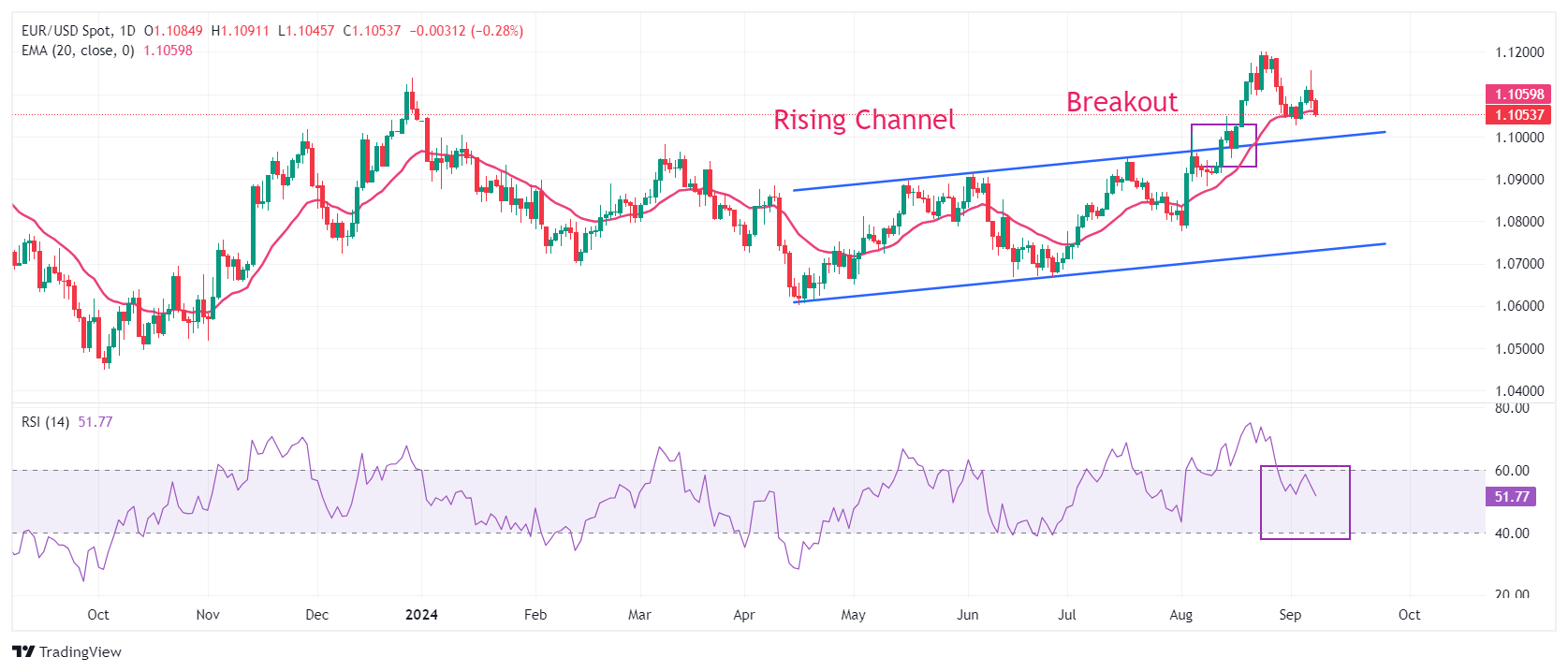
EUR/USD dips below 1.1050 in Monday’s European trading hours. The major currency pair weakens after failing to sustain above the crucial resistance of 1.1100. The near-tern outlook of the shared currency pair has become uncertain as it has dropped below the 20-day Exponential Moving Average (EMA), which trades around 1.1060.
The 14-day Relative Strength Index (RSI) falls further to 50.00, suggesting a lack of bullish momentum.
The pair is expected to find support near the psychological level of 1.1000. On the upside, last week’s high of 1.1155 and the round-level resistance of 1.1200 will act as major barricades for the Euro bulls.
ECB FAQs
The European Central Bank (ECB) in Frankfurt, Germany, is the reserve bank for the Eurozone. The ECB sets interest rates and manages monetary policy for the region. The ECB primary mandate is to maintain price stability, which means keeping inflation at around 2%. Its primary tool for achieving this is by raising or lowering interest rates. Relatively high interest rates will usually result in a stronger Euro and vice versa. The ECB Governing Council makes monetary policy decisions at meetings held eight times a year. Decisions are made by heads of the Eurozone national banks and six permanent members, including the President of the ECB, Christine Lagarde.
In extreme situations, the European Central Bank can enact a policy tool called Quantitative Easing. QE is the process by which the ECB prints Euros and uses them to buy assets – usually government or corporate bonds – from banks and other financial institutions. QE usually results in a weaker Euro. QE is a last resort when simply lowering interest rates is unlikely to achieve the objective of price stability. The ECB used it during the Great Financial Crisis in 2009-11, in 2015 when inflation remained stubbornly low, as well as during the covid pandemic.
Quantitative tightening (QT) is the reverse of QE. It is undertaken after QE when an economic recovery is underway and inflation starts rising. Whilst in QE the European Central Bank (ECB) purchases government and corporate bonds from financial institutions to provide them with liquidity, in QT the ECB stops buying more bonds, and stops reinvesting the principal maturing on the bonds it already holds. It is usually positive (or bullish) for the Euro.
Author

Sagar Dua
FXStreet
Sagar Dua is associated with the financial markets from his college days. Along with pursuing post-graduation in Commerce in 2014, he started his markets training with chart analysis.