|

EUR/USD falls as ISM Manufacturing PMI improves, boosting USD on Fed tightening speculation

  • EUR/USD dips as ISM Manufacturing PMI for April shows improvement but falls short of expansionary territory.
  • IMF Chief Downplays de-dollarization concerns amid banking sector vulnerabilities.
  • EU Inflation Figures and HCOB Manufacturing PMI to provide insight on the European Central Bank's chances for a 50 or 25 bps rate hike.

The EUR/USD dropped below 1.1000 after the ISM announced that manufacturing activity in April improved. However, it stood in contractionary territory, while a measure of inflation in the same data increased. Therefore, speculations for further tightening by the Federal Reserve (Fed) underpinned the US Dollar (USD). At the time of writing, the EUR/USD is trading at 1.0969 after hitting a high of 1.1035.

EUR/USD losses traction and creeps lower on US data

A risk-on impulse dominates the US equity markets, courtesy of JP Morgan's acquiring the troubled First Republic Bank. However, that's not happening in the FX space, as the EUR/USD fell after the ISM Manufacturing PMI for April improved to 47.1 from 46.3 in the prior's month. While there were improvements in the Orders and Production subcomponents, they fell short of reaching expansionary territory. The Prices Index increased by 4 points to 53.2, which led to speculation that the Federal Reserve might implement tighter monetary policies in the upcoming Wednesday.

Therefore, the EUR/USD retraced, past the daily pivot point and beneath the S1 daily pivot, at 1.0970. It should be said that the greenback underpinned by higher US T-bond yields, its printing losses of 0.46%, up at 102.149.

As of writing, comments from the IMF Managing Director Kristalina Georgieva on Monday said, "De-dollarization isn't on top of my worry list." She added, "There may be more vulnerabilities exposed in the banking sector," and warned that they would see quite a lot of regulatory and disclosure thinking in the wake of the banking crisis.

An absent Eurozone's (EU) economic docket kept EUR/USD traders leaning on the American Dollar (USD) dynamics and market sentiment. On Tuesday, the EU's agenda will feature inflation figures and the HCOB Manufacturing PMI in its final reading. The US economic calendar would feature the JOLTs Job Openings report and Factory Orders ahead of Wednesday's Federal Reserve monetary policy decision.

EUR/USD Technical Analysis
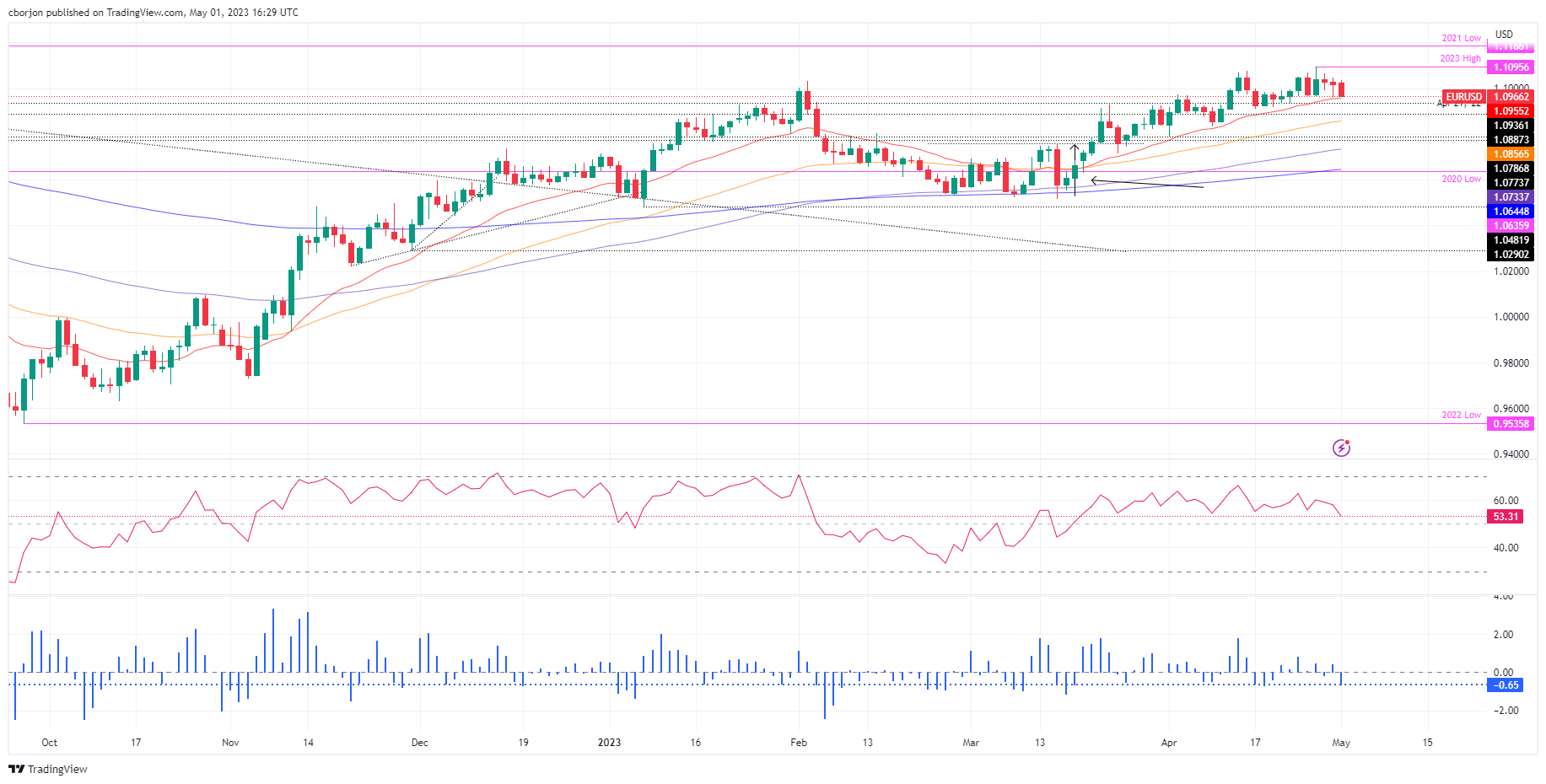
EUR/USD Daily Chart

From a technical perspective, the EUR/USD is still upward biased but about to test the 20-day EMA at 1.0955. A fall below the latter will expose the 1.0900 figure, followed by the 50-day EMA at 1.0856. Conversely, if EUR/USD buyers reclaim 1.1000, further upside is warranted at around 1.1095.

EUR/USD

Overview
Today last price1.0965
Today Daily Change-0.0054
Today Daily Change %-0.49
Today daily open1.1019
 
Trends
Daily SMA201.0965
Daily SMA501.0799
Daily SMA1001.0762
Daily SMA2001.0414
 
Levels
Previous Daily High1.1045
Previous Daily Low1.0962
Previous Weekly High1.1095
Previous Weekly Low1.0962
Previous Monthly High1.1095
Previous Monthly Low1.0788
Daily Fibonacci 38.2%1.0994
Daily Fibonacci 61.8%1.1014
Daily Pivot Point S11.0973
Daily Pivot Point S21.0926
Daily Pivot Point S31.089
Daily Pivot Point R11.1055
Daily Pivot Point R21.1092
Daily Pivot Point R31.1138

Author

Christian Borjon Valencia

Markets analyst, news editor, and trading instructor with over 14 years of experience across FX, commodities, US equity indices, and global macro markets.


More from Christian Borjon Valencia
Share:

Editor's Picks

AUD/USD consolidates above 0.7000; remains close to monthly top

AUD/USD holds steady above 0.7000 during the Asian session on Friday, trading just below the previous day's monthly low amid diverging forces. A hawkish RBA continues to support the Aussie, while the recent decline in US bond yields keeps the US Dollar depressed near a three-week low. However, oil-driven inflation fears reinforce Fed hike bets, which, along with geopolitical risks, could benefit the safe-haven buck and cap the currency pair.

USD/JPY bounces off one-month low; climbs to 157.00 amid reviving USD demand

USD/JPY rebounds from the 156.00 neighborhood, or a one-month low touched during Friday’s Asian session, with bulls looking to extend momentum beyond 157.00 amid the emergence of some US Dollar buying. Meanwhile, Japan's National CPI rose to a nine-month peak and reaffirmed BoJ rate-hike bets, which could support the Japanese Yen and cap gains for the currency pair.

Gold stalls recovery from three-month low as Fed hike bets and USD uptick cap gains

Gold struggles to capitalize on a modest intraday bounce from levels below the $4,000 psychological mark, or a three-month low set during the Asian session, and sticks to a negative tone for the second straight day. The Federal Reserve recently signaled that there is no urgency to raise interest rates. Traders, however, are still pricing in around an 80% chance that the US central bank will raise borrowing costs again at its December policy meeting.

Bitcoin, Ethereum, and Ripple rebound as major support levels cap recent sell-off

Bitcoin, Ethereum and Ripple rebound modestly on Friday after correcting and testing their key support zone the previous day. BTC holds the 50-day EMA, ETH finds support around the 100-day EMA, while XRP holds the horizontal floor near $1.300. The price action of these top three cryptocurrencies suggests a recovery if this critical support zone holds; a decisive close below these levels suggests a deeper correction.

The week ahead – UK budget, Shell, BP and HSBC and NatWest results
Financial markets have undergone another turbulent week with concerns about public sector debt levels, the impact of energy policy and higher oil and gas prices, and what events in France might mean for the UK economy going forward.
What November 3 means for the Fed's rate path and the US Dollar

The USD faces a decisive period ahead of the November 3 midterm elections. While markets anticipate another interest rate increase from the Fed in December, the battle for control of Congress could reshape fiscal policy expectations and, indirectly, the path of US monetary policy in 2027.