EUR/USD edges higher during US session
- EUR/USD recuperates after the losses suffered following Tuesday’s US inflation report.
- The short-term uptrend is now in doubt but the move down lacks momentum.
- Analysts at TD Securities are still penciling in June for a Fed rate cut.

EUR/USD catches a bid during the early US session on Wednesday after seeing some weakness following the release of higher-than-expected inflation data from the United States (US) on Tuesday. The hot inflation data reduced the chances of an early interest-rate cut from the Federal Reserve (Fed).
The pair is trading in the 1.0940s during the US session, down from the last major peak in the 1.0980s reached on Friday.
Investors have shifted their expectations away from the possibility of the Fed pressing the button on cutting interest rates in May, with the focus now more firmly on June.
Since keeping interest rates higher for longer is positive for the US Dollar (USD), as it attracts greater capital inflows, the US Consumer Price Index (CPI) data release has seen the Greenback gain in most pairs, including EUR/USD.
EUR/USD unphased after Eurozone Industrial Production plunges
Eurozone Industrial Production showed a deeper-than-expected decline of 3.2% month-on-month in January, from the downwardly revised 1.6% fall in December, and the expected negative 1.5%, according to data from Eurostat, released on Wednesday.
"It was the sharpest contraction in activity since March of the previous year, and the second-largest decline since the aftermath of the COVID-19 outbreak in April 2020, primarily driven by a staggering 14.5% drop in the production of capital goods." According to Tradingeconomics.com.
EUR/USD has not reacted much to the release, continuing to trade in the 1.0920s after the data.
EUR/USD: June still on for first rate cut, TD Securities says
June has firmed as the month for liftoff for economists at TD Securities, despite Tuesday’s hot inflation data, as the economists see services inflation continuing to “normalize”, according to a recent note.
"We don't think today's report meaningfully changes the Fed's inclination to first ease by the June FOMC meeting,” they said after the February CPI release.
“In our view, services inflation should resume a clear path toward normalization over the next few months as the tougher seasonal part of the year is already behind us ," they added.
Ultimately they see the US Dollar weakening in Q2 and Q3, which is likely to provide a positive push for EUR/USD unless the Euro (EUR) suffers equally.
Technical Analysis: EUR/USD continues correction lower
EUR/USD registered another step lower on Tuesday after falling from the 1.0981 peak established on March 8.
The latest decline extends a sequence of falling peaks and troughs and brings into doubt the previous short-term uptrend.
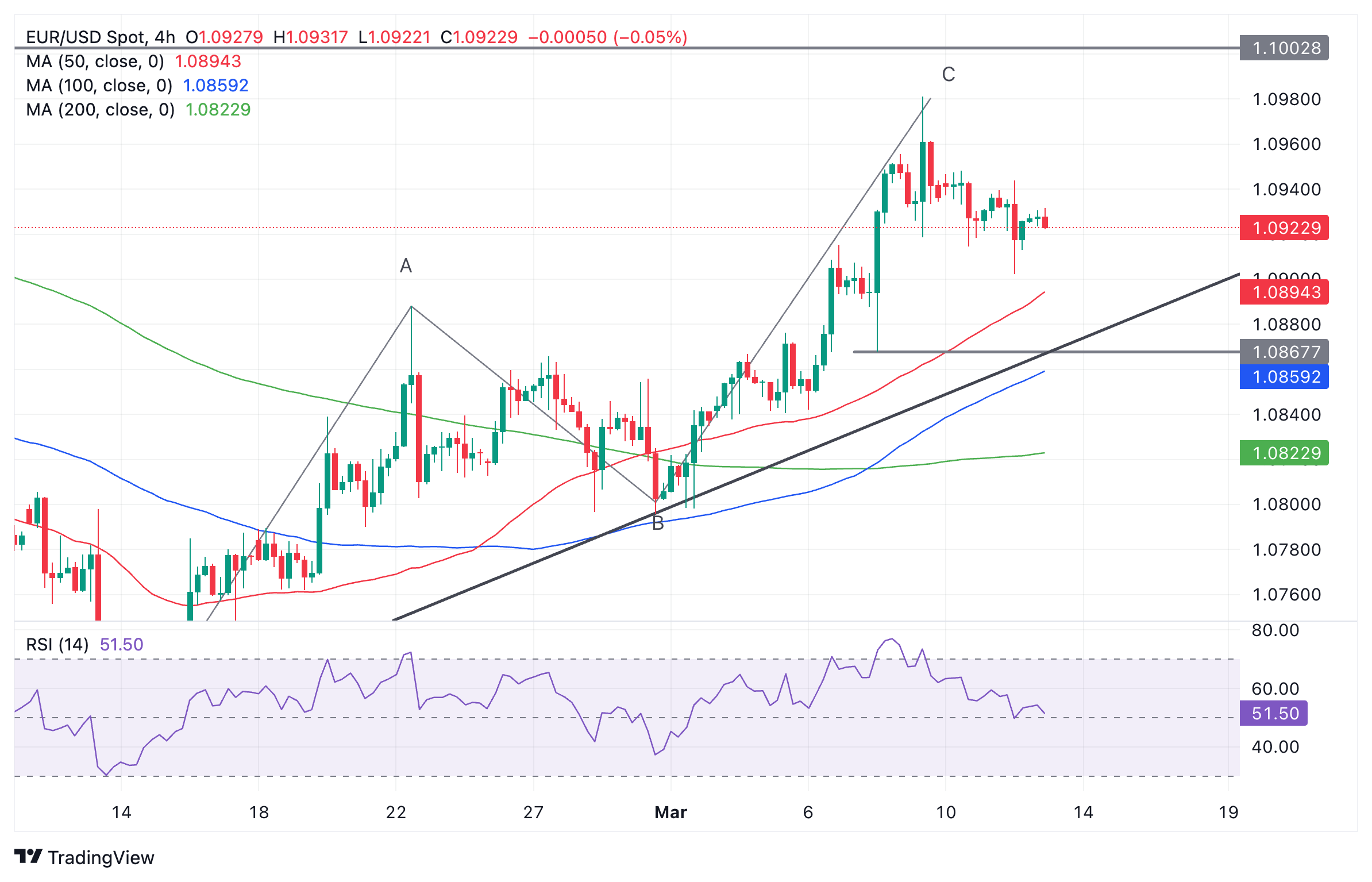
Euro vs US Dollar: 4-hour chart
That said, the move down lacks momentum and has been slower than the move up that preceded it, suggesting there is still a chance it could just be a correction rather than a reversal of the previous uptrend.
It is still possible the correction could fall even lower. One possible zone where price could find support is between 1.0898 (February 2 high) and the top of the Measured Move’s A wave at 1.0888.
A break below 1.0867 would probably solidify the case for a trend reversal and see bears take control.
Resumption of uptrend
A break above 1.0955 would be required for evidence of a resumption of the uptrend. A move above the 1.0981 high of March 8 would provide confirmation as it would establish a higher high.
After that, tough resistance is expected at the 1.1000 psychological level, which is likely to be the scene of a fierce battle between bulls and bears.
A decisive break above 1.1000, however, would open the gates to further gains towards the key resistance level at 1.1139, the December 2023 high.
By “decisive” it is meant a break characterized by a long green candle piercing clearly above the level and closing near its high, or three green bars in a row, breaching the level.
Euro FAQs
What is the Euro?
The Euro is the currency for the 20 European Union countries that belong to the Eurozone. It is the second most heavily traded currency in the world behind the US Dollar. In 2022, it accounted for 31% of all foreign exchange transactions, with an average daily turnover of over $2.2 trillion a day.
EUR/USD is the most heavily traded currency pair in the world, accounting for an estimated 30% off all transactions, followed by EUR/JPY (4%), EUR/GBP (3%) and EUR/AUD (2%).
What is the ECB and how does it impact the Euro?
The European Central Bank (ECB) in Frankfurt, Germany, is the reserve bank for the Eurozone. The ECB sets interest rates and manages monetary policy.
The ECB’s primary mandate is to maintain price stability, which means either controlling inflation or stimulating growth. Its primary tool is the raising or lowering of interest rates. Relatively high interest rates – or the expectation of higher rates – will usually benefit the Euro and vice versa.
The ECB Governing Council makes monetary policy decisions at meetings held eight times a year. Decisions are made by heads of the Eurozone national banks and six permanent members, including the President of the ECB, Christine Lagarde.
How does inflation data impact the value of the Euro?
Eurozone inflation data, measured by the Harmonized Index of Consumer Prices (HICP), is an important econometric for the Euro. If inflation rises more than expected, especially if above the ECB’s 2% target, it obliges the ECB to raise interest rates to bring it back under control.
Relatively high interest rates compared to its counterparts will usually benefit the Euro, as it makes the region more attractive as a place for global investors to park their money.
How does economic data influence the value of the Euro?
Data releases gauge the health of the economy and can impact on the Euro. Indicators such as GDP, Manufacturing and Services PMIs, employment, and consumer sentiment surveys can all influence the direction of the single currency.
A strong economy is good for the Euro. Not only does it attract more foreign investment but it may encourage the ECB to put up interest rates, which will directly strengthen the Euro. Otherwise, if economic data is weak, the Euro is likely to fall.
Economic data for the four largest economies in the euro area (Germany, France, Italy and Spain) are especially significant, as they account for 75% of the Eurozone’s economy.
How does the Trade Balance impact the Euro?
Another significant data release for the Euro is the Trade Balance. This indicator measures the difference between what a country earns from its exports and what it spends on imports over a given period.
If a country produces highly sought after exports then its currency will gain in value purely from the extra demand created from foreign buyers seeking to purchase these goods. Therefore, a positive net Trade Balance strengthens a currency and vice versa for a negative balance.
Author

Joaquin Monfort
FXStreet
Joaquin Monfort is a financial writer and analyst with over 10 years experience writing about financial markets and alt data. He holds a degree in Anthropology from London University and a Diploma in Technical analysis.