EUR/USD dives to fresh weekly lows with ECB speakers on focus
- The Euro explores levels below 1.1600 as the previous recovery attempt failed.
- markets are looking for direction with investors awaiting US CPI data and the Fed decision next week.
- A protracted US shutdown and hopes of Fed monetary easing are keeping US Dollar's rallies contained.

EUR/USD has retraced previous gains on Wednesday, to extend its decline to one-week lows below 1.1600, trading at 1.1586 at the time of writing. The US Dollar (USD) resumed its uptrend in the early European trading session, with markets in a cautious mood ahead of the speeches of the European Central Bank (ECB) and the Federal Reserve (Fed) officials due later on the day.
the
On Tuesday, US President Donald Trump rebuffed meeting requests by Democratic lawmakers from the previous day, saying that he will not meet them until the government reopens. Meanwhile, the shutdown enters its fourth week as the Senate failed to pass a funding resolution for the 11th time on Monday.
In the absence of key macroeconomic releases in the Eurozone and the US, the speeches of European Central Bank (ECB) policymakers, including President Christine Lagarde and Vice President Luis de Guindos, and Fed officials will be the unique distraction for traders. These speeches, however, are unlikely to provide any new clues on the central banks' near-term monetary policies.
Euro Price Today
The table below shows the percentage change of Euro (EUR) against listed major currencies today. Euro was the strongest against the British Pound.
| USD | EUR | GBP | JPY | CAD | AUD | NZD | CHF | |
|---|---|---|---|---|---|---|---|---|
| USD | 0.11% | 0.47% | -0.11% | -0.04% | -0.07% | -0.05% | 0.05% | |
| EUR | -0.11% | 0.36% | -0.23% | -0.15% | -0.20% | -0.14% | -0.07% | |
| GBP | -0.47% | -0.36% | -0.57% | -0.51% | -0.54% | -0.50% | -0.42% | |
| JPY | 0.11% | 0.23% | 0.57% | 0.06% | 0.04% | 0.07% | 0.17% | |
| CAD | 0.04% | 0.15% | 0.51% | -0.06% | -0.04% | 0.00% | 0.07% | |
| AUD | 0.07% | 0.20% | 0.54% | -0.04% | 0.04% | 0.04% | 0.12% | |
| NZD | 0.05% | 0.14% | 0.50% | -0.07% | -0.01% | -0.04% | 0.08% | |
| CHF | -0.05% | 0.07% | 0.42% | -0.17% | -0.07% | -0.12% | -0.08% |
The heat map shows percentage changes of major currencies against each other. The base currency is picked from the left column, while the quote currency is picked from the top row. For example, if you pick the Euro from the left column and move along the horizontal line to the US Dollar, the percentage change displayed in the box will represent EUR (base)/USD (quote).
Daily digest market movers: Fed monetary easing hopes to limit US Dollar rallies
- The US Dollar lost momentum as the latest episode of the Sino-US trade war went into the back burner, and investors shifted their focus once again to the protracted US government shutdown and the prospects of a series of interest rate cuts by the Federal Reserve.
- A survey by Reuters showed on Tuesday that most analysts expect the Fed to cut rates by 25 basis points at the October 28-29 meeting and a further quarter-point in December. 25 of 33 economists show concerns that the central bank might go too far with monetary easing and set a very low terminal rate by the end of next year.
- US President Trump affirmed on Tuesday that Republicans "will not be extorted" by Democrats to bend to their demands, which suggests that this government closure is likely to be one of the largest in history. Such an extended closure will likely take a toll on US GDP growth and undermine investors' confidence in the US Dollar.
- Earlier this week, Trump announced that he will meet Chinese President Xi Jinping in South Korea next week and that he expects to reach a fair deal. These comments have ditched fears of a US-China trade war, at least for now, and triggered a sharp sell-off in precious metals.
Technical Analysis: EUR/USD extends losses below the 1.1600 support area
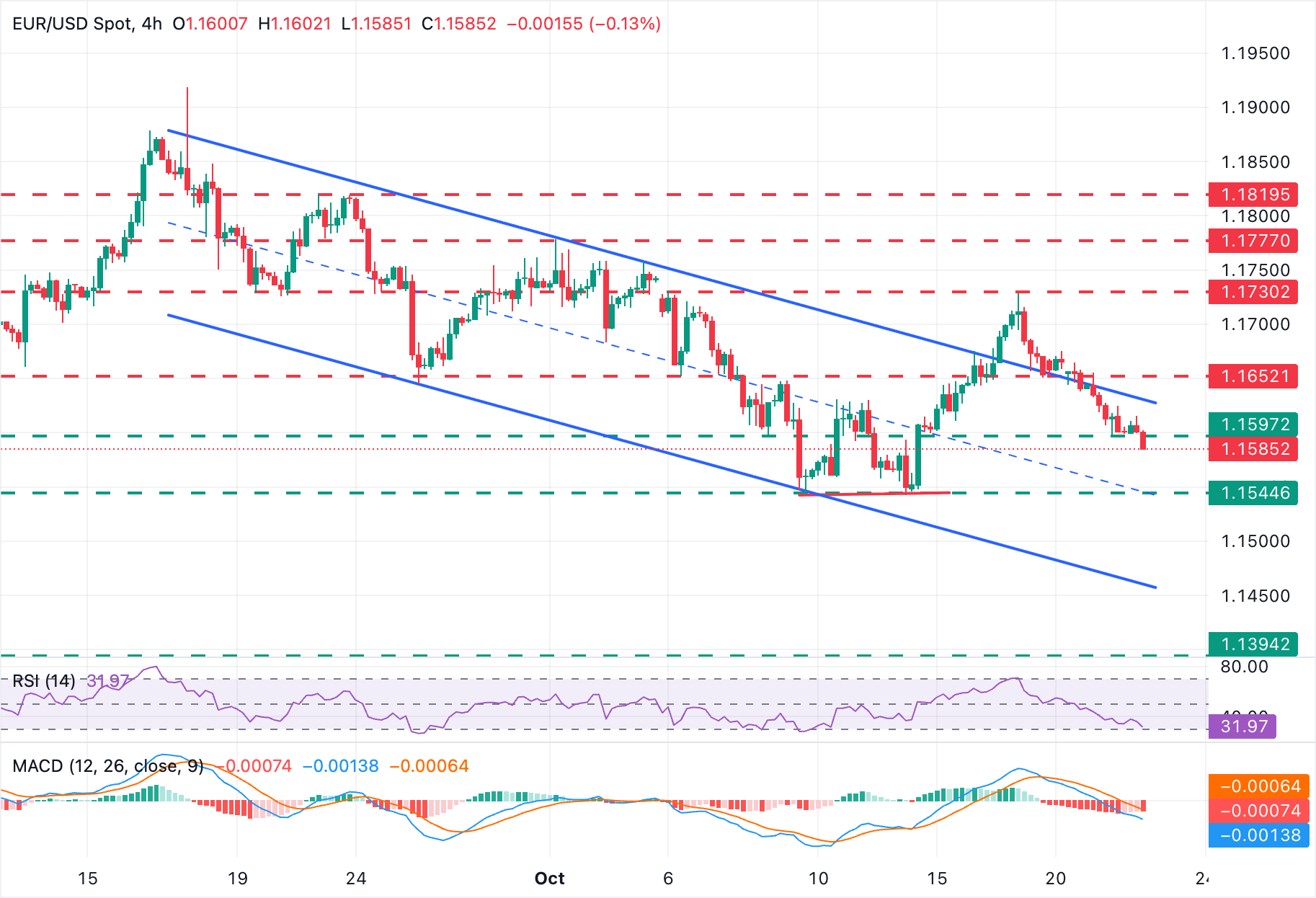
EUR/USD's upside attempts have been short-lived, and the pair resumed its decline on Wednesday's European session, breaching the 1.1600 support area. The pair remains on a bearish trend following the rejection at 1.1730 last week. Technical indicators are in negative territory. The 4-hour Relative Strength Index is close but not yer ar oversold levels, and the Moving Average Convergence-Divergence (MACD) remains well below the signal line.
With this in mind, the possibility of a retest of the October 9 and 14 lows in the area of 1.1545 remains on the table. Further down, the channel bottom, now around 1.1460, emerges as the next potential target. To the upside, the pair would need an unlikely rebound beyond Tuesday's highs, in the area of 1.1650 to shift the focus towards the October 17 high, at 1.1728. Further up, the October 1 high, around 1.1775, comes into focus.
ECB FAQs
The European Central Bank (ECB) in Frankfurt, Germany, is the reserve bank for the Eurozone. The ECB sets interest rates and manages monetary policy for the region. The ECB primary mandate is to maintain price stability, which means keeping inflation at around 2%. Its primary tool for achieving this is by raising or lowering interest rates. Relatively high interest rates will usually result in a stronger Euro and vice versa. The ECB Governing Council makes monetary policy decisions at meetings held eight times a year. Decisions are made by heads of the Eurozone national banks and six permanent members, including the President of the ECB, Christine Lagarde.
In extreme situations, the European Central Bank can enact a policy tool called Quantitative Easing. QE is the process by which the ECB prints Euros and uses them to buy assets – usually government or corporate bonds – from banks and other financial institutions. QE usually results in a weaker Euro. QE is a last resort when simply lowering interest rates is unlikely to achieve the objective of price stability. The ECB used it during the Great Financial Crisis in 2009-11, in 2015 when inflation remained stubbornly low, as well as during the covid pandemic.
Quantitative tightening (QT) is the reverse of QE. It is undertaken after QE when an economic recovery is underway and inflation starts rising. Whilst in QE the European Central Bank (ECB) purchases government and corporate bonds from financial institutions to provide them with liquidity, in QT the ECB stops buying more bonds, and stops reinvesting the principal maturing on the bonds it already holds. It is usually positive (or bullish) for the Euro.
the
Author

Guillermo Alcala
FXStreet
Graduated in Communication Sciences at the Universidad del Pais Vasco and Universiteit van Amsterdam, Guillermo has been working as financial news editor and copywriter in diverse Forex-related firms, like FXStreet and Kantox.