EUR/USD drops below 1.1750 as Powell’s cautious tone lifts Dollar
- EUR/USD slumps as Powell reiterates balanced dual mandate, stressing risks to jobs and inflation.
- US New Home Sales surged over 20% in August, supporting Dollar rebound after weaker PMI data earlier in the week.
- German IFO sentiment slid to four-month low, while French PM floated tax hikes, further weighing on Euro outlook.

EUR/USD tumbles on Wednesday edges down 0.66% as the Greenback recovers following Tuesday’s Fed Chair Jerome Powell speech, in which he was cautious regarding rushing to reduce interest rates. The pair trades at 1.1738 after hitting a daily high of 1.1819.
Greenback recovers on upbeat US housing data and Fed caution; Euro pressured by weak German sentiment and French tax talk
The financial markets narrative hasn’t changed, with investors still expecting at least two rate cuts by the Fed, towards the end of the year. Nevertheless, Powell saying that the Fed would still look at both sides of the dual mandate as the risks of inflation are tilted to the upside and for employment to the downside. He stressed that monetary policy is modestly restrictive, but “well positioned” for future economic developments.
Meanwhile, the housing market in the US improved after August’s New Home Sales grew by over 20%, according to the US Census Bureau. The report boosted the US Dollar, which was sold off on Tuesday after a weaker than expected S&P Global Flash PMI data.
The parade of Fed officials continued Wednesday as San Francisco Fed Mary Daly and Chicago’s Fed Austan Goolsbee crossed the newswire.
The Euro began its slide after the German’s latest IFO report weakened to a four-month low in September, with the economic recovery suffering a setback. In the meantime, French PM Lecornu said he is open to a tax on top earners and firms, according to BFM TV.
Ahead this week the economic docket in the US will feature Initial Jobless Claims for the week ending September 20, Durable Goods Orders, Gross Domestic Product (GDP) figures and further Fed speakers on Thursday. In the Eurozone, Germany’s GfK Consumer Confidence Survey for October, would update the status of households.
Daily market movers: Euro plunges, weighed by Germany’s IFO data
- The US Dollar Index (DXY), which tracks the buck’s value against a basket of six currencies, is up 0.66% at 97.85.
- New Home Sales in August improved sharply, from 0.664 million to 0.8 million, a 20.5% increase exceeding forecasts of 0.65 million.
- Fed’s Goolsbee warned against a series of rate cuts, saying the jobs market is still mostly steady and solid, and added that he is uncomfortable with overly frontloading cuts on the presumption that inflation will probably just be transitory. He blamed US President Trump policies for his reluctance to lower rates.
- Mary Daly said that further policy adjustments likely will be needed as the Fed works to restore price stability and provide needed support to the jobs market. She fully supported the Fed’s 25bps rate cut last week, said risks to the economy had shifted and it was time to act, and emphasized that the Fed’s rate-path projections are not promises.
- Traders are eyeing the release of Initial Jobless Claims for the week ending September 20, with estimates of 235K people filing for unemployment benefits, worse than the previous number of 231K. At the same time, the final reading of the US GDP for the second quarter is expected to remain unchanged at 3.3% YoY.
- Durable Goods Orders in August, which are projected to improve, following July’s dismal print of -2.8%. Economists estimate that orders would dip -0.5% MoM.
- German’s IFO Business Climate for September dipped from 89 to 87.7 below forecast of 89.3. The Current Assessment also slid to 85.7 from 86.4 for the same period, as companies were less satisfied with current business, while their expectations clouded noticeably. IFO Expectations tumbled from 91.6 to 89.7, beneath forecasts for an improvement to 92.
- The Federal Reserve is expected to reduce interest rates by 25 bps at the October 19 meeting, as revealed by data from Prime Market Terminal. Odds are at 91%. The European Central Bank (ECB) is foreseen to hold rates firm, following remarks by President Lagarde after the last ECB’s meeting, who said “The disinflation process is over.”
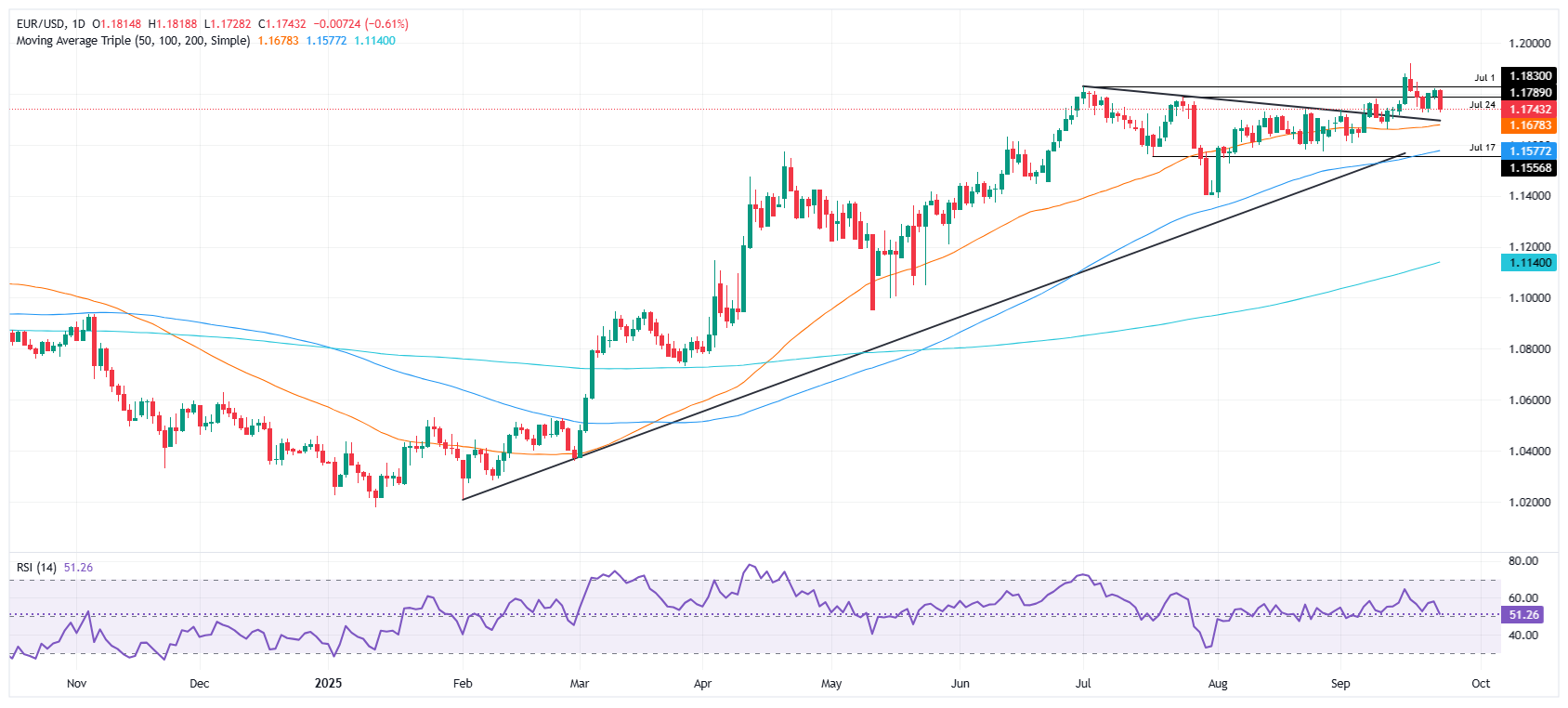
Technical outlook: EUR/USD tanks below 1.1800, bears eye 1.1700
EUR/USD trend remains up, but the formation of an ‘evening star’ indicates that a pullback is on the cards. Finishing Wednesday’s session below 1.1750, paves the way for further downside.
The Relative Strength Index (RSI), although bullish, it is aiming towards its neutral level. Hence, sellers seem to be gathering momentum in the near term.
If EUR/USD clears 1.1700, the first support would be the 50-day Simple Moving Average (SMA) at 1.1678, followed by confluence of the 100-day SMA and the August 27 swing low near 1.1560–1.1584.
On the flip side, if buyers push prices above 1.1750, look for a move to 1.1800. The next area of interest would be 1.1850 before testing the yearly high of 1.1918.
Euro FAQs
The Euro is the currency for the 19 European Union countries that belong to the Eurozone. It is the second most heavily traded currency in the world behind the US Dollar. In 2022, it accounted for 31% of all foreign exchange transactions, with an average daily turnover of over $2.2 trillion a day. EUR/USD is the most heavily traded currency pair in the world, accounting for an estimated 30% off all transactions, followed by EUR/JPY (4%), EUR/GBP (3%) and EUR/AUD (2%).
The European Central Bank (ECB) in Frankfurt, Germany, is the reserve bank for the Eurozone. The ECB sets interest rates and manages monetary policy. The ECB’s primary mandate is to maintain price stability, which means either controlling inflation or stimulating growth. Its primary tool is the raising or lowering of interest rates. Relatively high interest rates – or the expectation of higher rates – will usually benefit the Euro and vice versa. The ECB Governing Council makes monetary policy decisions at meetings held eight times a year. Decisions are made by heads of the Eurozone national banks and six permanent members, including the President of the ECB, Christine Lagarde.
Eurozone inflation data, measured by the Harmonized Index of Consumer Prices (HICP), is an important econometric for the Euro. If inflation rises more than expected, especially if above the ECB’s 2% target, it obliges the ECB to raise interest rates to bring it back under control. Relatively high interest rates compared to its counterparts will usually benefit the Euro, as it makes the region more attractive as a place for global investors to park their money.
Data releases gauge the health of the economy and can impact on the Euro. Indicators such as GDP, Manufacturing and Services PMIs, employment, and consumer sentiment surveys can all influence the direction of the single currency. A strong economy is good for the Euro. Not only does it attract more foreign investment but it may encourage the ECB to put up interest rates, which will directly strengthen the Euro. Otherwise, if economic data is weak, the Euro is likely to fall. Economic data for the four largest economies in the euro area (Germany, France, Italy and Spain) are especially significant, as they account for 75% of the Eurozone’s economy.
Another significant data release for the Euro is the Trade Balance. This indicator measures the difference between what a country earns from its exports and what it spends on imports over a given period. If a country produces highly sought after exports then its currency will gain in value purely from the extra demand created from foreign buyers seeking to purchase these goods. Therefore, a positive net Trade Balance strengthens a currency and vice versa for a negative balance.
Author

Christian Borjon Valencia
FXStreet
Markets analyst, news editor, and trading instructor with over 14 years of experience across FX, commodities, US equity indices, and global macro markets.

















