EUR/USD slumps on Eurozone economic risks, Fed's restrictive policy stance
- EUR/USD falls to near 1.0815 as the Fed is in no rush to cut interest rates soon.
- US President Trump’s tariff agenda could lead to cost-push inflation globally.
- ECB Lagarde expects potential Trump-led inflation in the Eurozone won’t be persistent.

EUR/USD trades lower to near the 10-day low of 1.0815 in Friday’s North American session. The major currency pair faces selling pressure as the US Dollar (USD) strengthens after the Federal Reserve (Fed) expressed in the policy meeting on Wednesday that interest rate cuts are not on the table in the current scenario. The US Dollar Index (DXY), which tracks the Greenback’s value against six major currencies, rises to near 104.15.
On Wednesday, the Fed kept interest rates steady in the range of 4.25%-4.50% for the second time in a row, as expected. Fed Chair Jerome Powell said in the press conference that the central bank is not going to be in a “hurry” to move onto “interest rate cuts”. His comments supporting a restrictive monetary policy stance stemmed from “unusually elevated” uncertainty over the United States (US) economic outlook.
Powell commented that the implementation of new policies by US President Donald Trump could lead to an economic slowdown and a resurgence in inflationary pressures in the near term.
During North American trading hours on Friday, Chicago Fed President Austan Goolsbee also supported a 'wait and see' approach for the interest rate policy in an interview with CNBC. "The Fed needs to be a steady hand and take the long view on the economy," Goolsbee said. He added that before judging how "monetary policy reacts to tariffs", the Fed needs to know how long the "tariffs last, possible retaliation, pass through to consumers". Goolsbee further added that the Fed also has to interpret the impact of incoming tax cuts and other issues.
Meanwhile, investors seek meaningful updates on Trump’s plan of imposing reciprocal tariffs on April 2. Market participants expect tariffs might affect economic growth and boost price pressures across the globe. Globally, manufacturers will be forced to underutilize their production capacity, which could result in fresh escalation in cost-push inflation.
On the economic front, investors will focus on the flash US S&P Global Purchasing Managers Index (PMI) data for March, which will be released on Monday.
Daily digest market movers: EUR/USD weakens amid fears of Trump's reciprocal tariffs
- The downside move in the EUR/USD pair is also driven by weakness in the Euro (EUR) amid fears that US President Trump’s reciprocal tariffs will significantly impact the Eurozone’s economic growth.
- European Central Bank President Christine Lagarde has also warned about downside economic risks from the Trump-led trade war and dials back fears of persistently higher Eurozone inflation. On Thursday, Lagarde said before the European Parliament Committee that the inflationary impact of the trade war would be temporary as the effect would “ease in the medium term” due to “lower economic activity dampening inflationary pressures”.
- The major victim of Trump’s reciprocal tariffs is expected to be Germany, a leading trading partner of the US. The US charges a 2.5% levy on the import of German cars while the Eurozone takes 10% duty. Till now, Trump has threatened to impose 25% tariffs on foreign automobiles and introduce reciprocal tariffs soon. Investors seek to know whether the US will impose 10% or 25% tariffs on German cars.
- Meanwhile, the approval for the infusion of billions of Euros into the German economy through the expansion of borrowing limit by officials at Bundestag lower house of parliament is expected to support the economy from potential US tariff fears. This week, likely Chancellor Frederich Merz-led-Conservatives and the Social Democratic Party (SDP) secured support from the Greens for the creation of an infrastructure fund worth 500 billion Euro (EUR) and breaking fiscal conservatism to boost defense spending.
Technical Analysis: EUR/USD declines to near 1.0800
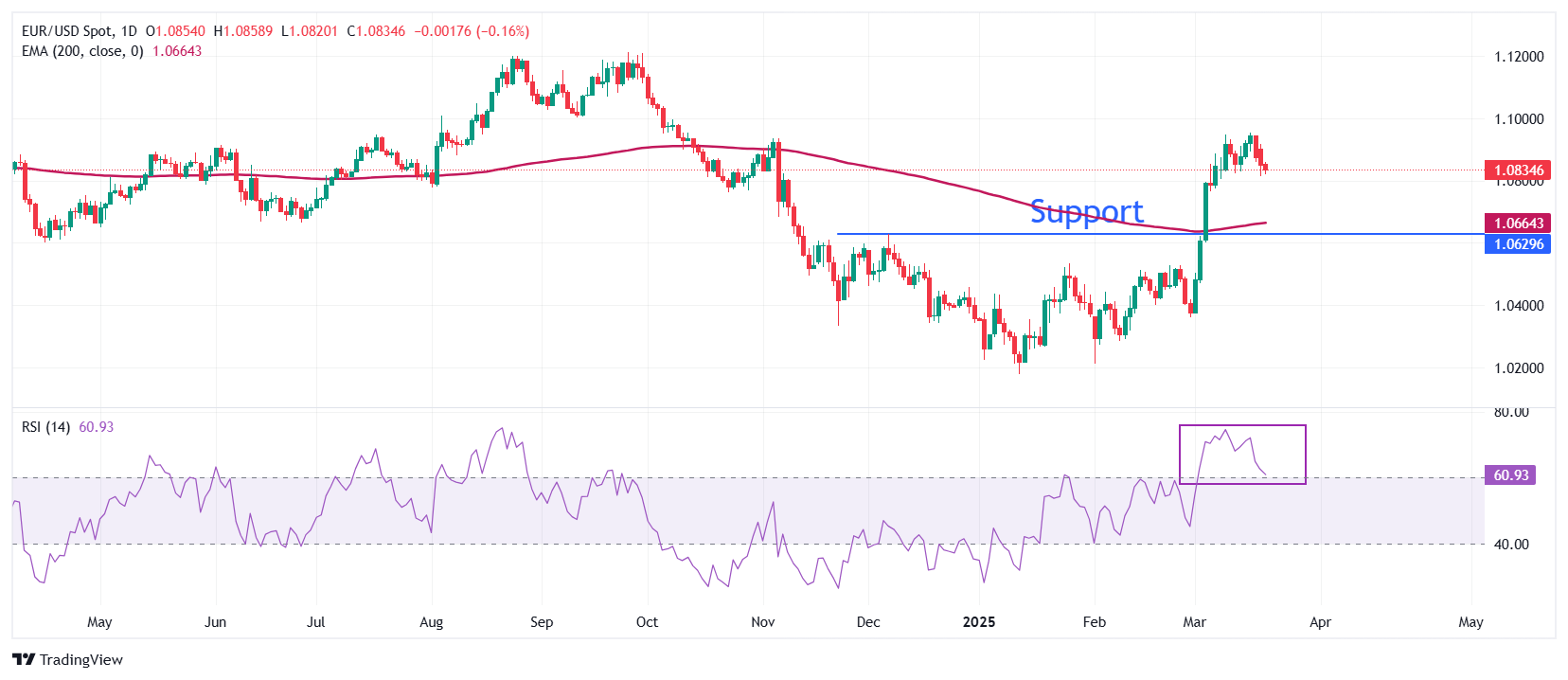
EUR/USD declines to near 1.0815 after failing to hold the key level of 1.0900. However, the long-term outlook of the major currency pair is still bullish as it holds above the 200-day Exponential Moving Average (EMA), which trades around 1.0664.
The pair strengthened after a decisive breakout above the December 6 high of 1.0630 on March 5.
The 14-day Relative Strength Index (RSI) cools down after turning overbought around 75.00, suggesting that the bullish momentum has moderated, but the upside bias remains intact.
Looking down, the December 6 high of 1.0630 will act as the major support zone for the pair. Conversely, the psychological level of 1.1000 will be the key barrier for the Euro bulls.
Fed FAQs
Monetary policy in the US is shaped by the Federal Reserve (Fed). The Fed has two mandates: to achieve price stability and foster full employment. Its primary tool to achieve these goals is by adjusting interest rates. When prices are rising too quickly and inflation is above the Fed’s 2% target, it raises interest rates, increasing borrowing costs throughout the economy. This results in a stronger US Dollar (USD) as it makes the US a more attractive place for international investors to park their money. When inflation falls below 2% or the Unemployment Rate is too high, the Fed may lower interest rates to encourage borrowing, which weighs on the Greenback.
The Federal Reserve (Fed) holds eight policy meetings a year, where the Federal Open Market Committee (FOMC) assesses economic conditions and makes monetary policy decisions. The FOMC is attended by twelve Fed officials – the seven members of the Board of Governors, the president of the Federal Reserve Bank of New York, and four of the remaining eleven regional Reserve Bank presidents, who serve one-year terms on a rotating basis.
In extreme situations, the Federal Reserve may resort to a policy named Quantitative Easing (QE). QE is the process by which the Fed substantially increases the flow of credit in a stuck financial system. It is a non-standard policy measure used during crises or when inflation is extremely low. It was the Fed’s weapon of choice during the Great Financial Crisis in 2008. It involves the Fed printing more Dollars and using them to buy high grade bonds from financial institutions. QE usually weakens the US Dollar.
Quantitative tightening (QT) is the reverse process of QE, whereby the Federal Reserve stops buying bonds from financial institutions and does not reinvest the principal from the bonds it holds maturing, to purchase new bonds. It is usually positive for the value of the US Dollar.
Author

Sagar Dua
FXStreet
Sagar Dua is associated with the financial markets from his college days. Along with pursuing post-graduation in Commerce in 2014, he started his markets training with chart analysis.

















