EUR/USD crashes below 1.16 as political turmoil in France, boost USD
- Euro hits eight-week low near 1.1540 after French PM Lecornu’s resignation fuels fiscal uncertainty and investor anxiety.
- German exports and imports disappoint; ECB minutes strike cautious tone amid persistent economic fragility.
- DXY climbs 1.7% this week as Fed officials stay wary on inflation and U.S. government shutdown drags into day nine.

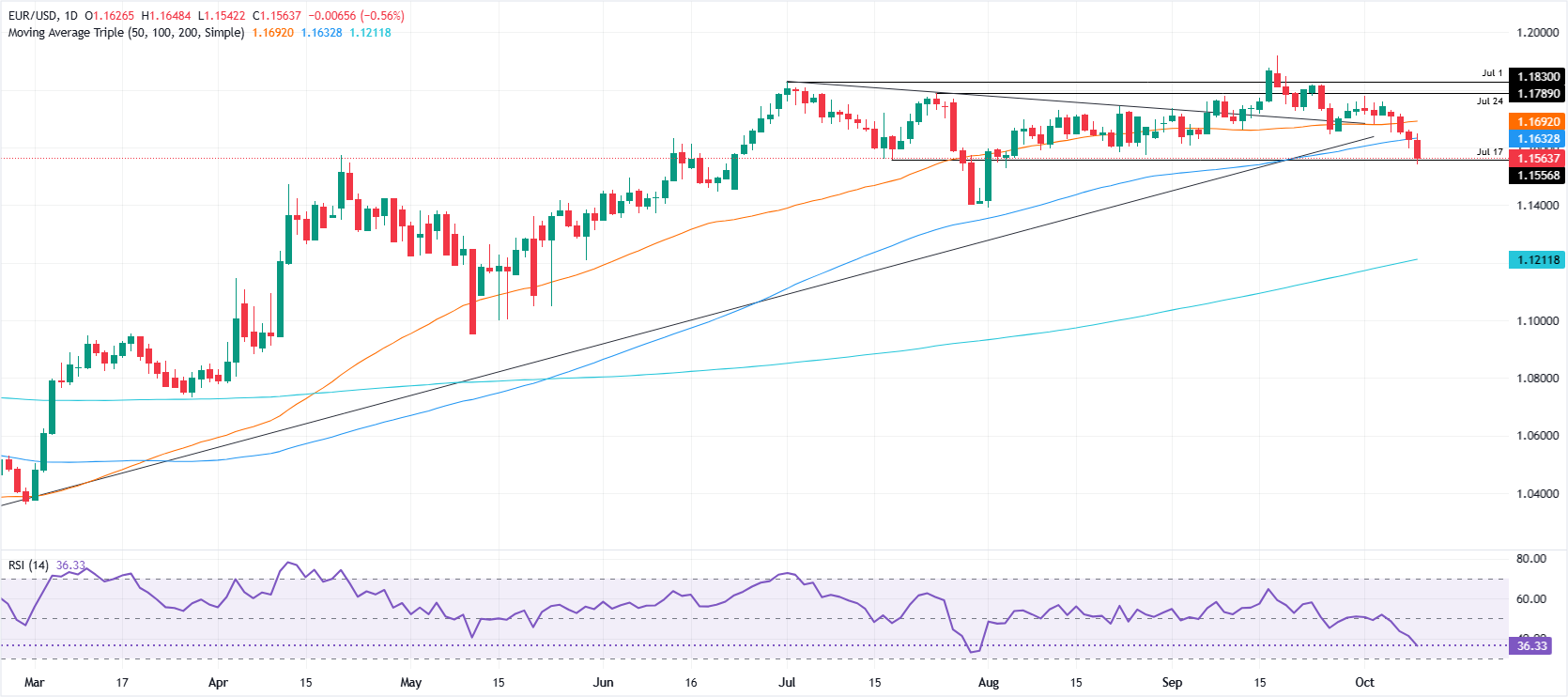
The EUR/USD tumbles below the 1.1600 figure, losing over 0.50% as the US Dollar extended its weekly rally, posting gains of more than 1.70% against a basket of six currencies, the DXY, sponsored by a risk-off mood. At the time of writing, the pair trades at 1.1563 after hitting a daily high of 1.1648.
Greenback extends rally as risk-off sentiment and soft German data pressure the shared currency
The Euro fell to an eight-week low of 1.1542 on Thursday amid the political turmoil in France. The resignation of the French Prime Minister Sebastien Lecornu keeps investors worried about the country’s fiscal deficit. Meanwhile, Lecornu continues to negotiate with the opposition, while President Emmanuel Macron would name a new PM by Friday.
German economic data showed that exports missed estimates and imports plunged more than expected. At the same time, the minutes of the latest European Central Bank meeting showed that officials are confident but adopted a cautious stance amid high uncertainty.
Across the pond, the US government shutdown hit to its ninth day. US House Minority Leader Jeffries suggested the absence of talks between House GOP and Democrats.
Meanwhile, Fed Governor Michael Barr remained slightly hawkish though said that tariffs would not spill over on services inflation and favors a cautious approach regarding further easing.
Minneapolis Fed President Neel Kashkari said that he “basically agrees” with everything that Fed Barr said.
Daily market movers: EUR/USD collapsed by the strength of the Dollar
- Minutes from the Fed revealed policymakers’ debate over the response to changing risks, while most officials warned about inflation, despite acknowledging job market risks. Officials were worried about protecting the labor market and favored easing policy “further over the remainder of this year.”
- Fed policymakers are evenly split regarding the fed funds rate, with nine of them favoring two cuts and Stephen Miren eyeing several more, while the remaining nine projecting one one or no further rate cuts.
- Fed Governor Michael Barr said that he does not think that there is a generalized spillover of tariffs on services inflation. He added that uncertainty about inflation and the jobs market warrants a cautious approach to additional rate cuts.
- Further comments by Fed Governor Michael Bar revealed that the current monetary policy is appropriate and rates are modestly restrictive. He sees Fed’s inflation goal facing significant risks and added that the recent data could show that Gross Domestic Product (GDP) remained strong in Q3 2025.
- New York Fed President John Williams said he supports additional interest rate cuts this year, citing the risk of a further slowdown in the labor market. His comments, published on Thursday in The New York Times, underscore growing concern among policymakers about softening employment conditions.
- The Minutes of the European Central Bank showed that policymakers saw no immediate need to adjust interest rates in September, viewing risks to inflation and growth as broadly balanced, according to minutes from the policy meeting released Thursday. The accounts noted that heightened uncertainty around global trade policies supported maintaining the current stance, allowing officials more time to gauge the full economic impact of tariffs.
- Money markets indicate that the Fed will cut interest rates by 25 basis points (bps) at the upcoming October 29 meeting. The odds stand at 94%, according to the Prime Market Terminal interest rate probability tool.
Technical outlook: EUR/USD collapses below 1.1600, eyes on 1.1500
The EUR/USD shifted downward biased in the short term, after diving below the 20-day Simple Moving Average (SMA) at 1.1644 and beneath 1.1600. The Relative Strength Index (RSI) is aiming towards its neutral line, meaning that sellers are gaining momentum.
The first key support would be 1.1550, followed by the 1.1500 mark. If surpassed, the next area of interest would be the August 1 cycle low at 1.1391.
On the upside, the EUR/USD first resistance would be 1.1600, followed by 1.1650 and 1.1700. A breach of the latter will expose 1.1800 and the July 1 high at 1.1830.
Euro FAQs
The Euro is the currency for the 19 European Union countries that belong to the Eurozone. It is the second most heavily traded currency in the world behind the US Dollar. In 2022, it accounted for 31% of all foreign exchange transactions, with an average daily turnover of over $2.2 trillion a day. EUR/USD is the most heavily traded currency pair in the world, accounting for an estimated 30% off all transactions, followed by EUR/JPY (4%), EUR/GBP (3%) and EUR/AUD (2%).
The European Central Bank (ECB) in Frankfurt, Germany, is the reserve bank for the Eurozone. The ECB sets interest rates and manages monetary policy. The ECB’s primary mandate is to maintain price stability, which means either controlling inflation or stimulating growth. Its primary tool is the raising or lowering of interest rates. Relatively high interest rates – or the expectation of higher rates – will usually benefit the Euro and vice versa. The ECB Governing Council makes monetary policy decisions at meetings held eight times a year. Decisions are made by heads of the Eurozone national banks and six permanent members, including the President of the ECB, Christine Lagarde.
Eurozone inflation data, measured by the Harmonized Index of Consumer Prices (HICP), is an important econometric for the Euro. If inflation rises more than expected, especially if above the ECB’s 2% target, it obliges the ECB to raise interest rates to bring it back under control. Relatively high interest rates compared to its counterparts will usually benefit the Euro, as it makes the region more attractive as a place for global investors to park their money.
Data releases gauge the health of the economy and can impact on the Euro. Indicators such as GDP, Manufacturing and Services PMIs, employment, and consumer sentiment surveys can all influence the direction of the single currency. A strong economy is good for the Euro. Not only does it attract more foreign investment but it may encourage the ECB to put up interest rates, which will directly strengthen the Euro. Otherwise, if economic data is weak, the Euro is likely to fall. Economic data for the four largest economies in the euro area (Germany, France, Italy and Spain) are especially significant, as they account for 75% of the Eurozone’s economy.
Another significant data release for the Euro is the Trade Balance. This indicator measures the difference between what a country earns from its exports and what it spends on imports over a given period. If a country produces highly sought after exports then its currency will gain in value purely from the extra demand created from foreign buyers seeking to purchase these goods. Therefore, a positive net Trade Balance strengthens a currency and vice versa for a negative balance.
Author

Christian Borjon Valencia
FXStreet
Markets analyst, news editor, and trading instructor with over 14 years of experience across FX, commodities, US equity indices, and global macro markets.