EUR/USD refreshes six-month low on Trump's victory, German political collapse
- EUR/USD weakens as investors await a slew of Fed speakers for fresh interest rate guidance.
- The Euro declines as Trump’s policies are expected to weigh on the Eurozone’s exports.
- This week, investors will focus on the US inflation data for October.

EUR/USD posts a fresh six-month low near 1.0650 in Monday’s North American session. The major currency pair weakens as the election of Republican Donald Trump as US President has strengthened the US Dollar’s (USD) outlook in the long run. The US Dollar Index (DXY), which gauges Greenback’s value against six major currencies, climbs above 105.30.
Trump vowed to raise import tariffs and lower taxes in his election campaign, which would add to United States (US) inflationary pressures and boost debt levels. According to a November 6-7 Reuters poll, 62% of respondents – including 94% of Democrats and 34% of Republicans – said that Trump's policies likely "will push the US national debt higher."
Trump's tax cut proposals could add $7.5 trillion to the nation's debt over the next decade, according to the nonpartisan Committee for a Responsible Federal Budget.
This week, investors will pay close attention to speeches from a slew of Federal Reserve (Fed) officials to get fresh cues about the likely monetary policy action in December. According to the CME FedWatch tool, there is a 65% chance that the central bank will cut interest rates again by 25 basis points (bps) to 4.25%-4.50% in December. This would be the second quarter-to-a-percent interest rate cut by the Fed in a row, as it also reduced its key borrowing rates last week.
On the economic front, investors will focus on the US Consumer Price Index (CPI) data for October, which will be published on Wednesday. The impact of the inflation data is expected to be nominal on the interest rate outlook as Fed officials are confident about the disinflation trend towards the bank’s target of 2%. However, a significant deviation from the consensus could impact the same.
Daily digest market movers: EUR/USD has been hit hard by Euro's weakness
- EUR/USD remains on tenterhooks as the Euro’s (EUR) outlook is uncertain due to expectations of a global trade war after Trump’s victory in the US presidential election. In the election campaign, Trump warned that the European bloc would have to pay a big price for not buying enough American exports.
- The impact of Trump’s victory is noticeable on European economic leaders. Speaking at the European Union (EU) Summit on Friday, former European Central Bank (ECB) President Mario Draghi said, "The sense of urgency today is greater than it was a week ago," Reuters reported.
- Domestic problems in the Eurozone’s major members have also weakened the Euro’s appeal. The collapse of the German three-party coalition has come at a time when the economy is going through a rough phase. The nation managed to dodge a technical recession after expanding surprisingly by 0.2% quarterly in Q3, according to data released by the Federal Statistics Office of Germany on October 30. However, political uncertainty could lead to postponement of government spending and investments.
- Meanwhile, investors look for fresh cues about the ECB’s likely interest rate action in the December meeting. ECB policymaker and head of Austrian National Bank Robert Holzmann said there is no reason for the central bank to not cut interest rates next month at current point of time, however, the decision will be based on the economic data, which will be available in December.
Euro PRICE Today
The table below shows the percentage change of Euro (EUR) against listed major currencies today. Euro was the strongest against the Japanese Yen.
| USD | EUR | GBP | JPY | CAD | AUD | NZD | CHF | |
|---|---|---|---|---|---|---|---|---|
| USD | 0.67% | 0.43% | 0.72% | 0.34% | 0.19% | 0.09% | 0.45% | |
| EUR | -0.67% | -0.27% | 0.15% | -0.23% | -0.40% | -0.49% | -0.15% | |
| GBP | -0.43% | 0.27% | 0.34% | 0.05% | -0.12% | -0.21% | 0.13% | |
| JPY | -0.72% | -0.15% | -0.34% | -0.38% | -0.61% | -0.53% | -0.27% | |
| CAD | -0.34% | 0.23% | -0.05% | 0.38% | -0.10% | -0.26% | 0.08% | |
| AUD | -0.19% | 0.40% | 0.12% | 0.61% | 0.10% | -0.12% | 0.25% | |
| NZD | -0.09% | 0.49% | 0.21% | 0.53% | 0.26% | 0.12% | 0.34% | |
| CHF | -0.45% | 0.15% | -0.13% | 0.27% | -0.08% | -0.25% | -0.34% |
The heat map shows percentage changes of major currencies against each other. The base currency is picked from the left column, while the quote currency is picked from the top row. For example, if you pick the Euro from the left column and move along the horizontal line to the US Dollar, the percentage change displayed in the box will represent EUR (base)/USD (quote).
Technical Analysis: EUR/USD posts fresh six-month low around 1.0650
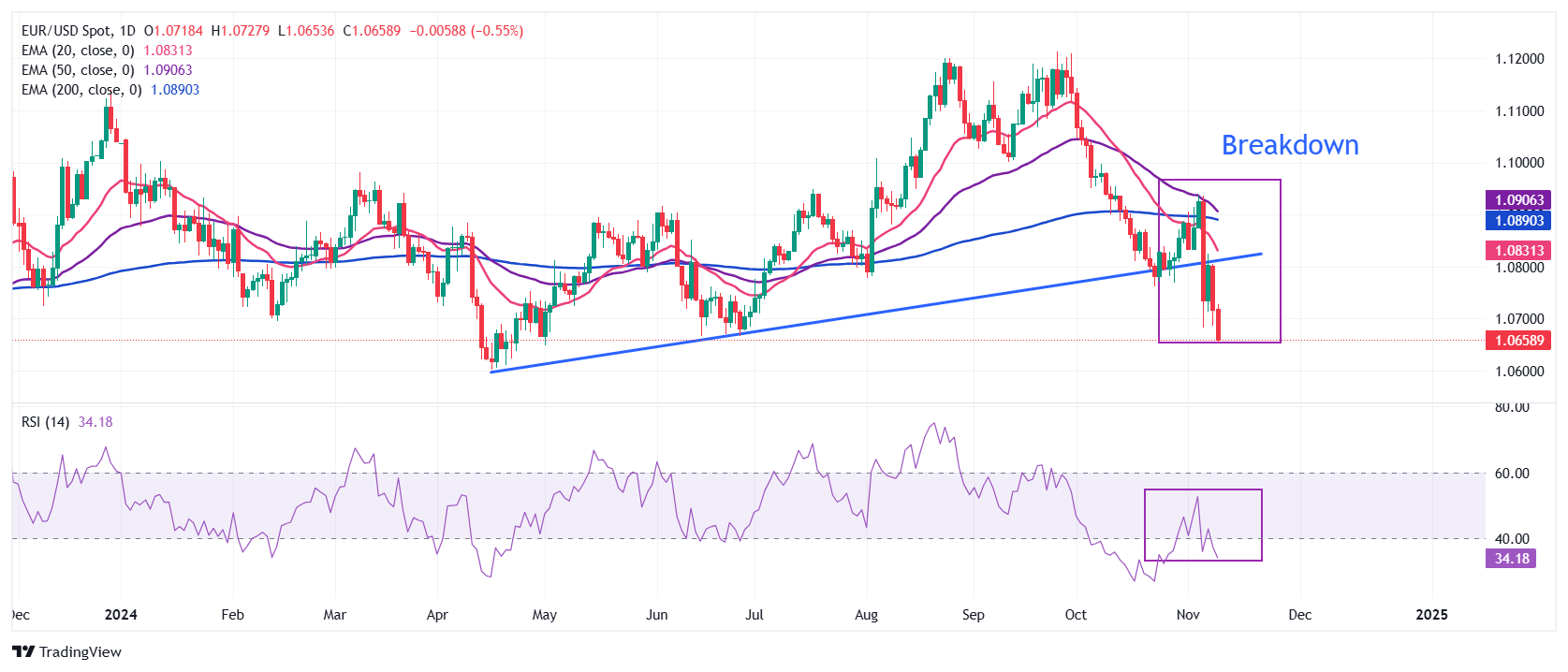
EUR/USD declines to a fresh more than six-month low around 1.0650. The near-term trend of the major currency pair remains bearish as the 20-day and 50-day Exponential Moving Averages (EMAs) near 1.0840 and 1.0910, respectively, continue to decline.
The 14-day Relative Strength Index (RSI) slides 40.00, adds to expectations of more weakness ahead.
The upward-sloping trendline around 1.0800, plotted from the April 16 low at around 1.0600, will act as a key resistance zone for Euro (EUR) bulls. Looking down, the shared currency pair could decline to the year-to-date (YTD) low of 1.0600.
(This story was corrected on November 11 at 11:33 GMT to say that the US CPI data for October will be published on Wednesday, not Thursday.)
Fed FAQs
Monetary policy in the US is shaped by the Federal Reserve (Fed). The Fed has two mandates: to achieve price stability and foster full employment. Its primary tool to achieve these goals is by adjusting interest rates. When prices are rising too quickly and inflation is above the Fed’s 2% target, it raises interest rates, increasing borrowing costs throughout the economy. This results in a stronger US Dollar (USD) as it makes the US a more attractive place for international investors to park their money. When inflation falls below 2% or the Unemployment Rate is too high, the Fed may lower interest rates to encourage borrowing, which weighs on the Greenback.
The Federal Reserve (Fed) holds eight policy meetings a year, where the Federal Open Market Committee (FOMC) assesses economic conditions and makes monetary policy decisions. The FOMC is attended by twelve Fed officials – the seven members of the Board of Governors, the president of the Federal Reserve Bank of New York, and four of the remaining eleven regional Reserve Bank presidents, who serve one-year terms on a rotating basis.
In extreme situations, the Federal Reserve may resort to a policy named Quantitative Easing (QE). QE is the process by which the Fed substantially increases the flow of credit in a stuck financial system. It is a non-standard policy measure used during crises or when inflation is extremely low. It was the Fed’s weapon of choice during the Great Financial Crisis in 2008. It involves the Fed printing more Dollars and using them to buy high grade bonds from financial institutions. QE usually weakens the US Dollar.
Quantitative tightening (QT) is the reverse process of QE, whereby the Federal Reserve stops buying bonds from financial institutions and does not reinvest the principal from the bonds it holds maturing, to purchase new bonds. It is usually positive for the value of the US Dollar.
Author

Sagar Dua
FXStreet
Sagar Dua is associated with the financial markets from his college days. Along with pursuing post-graduation in Commerce in 2014, he started his markets training with chart analysis.