EUR/USD climbs as weak US jobs data fuels Fed cut bets
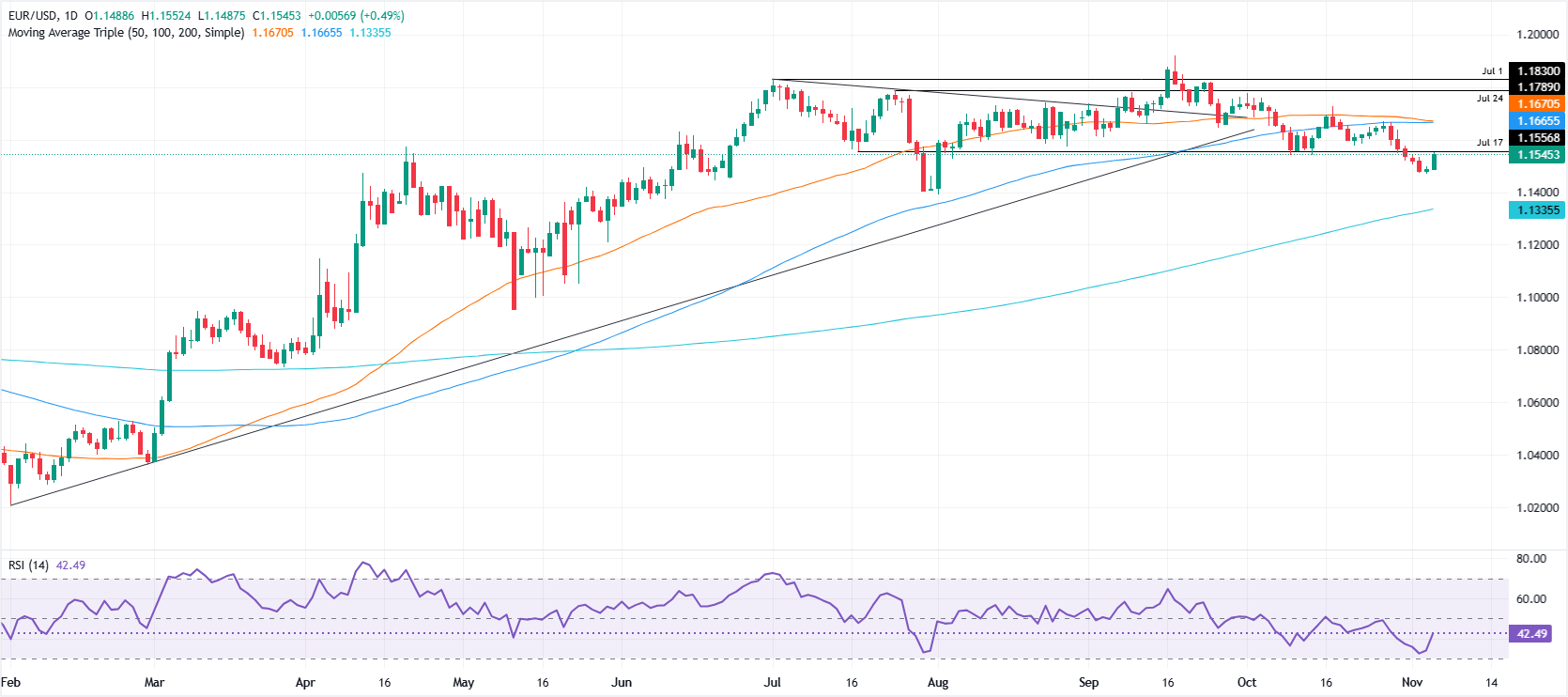
- EUR/USD rises 0.45% to 1.1545 after rebounding from daily lows near 1.1486 amid broad USD weakness.
- Challenger report shows 150K US job cuts in October, the sharpest monthly decline in two decades.
- Fed officials maintain dovish to neutral tone as traders price in higher odds of a December rate cut.

EUR/USD recovers some ground on Thursday, post gains of 0.45% after bouncing off daily lows of 1.1486 as the Greenback weakened. A soft jobs data in the US increased speculation for a Fed rate cut at the December meeting. The pair trades at 1.1545 at the time of writing.
Euro rebounds above 1.15 as soft US employment figures and government shutdown weigh on Dollar sentiment
The US government shutdown keeps traders leaning on private companies releasing economic data, as was the case during the day. The Challenger report showed that employers cut over 150K jobs in October, the largest reduction for the month in 20 years, revealed Gray & Christmas. Consequently, money markets set their expectations that the Fed would continue to ease policy at the December meeting.
A bunch of Federal Reserve officials crossed the wires, led by regional Fed Presidents Beth Hammack of Cleveland, New York John Williams and Chicago’s Austan Goolsbee. Additionally, Fed Governors Stephen Miran and Michael Barr, kept their dovish and neutral stances, respectively.
In Europe, Retail Sales for the Eurozone (EZ) missed estimates of a 0.2% MoM increase, contracted by 0.1%. In the twelve months to September, Sales dipped from 1.6% in August to 1% YoY, revealed Eurostat.
Euro Price This week
The table below shows the percentage change of Euro (EUR) against listed major currencies this week. Euro was the strongest against the New Zealand Dollar.
| USD | EUR | GBP | JPY | CAD | AUD | NZD | CHF | |
|---|---|---|---|---|---|---|---|---|
| USD | -0.11% | -0.01% | -0.66% | 0.70% | 1.04% | 1.61% | 0.22% | |
| EUR | 0.11% | 0.13% | -0.46% | 0.83% | 1.15% | 1.73% | 0.33% | |
| GBP | 0.00% | -0.13% | -0.74% | 0.68% | 1.01% | 1.59% | 0.22% | |
| JPY | 0.66% | 0.46% | 0.74% | 1.34% | 1.68% | 2.24% | 1.01% | |
| CAD | -0.70% | -0.83% | -0.68% | -1.34% | 0.25% | 0.88% | -0.49% | |
| AUD | -1.04% | -1.15% | -1.01% | -1.68% | -0.25% | 0.57% | -0.80% | |
| NZD | -1.61% | -1.73% | -1.59% | -2.24% | -0.88% | -0.57% | -1.35% | |
| CHF | -0.22% | -0.33% | -0.22% | -1.01% | 0.49% | 0.80% | 1.35% |
The heat map shows percentage changes of major currencies against each other. The base currency is picked from the left column, while the quote currency is picked from the top row. For example, if you pick the Euro from the left column and move along the horizontal line to the US Dollar, the percentage change displayed in the box will represent EUR (base)/USD (quote).
Daily digest market movers: Euro surges on US Dollar weakness
- The US Dollar Index (DXY), which tracks the performance of the American currency against other six, slumps 0.42% down to 99.73.
- Cleveland Fed President Beth Hammack said it is “not obvious” the Fed should cut rates again given current inflation levels, noting that financial conditions remain accommodative. She added that despite that the labor market appears fragile, she expects the unemployment rate to diminish.
- Fed Governor Michael Barr said inflation progress has been made “but there is still work to do,” emphasizing that the central bank must ensure the job market remains solid.
- New York Fed President John Williams remarked that the natural rate of interest is difficult to pinpoint, with model-based estimates for the US neutral rate hovering near 1%.
- Chicago Fed President Austan Goolsbee added that the lack of official inflation data during the government shutdown “accentuates” his caution toward additional rate cuts.
Technical outlook: EUR/USD to remain sideways below 1.1600
EUR/USD reclaimed the 1.1500 milestone on Thursday, poised to test the 20-day Simple Moving Average (SMA) at 1.1591 ahead of 1.1600. Although the Relative Strength Index (RSI) is aiming upwards, remains beneath its neutral level, an indication that sellers are in charge.
However, if EUR/USD rises past 1.1600, buyers could test 1.1700. On the flip side, the path of least resistance, the first support would be the 1.1500. A breach of the latter will expose .1450, followed by 1.1400. A decisive break below these levels would expose the August 1 low at 1.1391 and the 200-day Simple Moving Average (SMA) near 1.1344.
Euro FAQs
The Euro is the currency for the 20 European Union countries that belong to the Eurozone. It is the second most heavily traded currency in the world behind the US Dollar. In 2022, it accounted for 31% of all foreign exchange transactions, with an average daily turnover of over $2.2 trillion a day. EUR/USD is the most heavily traded currency pair in the world, accounting for an estimated 30% off all transactions, followed by EUR/JPY (4%), EUR/GBP (3%) and EUR/AUD (2%).
The European Central Bank (ECB) in Frankfurt, Germany, is the reserve bank for the Eurozone. The ECB sets interest rates and manages monetary policy. The ECB’s primary mandate is to maintain price stability, which means either controlling inflation or stimulating growth. Its primary tool is the raising or lowering of interest rates. Relatively high interest rates – or the expectation of higher rates – will usually benefit the Euro and vice versa. The ECB Governing Council makes monetary policy decisions at meetings held eight times a year. Decisions are made by heads of the Eurozone national banks and six permanent members, including the President of the ECB, Christine Lagarde.
Eurozone inflation data, measured by the Harmonized Index of Consumer Prices (HICP), is an important econometric for the Euro. If inflation rises more than expected, especially if above the ECB’s 2% target, it obliges the ECB to raise interest rates to bring it back under control. Relatively high interest rates compared to its counterparts will usually benefit the Euro, as it makes the region more attractive as a place for global investors to park their money.
Data releases gauge the health of the economy and can impact on the Euro. Indicators such as GDP, Manufacturing and Services PMIs, employment, and consumer sentiment surveys can all influence the direction of the single currency. A strong economy is good for the Euro. Not only does it attract more foreign investment but it may encourage the ECB to put up interest rates, which will directly strengthen the Euro. Otherwise, if economic data is weak, the Euro is likely to fall. Economic data for the four largest economies in the euro area (Germany, France, Italy and Spain) are especially significant, as they account for 75% of the Eurozone’s economy.
Another significant data release for the Euro is the Trade Balance. This indicator measures the difference between what a country earns from its exports and what it spends on imports over a given period. If a country produces highly sought after exports then its currency will gain in value purely from the extra demand created from foreign buyers seeking to purchase these goods. Therefore, a positive net Trade Balance strengthens a currency and vice versa for a negative balance.
Author

Christian Borjon Valencia
FXStreet
Markets analyst, news editor, and trading instructor with over 14 years of experience across FX, commodities, US equity indices, and global macro markets.