EUR/USD climbs above 1.16 as Powell’s neutral tone weigh on Dollar
- Fed’s Powell signals “meeting-by-meeting” stance, says labor risks outweigh inflation pressures for now.
- France suspends pension reform amid political unrest, offering temporary relief to Euro sentiment.
- Dollar weakens as Sino-US trade tensions flare and business sentiment in the US deteriorates further.

EUR/USD recovers some ground on Tuesday as the Greenback weakens post neutral-dovish remarks by Fed Chair Jerome Powell and as the French government announced a suspension of a pension reform. The pair trades at 1.1606 up 0.32%.
Euro rebounds after Fed Chair signals caution and France suspends contentious pension overhaul
Euro’s gain was mainly sponsored by a neutral-dovish tilt by Powell, who said that the economy is in a low-hiring, low-firing trend, yet acknowledged that risks to the labor market had increased, compared to inflation. He added that the economy is firmer than expected, and reassured the central bank is on a meeting-by-meeting approach.
Boston Fed Susan Collins was slightly hawkish as she said inflation continues to be top of mind, adding that even with some additional easing, policy would remain “mildly restrictive.”
US-China tensions, ignited the Dollar’s sell-off on Tuesday, as US President Donald Trump harsh rhetoric towards Beijing, is triggering a reaction by Chinese authorities, which added port fees on US vessels.
Data-wise, the docket in the US revealed that business sentiment deteriorated. Across the pond, steady German inflation figures and deterioration of the ZEW Survey of Expectations in the Eurozone, exerted downward pressure in the pair, which the shared currency shrugged off late in the day.
Meanwhile, the European Central Bank President Christine Lagarde reiterated that monetary policy is in good place, while Villeroy stressed that the next move in the bank is more likely a cut than a hike.
Daily market movers: Euro boosted by a weak US Dollar
- Fed Chair Jerome Powell said the outlook for employment and inflation has “not changed much” since the September policy meeting, noting that recent data suggest economic activity may be firmer than expected. He added that risks to the labor market have risen alongside inflationary pressures.
- Powell attributed elevated inflation mainly to higher goods prices, emphasizing that the increase reflects the impact of tariffs rather than broader inflationary trends.
- Boston Fed Susan Collins said that inflation should begin to ease as tariff impact fades. She acknowledged that downside risks to the labor market had risen, but noted favorable financial conditions would support households.
- The Fed will receive an update on consumer price inflation on October 24. The US. Bureau of Labor Statistics announced that it will release its latest Consumer Price Index (CPI) report amid the ongoing shutdown.
- The US Dollar Index (DXY), which tracks the performance of the buck’s value against a basket of six currencies, sheds 0.25% of its value, down at 99.00.
- The NFIB Business Optimism Index tumbled 2.0 points to 98.8 last month, the first decline in three months. The NFIB Uncertainty Index jumped 7 points from August to 100, the fourth highest reading in over 51 years.
- Money markets are fully pricing in a 25-basis-point rate cut at the Fed’s October 29 meeting, with odds at 97%, according to the Prime Market Terminal probability tool.
- Germany's ZEW saw Economic Sentiment fall shy of expectations, 39.3, below estimates of 41 but above the previous reading of 37.3 . Current Conditions unexpectedly worsened to -80.0, worse than the previous month -76.4, and missing forecasts for an improvement to -74.8. The ZEW President commented that "Hopes for a medium-term recovery remain".
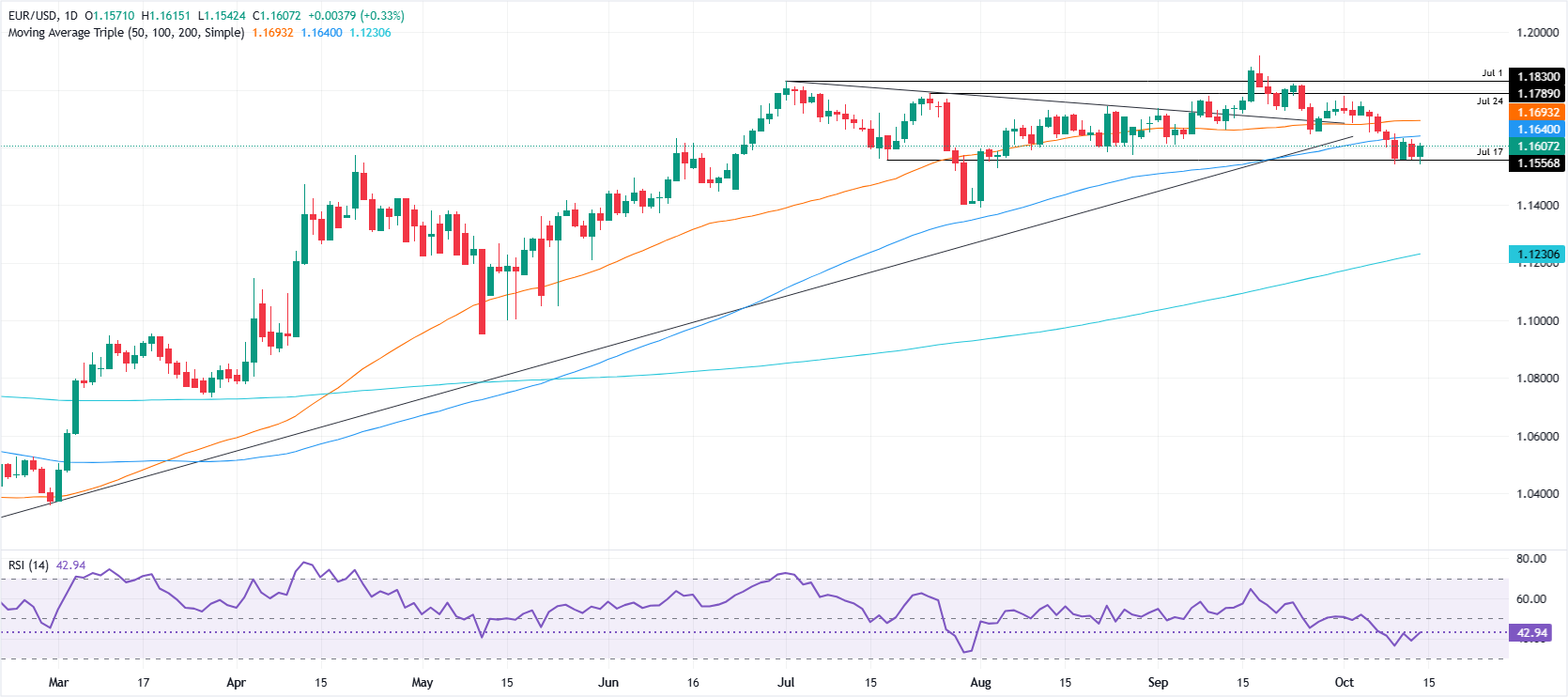
Technical outlook: EUR/USD reclaims 1.1600, yet it remains bearish
The EUR/USD technical picture improved on Tuesday, yet the pair remains neutral to downward biased as it remains below the 100-day Simple Moving Average (SMA) at 1.1641. Last Friday, the Relative Strength Index (RSI) drifted below the neutral 50 level, suggesting that downside momentum is gaining steam.
Key support lies at 1.1600, followed by 1.1550, and by 1.1500. A breach of the latter exposes the August 1 cycle low around 1.1391. Conversely, major resistance is seen at 1.1650 and 1.1700. A decisive move above 1.1700 could pave the way for a test of 1.1800 and the July 1 high at 1.1830.
Euro FAQs
The Euro is the currency for the 19 European Union countries that belong to the Eurozone. It is the second most heavily traded currency in the world behind the US Dollar. In 2022, it accounted for 31% of all foreign exchange transactions, with an average daily turnover of over $2.2 trillion a day. EUR/USD is the most heavily traded currency pair in the world, accounting for an estimated 30% off all transactions, followed by EUR/JPY (4%), EUR/GBP (3%) and EUR/AUD (2%).
The European Central Bank (ECB) in Frankfurt, Germany, is the reserve bank for the Eurozone. The ECB sets interest rates and manages monetary policy. The ECB’s primary mandate is to maintain price stability, which means either controlling inflation or stimulating growth. Its primary tool is the raising or lowering of interest rates. Relatively high interest rates – or the expectation of higher rates – will usually benefit the Euro and vice versa. The ECB Governing Council makes monetary policy decisions at meetings held eight times a year. Decisions are made by heads of the Eurozone national banks and six permanent members, including the President of the ECB, Christine Lagarde.
Eurozone inflation data, measured by the Harmonized Index of Consumer Prices (HICP), is an important econometric for the Euro. If inflation rises more than expected, especially if above the ECB’s 2% target, it obliges the ECB to raise interest rates to bring it back under control. Relatively high interest rates compared to its counterparts will usually benefit the Euro, as it makes the region more attractive as a place for global investors to park their money.
Data releases gauge the health of the economy and can impact on the Euro. Indicators such as GDP, Manufacturing and Services PMIs, employment, and consumer sentiment surveys can all influence the direction of the single currency. A strong economy is good for the Euro. Not only does it attract more foreign investment but it may encourage the ECB to put up interest rates, which will directly strengthen the Euro. Otherwise, if economic data is weak, the Euro is likely to fall. Economic data for the four largest economies in the euro area (Germany, France, Italy and Spain) are especially significant, as they account for 75% of the Eurozone’s economy.
Another significant data release for the Euro is the Trade Balance. This indicator measures the difference between what a country earns from its exports and what it spends on imports over a given period. If a country produces highly sought after exports then its currency will gain in value purely from the extra demand created from foreign buyers seeking to purchase these goods. Therefore, a positive net Trade Balance strengthens a currency and vice versa for a negative balance.
Author

Christian Borjon Valencia
FXStreet
Markets analyst, news editor, and trading instructor with over 14 years of experience across FX, commodities, US equity indices, and global macro markets.