EUR/USD breaks lower prior to Fed meeting
- EUR/USD descends into mid 1.0800s ahead of Wednesday’s key Fed meeting.
- Speculation is mounting that the Fed could alter how many interest rate cuts it expects to make in 2024.
- ECB Vice-President De Guindos sees services inflation still too high for a rate cut.


EUR/USD declines by five hundredths of a percent into the mid 1.0800s on Tuesday, before the big event of the week in Forex, the Federal Reserve’s (Fed) March meeting policy announcement.
Although the Fed is not expected to change its interest rates at the meeting, there is a chance it could change its accompanying statement and forecasts. This could alter the outlook for interest rates and therefore the US Dollar (USD) valuation.
Interest rates, set by central banks, are a key driver for foreign exchange markets. Higher interest rates tend to support a currency by attracting greater inflows of foreign capital with the opposite being the tendency for lower rates.
EUR/USD weakens as investors monetary policy expectations change
EUR/USD downside over recent days has mainly been driven by renewed US Dollar strength, on the back of a combination of rising expectations there will be a delay in the Fed cutting interest rates and that there may be fewer cuts overall in 2024.
Speculation is mounting that the Federal Reserve will revise the forecasts in its accompanying notes to the meeting, the Summary of Economic Projections (SEP). In the previous SEP, Fed officials forecast three 25 basis points (0.25%) rate cuts in 2024 but some analysts now think there is a material risk that this could be revised down to two 25 bps cuts to reflect inflationary pressures remaining elevated. A revision down to two cuts could pressure EUR/USD lower.
“The summary of economic projections will be updated and contains hawkish risks in our assessment with the committee potentially projecting fewer cuts in 2024,” says David Doyle, head of economics at Macquarie, in a note about the Fed meeting.
The market continues to see June as the first month when the Fed is more likely than not to make its first interest rate cut, but over the last few days July has gained in popularity. Current market-based probabilities, based on the CME FedWatch Tool, favor one or more cuts by June with a 55.1% chance, and by July with a 73.7% probability. The June figure has been trending down.
“Our view on FOMC policy remains that the first 25 bps cut will occur in July,” says Macquarie’s Doyle. “ In 2024 we anticipate 50 bps of cuts and a further 50 bps in 2025,” he adds.
Services inflation too high says De Guindos
In Europe, a similar debate is going on about when to begin cutting interest rates. On Tuesday, Vice-President of the European Central Bank (ECB), Luis de Guindos, said “we have to wait,” because “services inflation” remains too high.
De Guindos said he thought June was the right time to review cutting interest rates. His views fall in line with that of the ECB President Christine Lagarde and several other officials.
Although a faction within the ECB led by Francois Villeroy de Galhau appeared to be pushing for a spring rate cut earlier in the month, they appear to be outnumbered by officials favoring June.
The EUR/USD seemed to find some support on Monday after the Eurozone Trade Balance data showed a healthy surplus for the region, and final revisions for inflation data for February came out in line with flash estimates.
Data out on Tuesday is unlikely to move the dial much. In Europe, German and Eurozone ZEW Survey results are scheduled for publication. In the US, Building Permits (a leading indicator) and Housing Starts will be released later in the day.
Technical Analysis: EUR/USD falls below key level, now vulnerable to more declines
EUR/USD penetrates below the level of the 1.0867 swing lows on Tuesday, and by doing so probably reverses the direction of the short-term uptrend. Now the odds favor more losses.
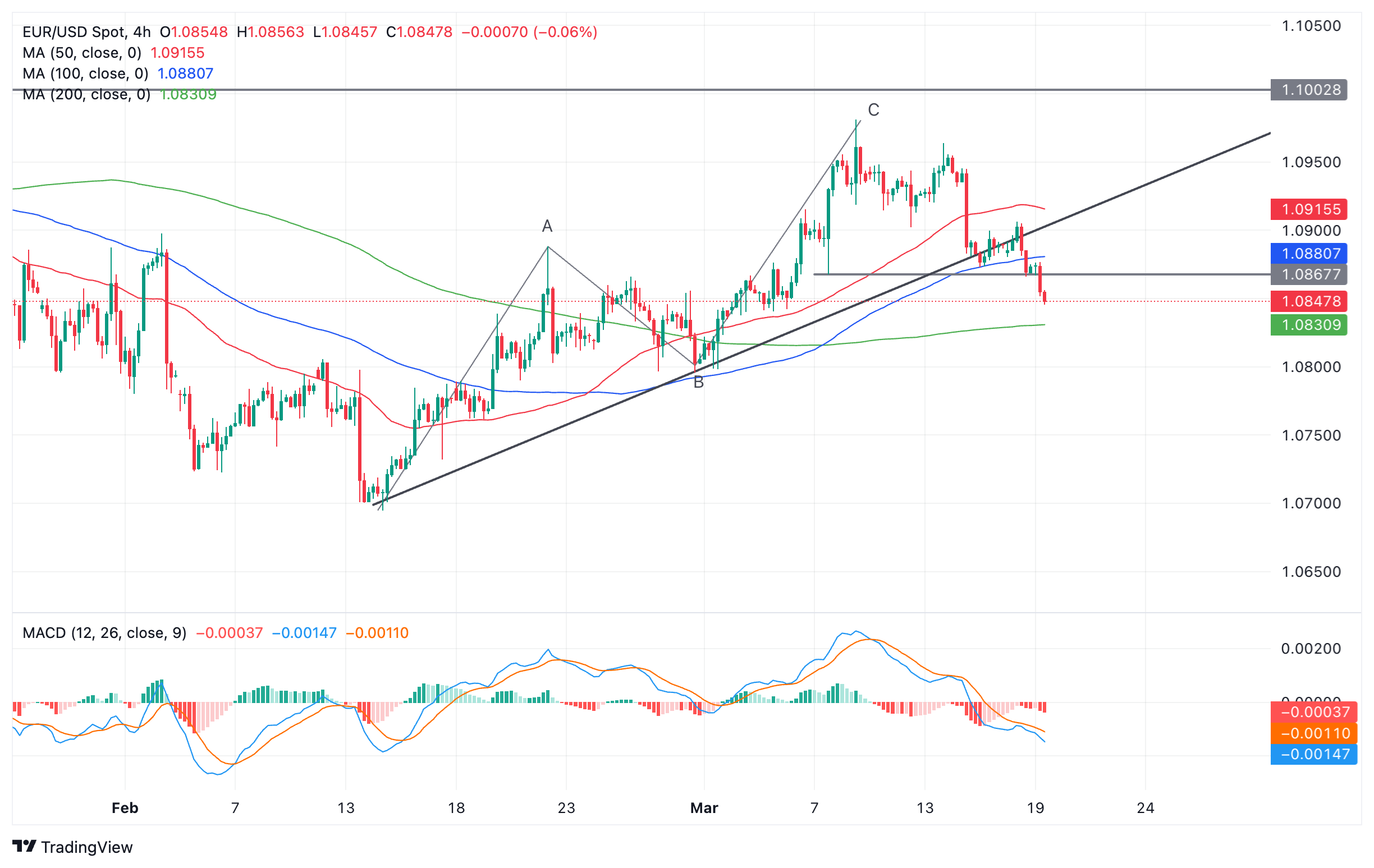
Euro versus US Dollar: 4-hour chart
A new series of declining peaks and troughs has begun since the March 8 highs. Subject to fundamentals, the price will probably continue to fall to the next key support level at roughly 1.0800 – the lows of wave B of the Measured Move that unfolded in February and early March.
The daily chart below is showing the Moving Average Convergence/ Divergence (MACD) momentum indicator crossing over the signal line, giving a bearish sell signal, and adding further evidence to a change of trend.
However, it is also flagging up a few key barriers to progress lower in the form of dynamic support from the red 50-day and then the green 200-day Simple Moving Averages (SMA).
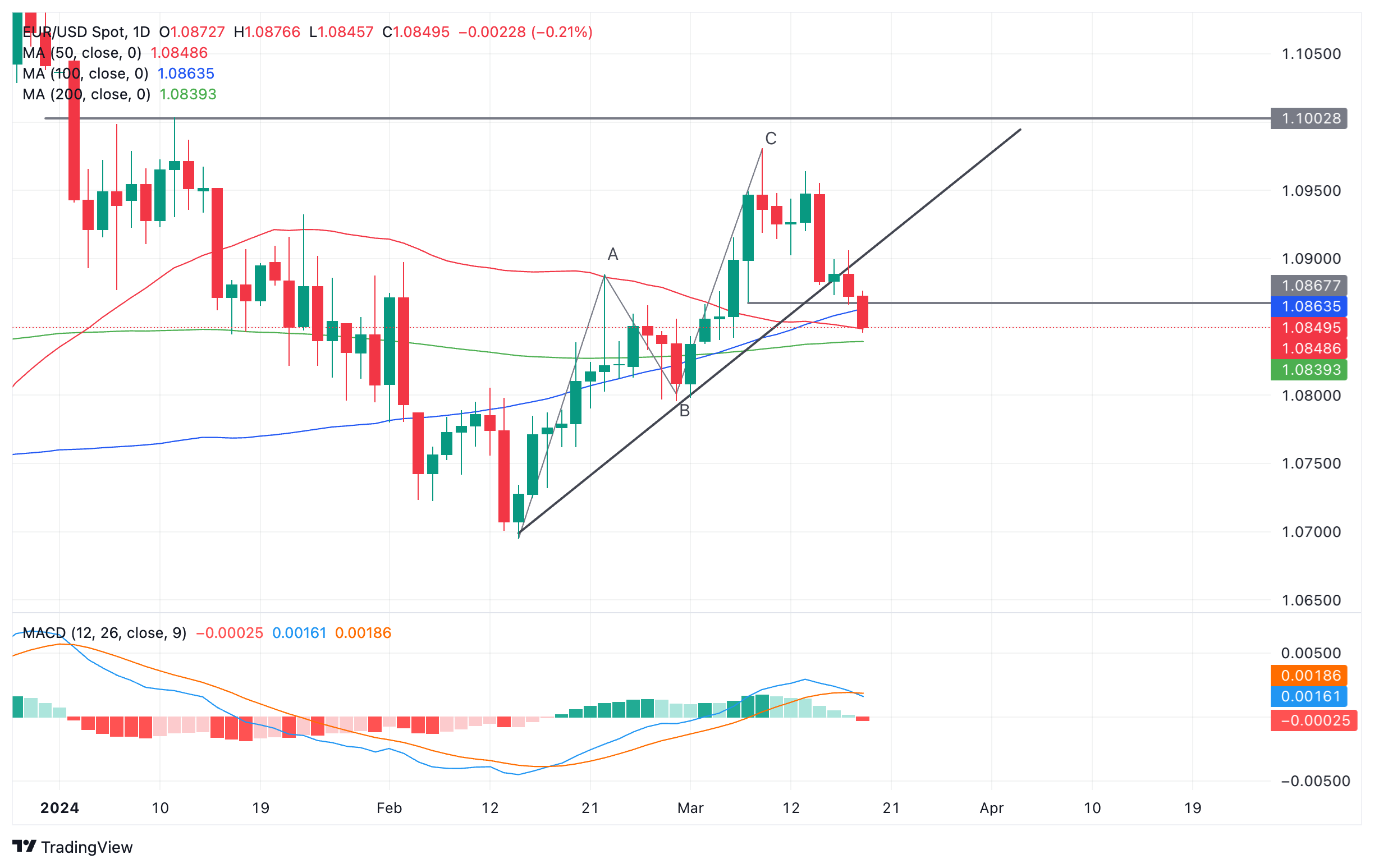
Euro versus US Dollar: Daily chart
The 50-day SMA is situated at 1.0848 and the 200-day SMA at 1.0839 and both are likely to be tough support levels to crack. Whether bears can push through, may well depend on the outcome of the up-and-coming Fed meeting.
Euro FAQs
The Euro is the currency for the 20 European Union countries that belong to the Eurozone. It is the second most heavily traded currency in the world behind the US Dollar. In 2022, it accounted for 31% of all foreign exchange transactions, with an average daily turnover of over $2.2 trillion a day. EUR/USD is the most heavily traded currency pair in the world, accounting for an estimated 30% off all transactions, followed by EUR/JPY (4%), EUR/GBP (3%) and EUR/AUD (2%).
The European Central Bank (ECB) in Frankfurt, Germany, is the reserve bank for the Eurozone. The ECB sets interest rates and manages monetary policy. The ECB’s primary mandate is to maintain price stability, which means either controlling inflation or stimulating growth. Its primary tool is the raising or lowering of interest rates. Relatively high interest rates – or the expectation of higher rates – will usually benefit the Euro and vice versa. The ECB Governing Council makes monetary policy decisions at meetings held eight times a year. Decisions are made by heads of the Eurozone national banks and six permanent members, including the President of the ECB, Christine Lagarde.
Eurozone inflation data, measured by the Harmonized Index of Consumer Prices (HICP), is an important econometric for the Euro. If inflation rises more than expected, especially if above the ECB’s 2% target, it obliges the ECB to raise interest rates to bring it back under control. Relatively high interest rates compared to its counterparts will usually benefit the Euro, as it makes the region more attractive as a place for global investors to park their money.
Data releases gauge the health of the economy and can impact on the Euro. Indicators such as GDP, Manufacturing and Services PMIs, employment, and consumer sentiment surveys can all influence the direction of the single currency. A strong economy is good for the Euro. Not only does it attract more foreign investment but it may encourage the ECB to put up interest rates, which will directly strengthen the Euro. Otherwise, if economic data is weak, the Euro is likely to fall. Economic data for the four largest economies in the euro area (Germany, France, Italy and Spain) are especially significant, as they account for 75% of the Eurozone’s economy.
Another significant data release for the Euro is the Trade Balance. This indicator measures the difference between what a country earns from its exports and what it spends on imports over a given period. If a country produces highly sought after exports then its currency will gain in value purely from the extra demand created from foreign buyers seeking to purchase these goods. Therefore, a positive net Trade Balance strengthens a currency and vice versa for a negative balance.
Author
Joaquin Monfort
FXStreet
Joaquin Monfort is a financial writer and analyst with over 10 years experience writing about financial markets and alt data. He holds a degree in Anthropology from London University and a Diploma in Technical analysis.