|

EUR/JPY Price Analysis: Hits two-day high around the Kumo but remains bearish

  • EUR/JPY hovers at around 157.30s, after rallying close to 1%, stalls at confluence of resistance levels.
  • Failure to break above 157.70 would pave the way to re-test 154.00.

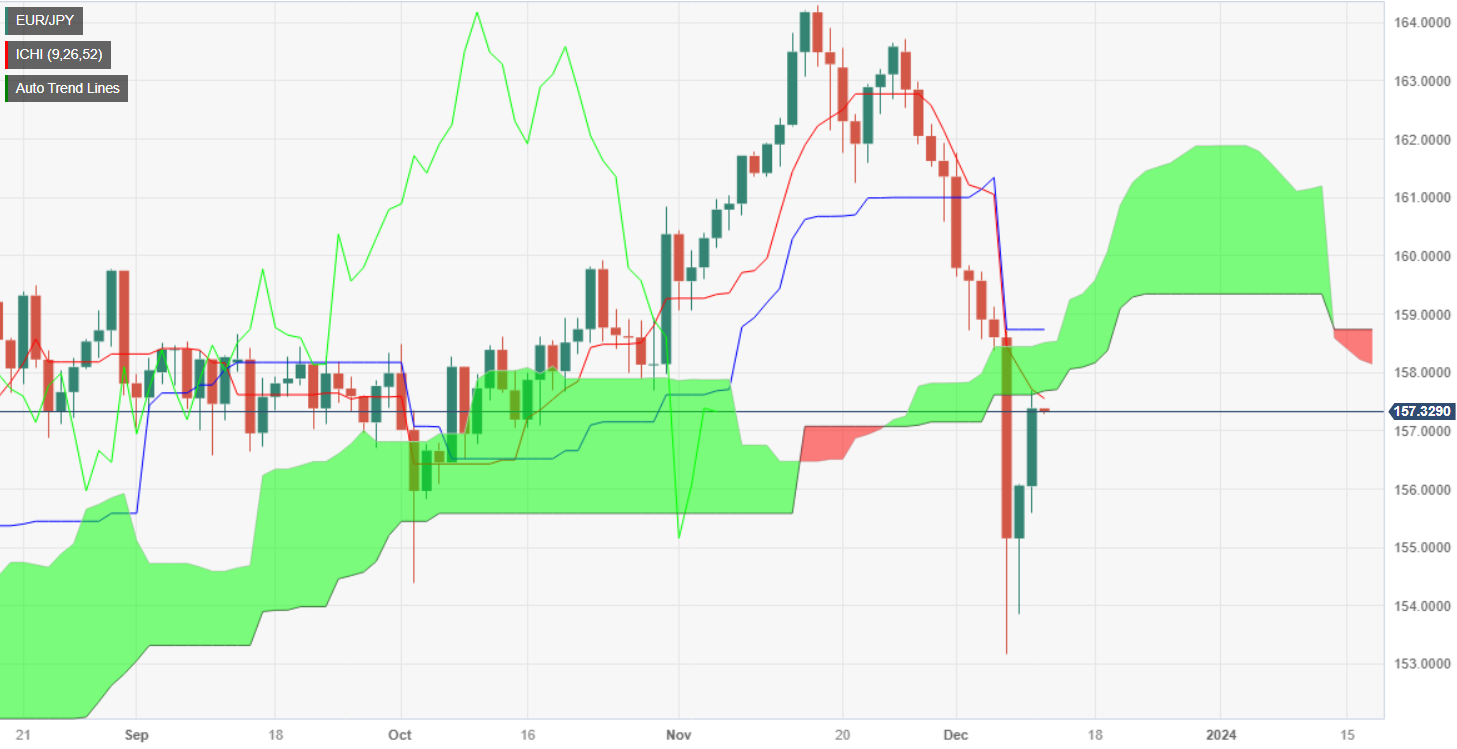
The EUR/JPY climbs close to 0.90% at the beginning of the week and tests a previous support trendline turned resistance at around the 157.20/30 area. Even though the pair is posting solid gains, it remains downward biased, as price action is below the Ichimoku Cloud (Kumo). That along the Chikou Span crossing below price action and the Tenkan-Sen crossing below the Kijun-Sen cements the bearish bias.

That said, EUR/JPY buyers need to reclaim the confluence of the Tenkan-Sen and the bottom of the Kumo at 157.60, followed by the Senkou Span A at 158.19. Further upside is seen above those two levels, at around the 159.00 figure.

For a bearish resumption, sellers must keep prices from breaching the Kumo. In that outcome, the first support would be the 157.00 mark, followed by the December 11 low of 155.86, followed by the December 8 swing low of 153.86.

EUR/JPY Price Analysis – Daily Chart
EUR/JPY Technical Levels

EUR/JPY

Overview
Today last price157.34
Today Daily Change1.28
Today Daily Change %0.82
Today daily open156.06
 
Trends
Daily SMA20161.33
Daily SMA50159.78
Daily SMA100158.71
Daily SMA200154.01
 
Levels
Previous Daily High156.09
Previous Daily Low153.86
Previous Weekly High159.84
Previous Weekly Low153.17
Previous Monthly High164.31
Previous Monthly Low159.07
Daily Fibonacci 38.2%155.24
Daily Fibonacci 61.8%154.72
Daily Pivot Point S1154.59
Daily Pivot Point S2153.11
Daily Pivot Point S3152.36
Daily Pivot Point R1156.82
Daily Pivot Point R2157.57
Daily Pivot Point R3159.05

Author

Christian Borjon Valencia

Markets analyst, news editor, and trading instructor with over 14 years of experience across FX, commodities, US equity indices, and global macro markets.


More from Christian Borjon Valencia
Share:

Editor's Picks

AUD/USD treads water above 0.7000 ahead of the RBA

AUD/USD alternates gains with losses just above the 0.7000 yardstick ahead of the opening bell in Asia on Tuesday. The pair’s decline follows the Greenback’s decent advance in a context of heightened geopolitical effervescence. Moving forward, the RBA is expected to hike its OCR to 4.60%.

USD/JPY climbs back toward 158.00 after BoJ minutes amid firm USD

USD/JPY finds dip-buyers and reverses part of Friday's slide driven by speculation that authorities will step in again to prop up the Japanese Yen. However, the BoJ's dovish Minutes cap the JPY. Meanwhile, the US Dollar regains traction as the US-Iran standoff supports crude oil prices, fueling inflation fears and reaffirming bets for an October Fed rate hike. This further supports the pair, driving it back toward 158.00.

Gold tumbles further; focus shifts to $4,100

Gold kicks in the week on the back foot, selling off to the vicinity of the $4,100 mark per troy ounce, levels last traded back in early August. The resurgence of geopolitical concerns in combination with the firmer US Dollar and rising US Treasury yields keep the yellow metal under heavy pressure on Monday.

Strategy buys 1,665 Bitcoin amid renewed geopolitical tensions
Bitcoin (BTC) dropped below $84,000 on Monday as Strategy (MSTR) announced a fresh treasury purchase of $143 million last week, boosting its holdings to 847,666 BTC. The company purchased 1,665 BTC for roughly $142.7 million, according to a filing with the Securities and Exchange Commission (SEC) on Monday.
The week ahead: A key moment for the global economy as threats rise

UK diesel hits a record, as economic concerns rise. The market expects an aggressive Fed rate hiking cycle, but is it necessary? Oil supply concerns ease, even as oil prices rise. What’s next for the AI trade.

Fed vs BoJ: Both hiked. The market only believes one of them – and the chart shows which

The Fed and the BoJ have just done something remarkably similar. Both central banks raised interest rates by 25 bps last week, both are confronting inflation risks, and both signal that future decisions will depend on incoming economic data.