|

EUR/JPY Price Analysis: Euro pulls back near 163.00 but bullish trend remains intact

  • EUR/JPY was seen around the 163.00 zone after retreating during Monday’s session.
  • Broader bias stays bullish, with downside limited by upward-trending averages.
  • Price holds above key supports, while resistance aligns with short-term recovery targets.

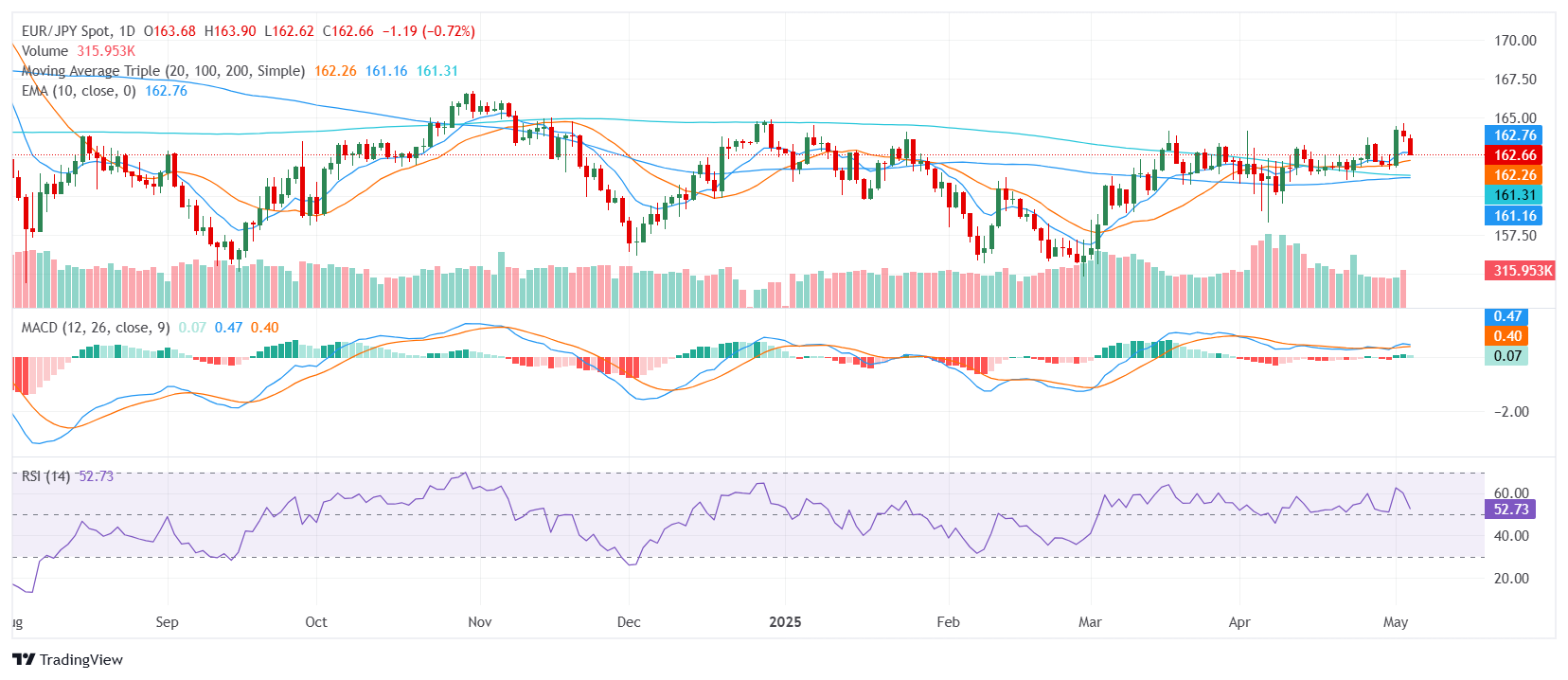
The EUR/JPY pair slipped lower on Monday, falling toward the 163.00 zone as the session closed and ahead of the Asian open. Despite the day’s decline, the broader setup remains constructive, with the pair still holding above critical trendline supports. Momentum readings appear neutral, but the underlying structure is sustained by bullish signals from longer-term indicators.

Technically, the pair maintains its bullish posture. The Moving Average Convergence Divergence signals continued buying interest, while the Relative Strength Index remains neutral near the midline around 53. Other tools such as the Awesome Oscillator and Bull Bear Power also print neutral readings, reflecting a short-term consolidation rather than a shift in directional momentum.

What reinforces the positive tone is the alignment of key moving averages. The 20-day, 100-day, and 200-day Simple Moving Averages are all rising and lie beneath current prices, providing a strong technical floor. The 30-day Exponential and Simple Moving Averages offer further dynamic support in the 162.10–162.15 area, helping contain deeper pullbacks.

Support levels are seen at 162.40, 162.26, and 162.14. Resistance is marked at 162.67, 162.76, and 163.60. A sustained bounce from current levels could see EUR/JPY test the upper end of its recent range, while a break below support would challenge the bullish case in the near term.

Daily Chart
Author

Patricio Martín

Patricio is an economist from Argentina passionate about global finance and understanding the daily movements of the markets.


More from Patricio Martín
Share:

Editor's Picks

AUD/USD sits at two-month lows near 0.6950 after Australian CPI data

AUD/USD is sitting at two-month lows near 0.6950 in the Asian session on Wednesday, as below-expectations August Australian underlying CPI data pours cold water on expectations for further RBA interest rate hikes. Chinese PMI data also fail to inspire the Australian Dollar, despite a pause in the US Dollar advance.

USD/JPY stays weak below 157.00 amid Japanese intervention risks

USD/JPY keeps losses below 157.00 in the Asian session on Wednesday, as hawkish BoJ expectations, along with intervention risks, underpin the Japanese Yen, countering dismal domestic factory output and retail sales data. Meanwhile, a broad US Dollar retreat also collaborates to the pair's downside.

Gold flat lines below $4,200, as focus shifts to US ADP and PCE

Gold extends its consolidative price move in the European session, trading near the $4,200 mark. Falling US bond yields drag the US Dollar away from the two-month high, touched on Tuesday, and act as a tailwind for the commodity. However, hawkish US Federal Reserve expectations cap the upside as traders await important US macro data before placing fresh directional bets on the non-yielding bullion.

Bitcoin consolidates below $85,000 amid rising US Treasury yields, derivatives deleveraging

Bitcoin consolidates near $83,000 at the time of writing on Wednesday after bulls failed to close above the key $85,000 level earlier this week. The Crypto King's investors remain cautious amid rising US Treasury yields and several key macroeconomic data releases due this week.

US core PCE inflation set to rise in August, pressuring the Federal Reserve

The United States Bureau of Economic Analysis will publish the Personal Consumption Expenditures Price Index data for August on Wednesday at 12:30 GMT. Market participants closely watch the PCE Price Index because it is the Federal Reserve’s preferred measure of inflation and could influence its policy outlook.

Silver is more volatile than Gold ahead of PCE and NFP. This chart shows the positioning gap
The market’s attention is focused on American data this week, but there’s something only those with a trained eye may be looking at: Gold and Silver positioning gap. Financial markets are moving on fears, mostly related to persistently high energy prices driven by the Middle East war. Sure, the US Dollar (USD) is strong, but at what cost?