EUR/GBP slightly rises following BoE’s decision, European inflation figures
- The EUR/GBP is trading at 0.8545, with 0.25% gains.
- The BoE held interest rates steady, as expected.
- Eurozone’s inflation figures from January came in higher than expected

In Thursday's session, the EUR/GBP rose to 0.8545, showing a 0.25% gain. The pair's daily chart maintains a neutral to bearish perspective, with bulls attempting to regain control and building momentum. Buyers won momentum after hot inflation figures from the Eurozone but the Bank of England’s hawkish stance may limit the upside.
The Bank of England opted to keep interest rates steady at 5.25%, marking the fourth consecutive unchanged decision. Six of the nine Monetary Policy Committee members supported maintaining the status quo, while Catherine Mann and Jonathan Haskel voted for a 25 basis points increase to 5.50%, and Swati Dhingra endorsed a similar-sized decrease. In addition, during the press conference, Andrew Bailey emphasized keeping interest rates higher for longer showing confindence that inflation will eventually reach the bank's 2% target.
On the other hand, the Eurozone’s Core Harmonized Index of Consumer Prices (HICP) came in higher than expected at 3.3% and gave the Euro a lift. However, after the first decisions of the European Central Bank (ECB) and the BoE, monetary policies divergences are favoring the Pound as markets anticipate less easing by the British bank. Incoming data will still dictate the trajectory of the cross for the next sessions.
EUR/GBP levels to watch
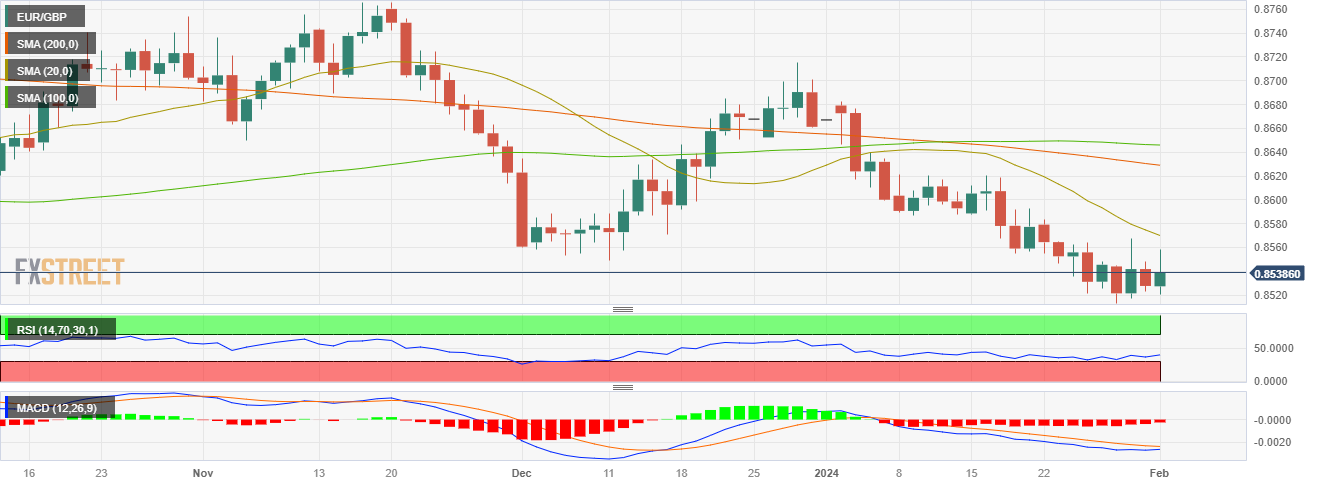
Based on the technical indicators from the daily chart, the bears seem to be maintaining control on a broader scale despite the gains. The Relative Strength Index (RSI) is on a positive slope, indicating potential strength among buyers. However, it is still in the negative territory, suggesting that negative momentum is still prevalent. Furthermore, the Moving Average Convergence Divergence (MACD) continues to present red bars, indicating a steady bearish momentum. In addition, the pair remains below the Simple Moving Averages (SMA) of 20,100 and 200-day period, suggesting the bears' continued dominance on a broader scale. Therefore, for an upward trajectory to be established, buyers will need to demonstrate a more substantial momentum shift.
EUR/GBP daily chart
Author

Patricio Martín
FXStreet
Patricio is an economist from Argentina passionate about global finance and understanding the daily movements of the markets.
















