EUR/GBP Price Forecast: Testing key support at the 0.8600 area
- The Euro accelerates its reversal with the Pound boosted on hotter UK inflation levels.
- A higher-than-expected UK CPI bolsters the case for a steady monetary policy over the next months.
- EUR/GBP: A break below 0.8595 would confirm a double top above 0.8740.

The Euro is trading lower for the third consecutive day against the Pound Sterling on Wednesday, after the rejection at the 0.8650 area on Tuesday. The pair has tested a key support area between 0.8600 and 0.8610, which, so far, remains holding bears.
The Pound is drawing support from strong CPI figures that give further reasons for BoE hawks to keep interest rates steady over the coming months, while the Euro remains on the defensive after comments from ECB’s Lagarde warning against economic uncertainty and moderate inflation figures, confirmed by the Eurozone’s final CPI data for July.
Technical Analysis: A break of 0.8610 confirms a Double Top at 0.8740-0.8750
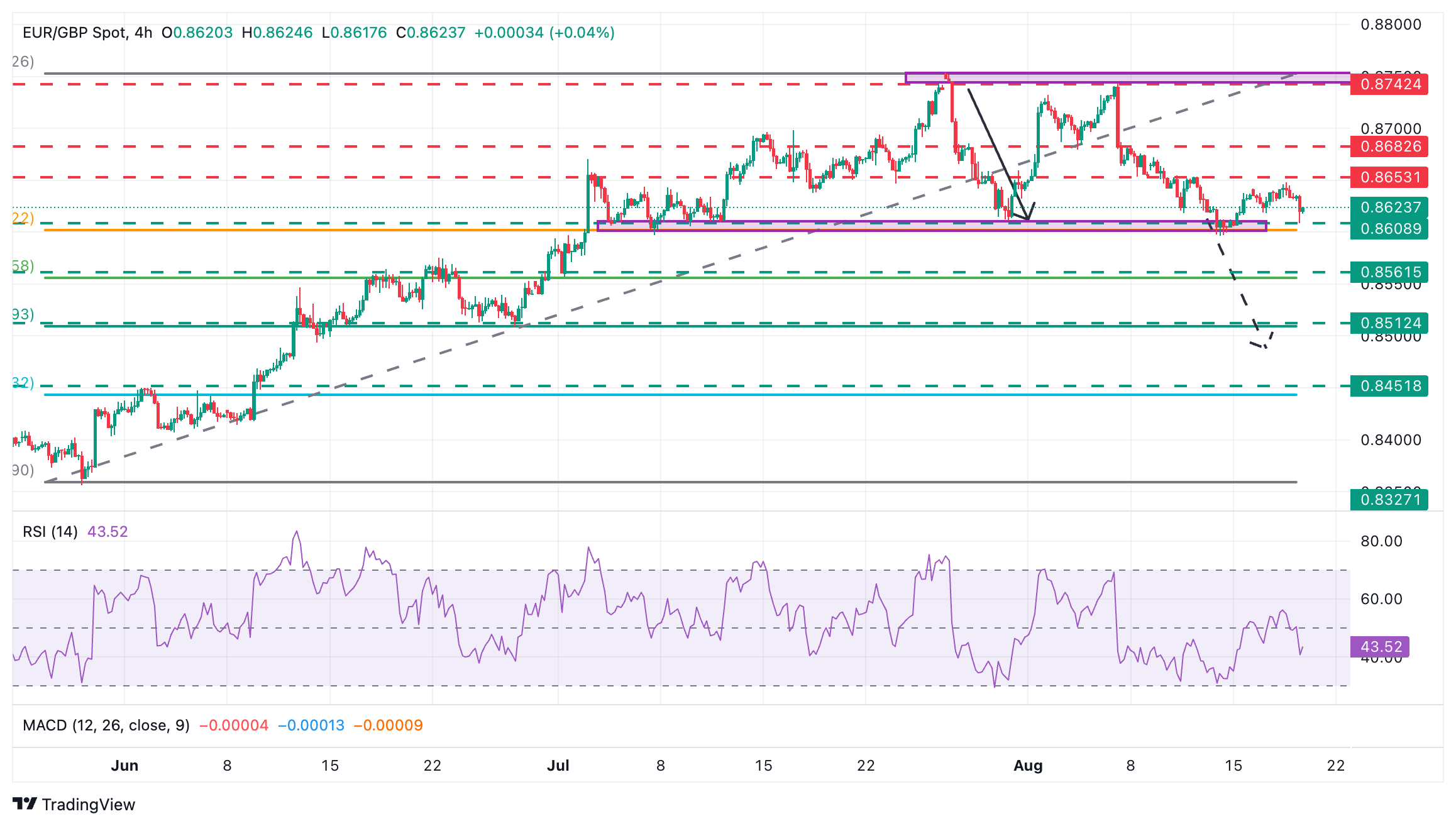
The EUR/GBP technical picture shows the pair under bearish pressure, with the RSI below the 50 level, and with bears looking at the 0.8600 area, which is the beckline of a Double Top pattern at August 25 and July 7 lows, at the 0.8740-0.8750 area.
This is a common figure for trend shifts, and would point to a deeper reversal from the EUR/GBP May-July rally. A confirmation below the July 7 and August 15 lows, at 0.8595, clears the path towards the 0.8560-0.8570 area (June 23 highs-July 1 lows). The DT’s measured target is at the 0.8500 area.
To the upside, the pair needs to extend gains beyond the August 13 high of 0.8655 to ease bearish pressure and shift the focus towards the August 5 low, at 0.8680. Further up, the July 28 and August 7 highs, at 0.8750, will come into view.
Economic Indicator
Consumer Price Index (YoY)
The United Kingdom (UK) Consumer Price Index (CPI), released by the Office for National Statistics on a monthly basis, is a measure of consumer price inflation – the rate at which the prices of goods and services bought by households rise or fall – produced to international standards. It is the inflation measure used in the government’s target. The YoY reading compares prices in the reference month to a year earlier. Generally, a high reading is seen as bullish for the Pound Sterling (GBP), while a low reading is seen as bearish.
Read more.Last release: Wed Aug 20, 2025 06:00
Frequency: Monthly
Actual: 3.8%
Consensus: 3.7%
Previous: 3.6%
Source: Office for National Statistics
The Bank of England is tasked with keeping inflation, as measured by the headline Consumer Price Index (CPI) at around 2%, giving the monthly release its importance. An increase in inflation implies a quicker and sooner increase of interest rates or the reduction of bond-buying by the BOE, which means squeezing the supply of pounds. Conversely, a drop in the pace of price rises indicates looser monetary policy. A higher-than-expected result tends to be GBP bullish.
Economic Indicator
Harmonized Index of Consumer Prices (YoY)
The Harmonized Index of Consumer Prices (HICP) measures changes in the prices of a representative basket of goods and services in the European Monetary Union. The HICP, released by Eurostat on a monthly basis, is harmonized because the same methodology is used across all member states and their contribution is weighted. The YoY reading compares prices in the reference month to a year earlier. Generally, a high reading is seen as bullish for the Euro (EUR), while a low reading is seen as bearish.
Read more.Last release: Wed Aug 20, 2025 09:00
Frequency: Monthly
Actual: 2%
Consensus: 2%
Previous: 2%
Source: Eurostat
Author

Guillermo Alcala
FXStreet
Graduated in Communication Sciences at the Universidad del Pais Vasco and Universiteit van Amsterdam, Guillermo has been working as financial news editor and copywriter in diverse Forex-related firms, like FXStreet and Kantox.

















