EUR/GBP holds above key support as UK economic concerns pressure Sterling
- EUR/GBP holds above key sypport at 0.8623 as bulls defend short-term trend.
- Economic and fiscal concerns in the UK put pressure on the Pound Sterling, while the Euro hinges on any advance regarding EU-US trade talks.
- Interest rate expectations, with the ECB expected to keep borrowing costs steady and the BoE to slash them, could serve as an additional catalyst for EUR/GBP.

The Euro (EUR) is edging higher against thePound Sterling (GBP) on Friday as rising expectations that the Bank of England (BoE) may cut interest rates and fiscal concerns place pressure on Sterling.
At the time of writing, EUR/GBP is trading near 0.8640 as both technical and fundamental factors remain in favour of bulls.
Fundamentally, the outlook remains supportive of the Euro. Thursday's softer-than-expected UK labor market data increased expectations for a potential BoE rate cut.
Meanwhile, the European Central Bank (ECB) has remained cautious but not explicitly dovish after inflation data failed to show signs of easing this week, providing a relative advantage to the Euro.
With no significant economic data due on Friday, market moves are likely to be driven by sentiment and positioning ahead of the August tariff deadline. Any developments arising from the US-EU trade talks that took place in Washington this week – or lack of progress – will likely serve as an additional catalyst for the Euro and the EUR/GBP pair.
EUR/GBP holds above key support as bulls defend short-term trend
EUR/GBP trades just above support at 0.8623, coinciding with the 23.6% Fibonacci retracement level of the March low-April high move.
After failing to test psychological resistance at the 0.8700 level, the longer upper wick that appeared at the top of the daily candle on Wednesday reflected a firm rejection from bears.
However, the downside move has been limited. Price action continues to hold above the 20-day Simple Moving Average (SMA) at 0.8612, the 50-day SMA at 0.8512 and the 100-day SMA at 0.8486. While these levels are providing support for the pair, they also indicates that the short-term trend remains bullish.
The Relative Strength Index (RSI) at 61 suggests that momentum remains in favour of the bulls, without entering overbought territory.
If the price continues to hold above 0.8623 and the 20-day MA, the bullish momentum is likely to persist.
EUR/GBP daily chart
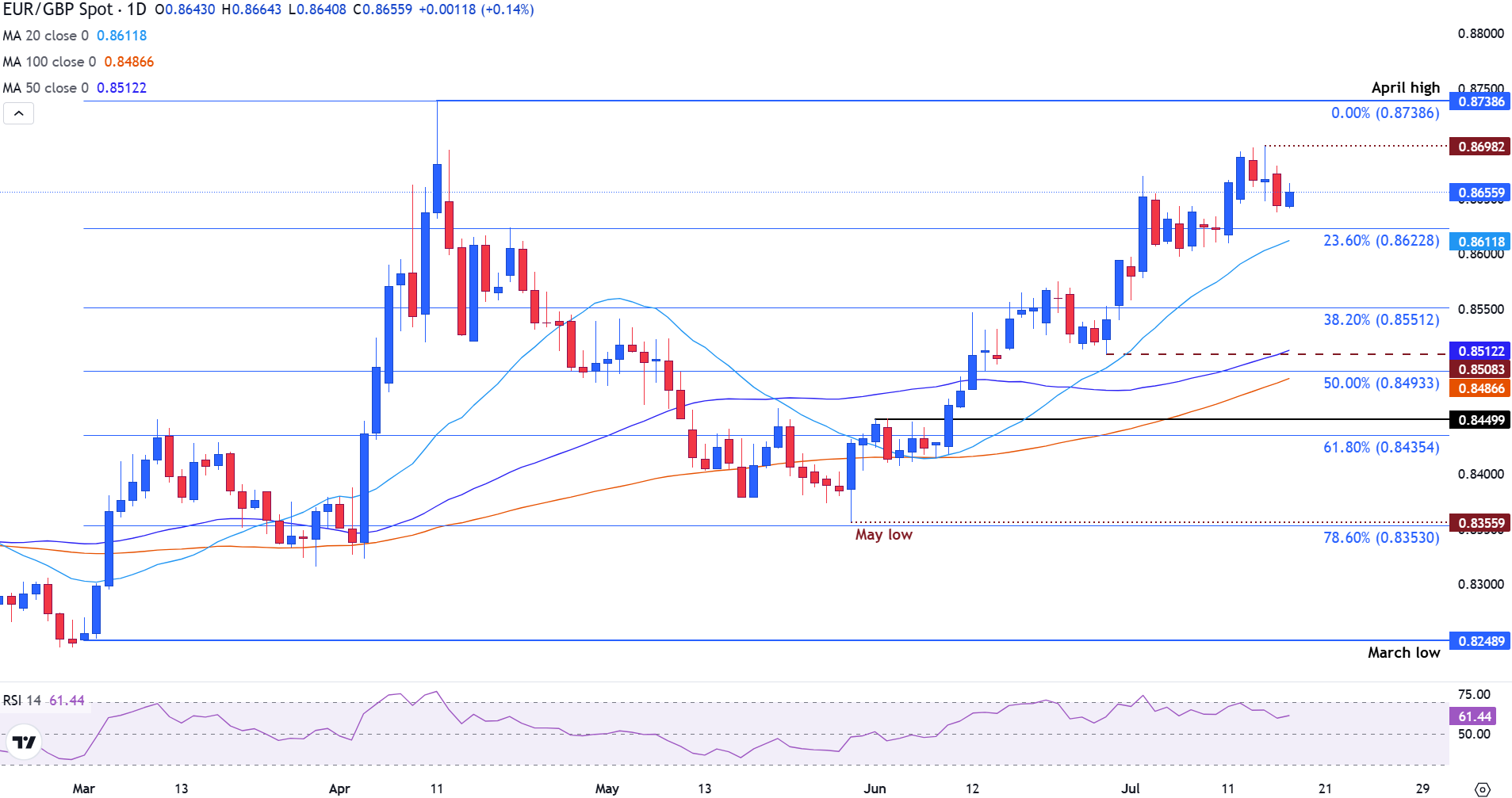
A breakout above Wednesday's high of 0.8698 could lead to a retest of the April high at 0.8739, especially if the RSI pushes higher toward 70.
On the downside, a sustained break below 0.8623 would expose the pair to deeper retracements, with support levels at the 32.8% Fibonacci level of 0.8551, the 50-day SMA and the 100-day SMA.
A drop below this region would suggest a potential shift in trend, targeting the 61.8% Fibonacci level at 0.8435.
Euro FAQs
The Euro is the currency for the 19 European Union countries that belong to the Eurozone. It is the second most heavily traded currency in the world behind the US Dollar. In 2022, it accounted for 31% of all foreign exchange transactions, with an average daily turnover of over $2.2 trillion a day. EUR/USD is the most heavily traded currency pair in the world, accounting for an estimated 30% off all transactions, followed by EUR/JPY (4%), EUR/GBP (3%) and EUR/AUD (2%).
The European Central Bank (ECB) in Frankfurt, Germany, is the reserve bank for the Eurozone. The ECB sets interest rates and manages monetary policy. The ECB’s primary mandate is to maintain price stability, which means either controlling inflation or stimulating growth. Its primary tool is the raising or lowering of interest rates. Relatively high interest rates – or the expectation of higher rates – will usually benefit the Euro and vice versa. The ECB Governing Council makes monetary policy decisions at meetings held eight times a year. Decisions are made by heads of the Eurozone national banks and six permanent members, including the President of the ECB, Christine Lagarde.
Eurozone inflation data, measured by the Harmonized Index of Consumer Prices (HICP), is an important econometric for the Euro. If inflation rises more than expected, especially if above the ECB’s 2% target, it obliges the ECB to raise interest rates to bring it back under control. Relatively high interest rates compared to its counterparts will usually benefit the Euro, as it makes the region more attractive as a place for global investors to park their money.
Data releases gauge the health of the economy and can impact on the Euro. Indicators such as GDP, Manufacturing and Services PMIs, employment, and consumer sentiment surveys can all influence the direction of the single currency. A strong economy is good for the Euro. Not only does it attract more foreign investment but it may encourage the ECB to put up interest rates, which will directly strengthen the Euro. Otherwise, if economic data is weak, the Euro is likely to fall. Economic data for the four largest economies in the euro area (Germany, France, Italy and Spain) are especially significant, as they account for 75% of the Eurozone’s economy.
Another significant data release for the Euro is the Trade Balance. This indicator measures the difference between what a country earns from its exports and what it spends on imports over a given period. If a country produces highly sought after exports then its currency will gain in value purely from the extra demand created from foreign buyers seeking to purchase these goods. Therefore, a positive net Trade Balance strengthens a currency and vice versa for a negative balance.
Author

Tammy Da Costa, CFTe®
FXStreet
Tammy is an economist and market analyst with a deep passion for financial markets, particularly commodities and geopolitics.