EUR/CHF Price Forecast: Euro stabilizes above 0.9300 as bears fails to trigger a breakdown
- The EUR/CHF is holding firm above 0.9300 as bears fail to trigger a breakdown.
- The cross has remained trapped in a sideways channel between 0.9300 and 0.9430 since early May.
- The RSI is pointing upward at 45.84, showing early signs of bullish momentum.

EUR/CHF is holding firm on Thursday, with the pair attempting to rebound from the lower boundary of its multi-week consolidation zone. Despite repeated downside tests near 0.9300, bears have failed to trigger a breakdown, keeping the pair confined within a tight horizontal channel between 0.9300 and 0.9430 that has been in place since early May.
At the time of writing, the cross is hovering near 0.9330, as a notable weakness in the Euro has dragged the pair closer to the lower boundary of the range, reinforcing the bearish pressure and highlighting the market’s lack of momentum.
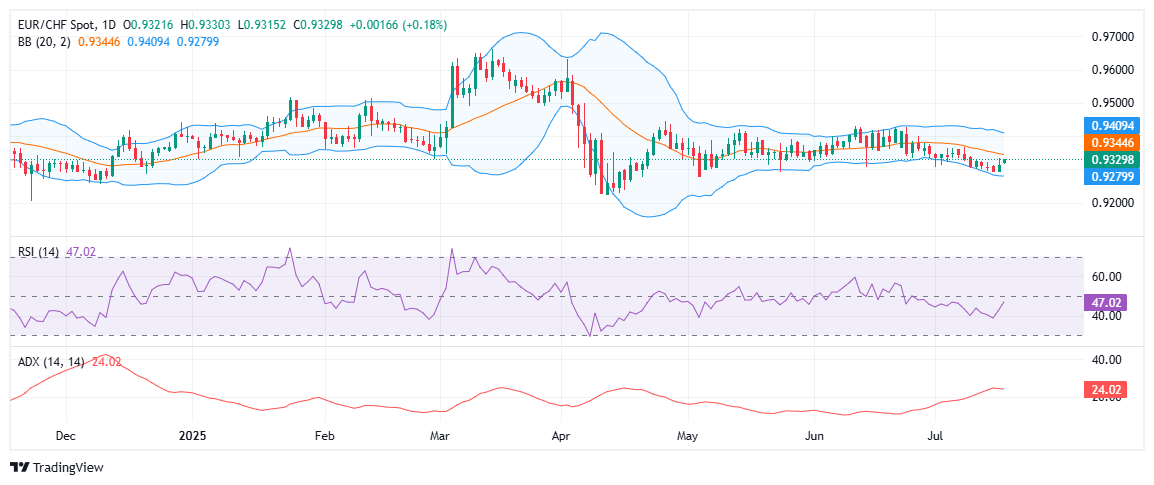
From a technical standpoint, the EUR/CHF cross remains stuck below the 20-day simple moving average (SMA), which also serves as the mid Bollinger Band and is currently positioned at 0.9344. This level continues to cap upside attempts, acting as a dynamic resistance within the broader consolidation.
The Bollinger Bands are narrowing, suggesting reduced volatility and a potential buildup for a breakout. However, until a decisive move outside the 0.9300-0.9430 range occurs, sideways action is likely to persist.
The Bollinger Bands are narrowing, pointing to reduced volatility and a potential breakout setup. However, the Relative Strength Index (RSI) is only modestly higher at 45.84, suggesting weak but emerging buying interest. Meanwhile, the Average Directional Index (ADX) at 24.02 suggests that trend strength is gradually building, but remains below the key 25 threshold, indicating that directional conviction is still lacking.
A sustained break below the 0.9300 support level would mark a bearish shift, potentially exposing downside levels around 0.9250. On the flip side, a bounce from current levels and a close above the 20-day SMA could see the cross reattempt the upper range boundary near 0.9430, with the next resistance seen at the psychological 0.9500 level.
Swiss Franc FAQs
The Swiss Franc (CHF) is Switzerland’s official currency. It is among the top ten most traded currencies globally, reaching volumes that well exceed the size of the Swiss economy. Its value is determined by the broad market sentiment, the country’s economic health or action taken by the Swiss National Bank (SNB), among other factors. Between 2011 and 2015, the Swiss Franc was pegged to the Euro (EUR). The peg was abruptly removed, resulting in a more than 20% increase in the Franc’s value, causing a turmoil in markets. Even though the peg isn’t in force anymore, CHF fortunes tend to be highly correlated with the Euro ones due to the high dependency of the Swiss economy on the neighboring Eurozone.
The Swiss Franc (CHF) is considered a safe-haven asset, or a currency that investors tend to buy in times of market stress. This is due to the perceived status of Switzerland in the world: a stable economy, a strong export sector, big central bank reserves or a longstanding political stance towards neutrality in global conflicts make the country’s currency a good choice for investors fleeing from risks. Turbulent times are likely to strengthen CHF value against other currencies that are seen as more risky to invest in.
The Swiss National Bank (SNB) meets four times a year – once every quarter, less than other major central banks – to decide on monetary policy. The bank aims for an annual inflation rate of less than 2%. When inflation is above target or forecasted to be above target in the foreseeable future, the bank will attempt to tame price growth by raising its policy rate. Higher interest rates are generally positive for the Swiss Franc (CHF) as they lead to higher yields, making the country a more attractive place for investors. On the contrary, lower interest rates tend to weaken CHF.
Macroeconomic data releases in Switzerland are key to assessing the state of the economy and can impact the Swiss Franc’s (CHF) valuation. The Swiss economy is broadly stable, but any sudden change in economic growth, inflation, current account or the central bank’s currency reserves have the potential to trigger moves in CHF. Generally, high economic growth, low unemployment and high confidence are good for CHF. Conversely, if economic data points to weakening momentum, CHF is likely to depreciate.
As a small and open economy, Switzerland is heavily dependent on the health of the neighboring Eurozone economies. The broader European Union is Switzerland’s main economic partner and a key political ally, so macroeconomic and monetary policy stability in the Eurozone is essential for Switzerland and, thus, for the Swiss Franc (CHF). With such dependency, some models suggest that the correlation between the fortunes of the Euro (EUR) and the CHF is more than 90%, or close to perfect.
Author

Vishal Chaturvedi
FXStreet
I am a macro-focused research analyst with over four years of experience covering forex and commodities market. I enjoy breaking down complex economic trends and turning them into clear, actionable insights that help traders stay ahead of the curve.