DraftKings approaches critical dual support structure

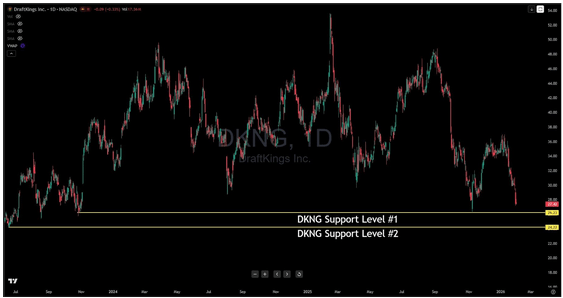
DraftKings (DKNG) is trading around $28 after another leg down from its recent peak near $49, and the sports betting giant is now staring at a support structure that's been battle-tested multiple times over the past two-plus years. For a stock that's seen more whipsaws than a rodeo, these two horizontal levels have consistently marked the boundaries where selling exhaustion meets renewed buying interest.
Let me walk you through what makes these support zones so significant. The first level sits at $26.23, just $2 below current price. This is a price point where DKNG has repeatedly found its footing during corrections. Scan back through the price history and you'll see this level acting as a floor during multiple selloffs across 2024 and into 2025. Each time price approached or touched this zone, buyers emerged with enough conviction to halt the decline and spark a recovery.
Below that, at $24.22, we have our secondary support level. Think of this as the backup plan if $26.23 fails to hold. This lower boundary has also proven its worth during deeper corrections, representing a zone where longer-term value buyers and dip-buyers have historically shown up in force. The spacing between these two levels—roughly $2—gives you a clear framework for managing risk and structuring trades.
What's interesting about DKNG's current setup is how it oscillates. This isn't a stock that grinds steadily in one direction. Instead, it swings violently between extremes, rallying from these support zones up to the $45-$53 range before giving back those gains and returning to test support again. We've seen this pattern play out multiple times, and it creates a tradeable rhythm for those paying attention.
Currently sitting at $28, DKNG has about $2 of cushion before testing that first support level. Given the stock's tendency for quick moves, that buffer could disappear in a single session if selling pressure intensifies. The question becomes, will this be another successful test that launches the next rally leg, or will we finally see a breakdown that invalidates the pattern?
For swing traders looking to play a bounce, the strategy is straightforward. Wait for price to approach $26.23 and watch for signs of support holding: bullish candle formations, volume drying up on the decline, or reversal patterns forming at the level. If you get confirmation, entry near $26 with a stop below $24 offers a clear risk parameter, with upside targets initially around $32-$35 where overhead resistance may emerge.
If $26.23 fails to hold, the next logical entry point becomes $24.22. A bounce from this secondary support would represent a deeper discount and potentially stronger risk-reward, assuming the level holds. Any close below $24, however, would break the multi-year support structure and suggest DKNG needs to find equilibrium at substantially lower levels.
DraftKings (DKNG) is trading around $28 after another leg down from its recent peak near $49, and the sports betting giant is now staring at a support structure that's been battle-tested multiple times over the past two-plus years. For a stock that's seen more whipsaws than a rodeo, these two horizontal levels have consistently marked the boundaries where selling exhaustion meets renewed buying interest.
Let me walk you through what makes these support zones so significant. The first level sits at $26.23, just $2 below current price. This is a price point where DKNG has repeatedly found its footing during corrections. Scan back through the price history and you'll see this level acting as a floor during multiple selloffs across 2024 and into 2025. Each time price approached or touched this zone, buyers emerged with enough conviction to halt the decline and spark a recovery.
Below that, at $24.22, we have our secondary support level. Think of this as the backup plan if $26.23 fails to hold. This lower boundary has also proven its worth during deeper corrections, representing a zone where longer-term value buyers and dip-buyers have historically shown up in force. The spacing between these two levels—roughly $2—gives you a clear framework for managing risk and structuring trades.
What's interesting about DKNG's current setup is how it oscillates. This isn't a stock that grinds steadily in one direction. Instead, it swings violently between extremes, rallying from these support zones up to the $45-$53 range before giving back those gains and returning to test support again. We've seen this pattern play out multiple times, and it creates a tradeable rhythm for those paying attention.
Currently sitting at $28, DKNG has about $2 of cushion before testing that first support level. Given the stock's tendency for quick moves, that buffer could disappear in a single session if selling pressure intensifies. The question becomes, will this be another successful test that launches the next rally leg, or will we finally see a breakdown that invalidates the pattern?
For swing traders looking to play a bounce, the strategy is straightforward. Wait for price to approach $26.23 and watch for signs of support holding: bullish candle formations, volume drying up on the decline, or reversal patterns forming at the level. If you get confirmation, entry near $26 with a stop below $24 offers a clear risk parameter, with upside targets initially around $32-$35 where overhead resistance may emerge.
If $26.23 fails to hold, the next logical entry point becomes $24.22. A bounce from this secondary support would represent a deeper discount and potentially stronger risk-reward, assuming the level holds. Any close below $24, however, would break the multi-year support structure and suggest DKNG needs to find equilibrium at substantially lower levels.
Author
Benjamin Pool
Verified Investing
A seasoned financial expert with a passion for empowering individuals to mastering smart money management.