Dow Jones Industrial Average middles as investors wait for things to happen
- The Dow Jones is holding near key moving averages on Thursday.
- Markets were largely unimpressed with US Retail Sales figures.
- Investors continue to hinge their exposure on Fed rate cut expectations.

The Dow Jones Industrial Average (DJIA) struck a middling tone on Thursday, churning around the 43,200 handle and testing down around 100 points on the day. Price action is hung up on the 50-day Exponential Moving Average (EMA), and investors await any sign of data that could signal a faster pace of rate cuts from the Federal Reserve (Fed).
Retail Sales figures moderated in December, easing back to 0.4% MoM in the headline figure. Markets expected a tick down to 0.6% from the previous month’s revised 0.8%. Core Retail Sales excluding automotive expenditures rose to 0.4% MoM from 0.2%, meeting median analyst forecasts. The mixed figures failed to spark significant changes in investor sentiment in either direction, and bidding action is muddling through a largely non-starter of a day for equities.
Despite overall middling action in equity markets, things are moving behind the scenes as traders jostle for position based on Fed rate cut expectations. Treasuries pulled back sharply earlier this week, and according to the CME’s FedWatch Tool, rate markets are now pricing in slightly more than even odds of the Fed delivering another quarter-point rate cut on May 7, a step closer than the previous middle ground of June 18.
Dow Jones news
The Dow Jones is taking a bit of a breather after a three-day bull run that saw the major equity index recover nearly 4% after kicking off the trading week near its lowest bids since October. The majority of the Dow’s listed equities are testing into the green on Thursday, but concentrated losses in key stocks are hobbling the average’s overall performance.
UnitedHealth Group (UNH) tumbled 4.5%, falling below $520 per share after the major health sector player missed analyst revenue expectations, reporting fourth-quarter income of $100.8 billion dollars, growing by 6.8% YoY. Wall Street expected at least %101.6 billion in revenue in Q4.
Apple (AAPL) is also shedding weight on the day, falling 3% and declining to $230 per share after it was revealed the tech megagiant is losing market share in Asian consumer arenas as upstart competitors take advantage of localized government subsidies. Apple still remains the preeminent name to beat in the smartphone market, but it lost market share in mainland China for the first time since 2023 even as overall consumer demand in the region saw growth for the first time in two years.
Dow Jones price forecast
Investors continue to bolster the Dow Jones back into the high end, determined to keep price action bolstered north of the 50-day EMA near 43,000. The Dow is testing the waters near 43,200 as major price levels rotate to provide technical support through intraday chart action.
Despite a near-term turnaround, bulls are showing some signs of exhaustion, and the Dow Jones remains down nearly 4% from record highs set back in November. DJIA is still running well north of its 200-day EMA which is climbing above 41,000, but a deepening pattern of swing lows may imply that the race could be coming to an end.
Dow Jones daily chart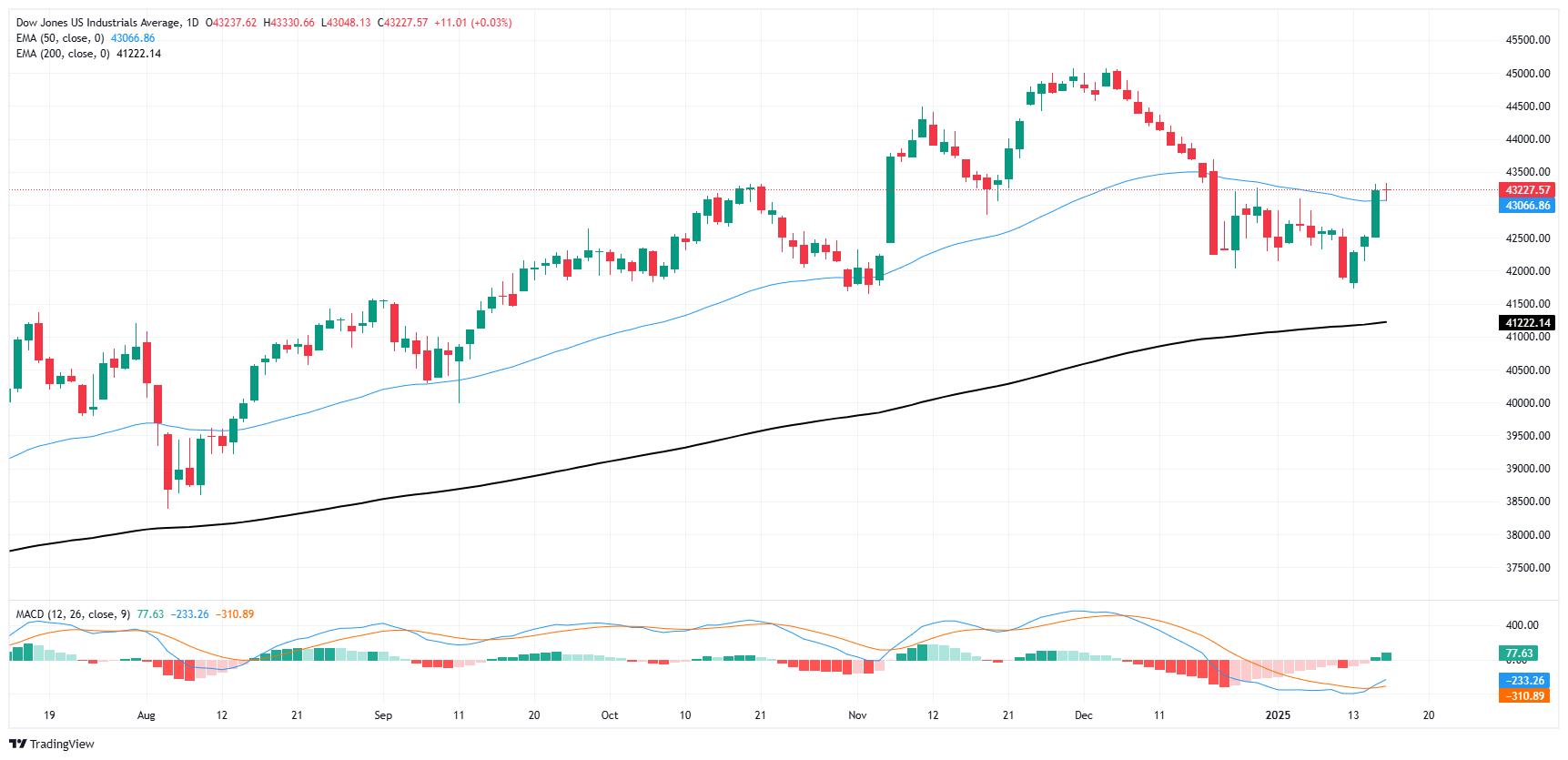
Economic Indicator
Initial Jobless Claims
The Initial Jobless Claims released by the US Department of Labor is a measure of the number of people filing first-time claims for state unemployment insurance. A larger-than-expected number indicates weakness in the US labor market, reflects negatively on the US economy, and is negative for the US Dollar (USD). On the other hand, a decreasing number should be taken as bullish for the USD.
Read more.Last release: Thu Jan 16, 2025 13:30
Frequency: Weekly
Actual: 217K
Consensus: 210K
Previous: 201K
Source: US Department of Labor
Every Thursday, the US Department of Labor publishes the number of previous week’s initial claims for unemployment benefits in the US. Since this reading could be highly volatile, investors may pay closer attention to the four-week average. A downtrend is seen as a sign of an improving labour market and could have a positive impact on the USD’s performance against its rivals and vice versa.
Author

Joshua Gibson
FXStreet
Joshua joins the FXStreet team as an Economics and Finance double major from Vancouver Island University with twelve years' experience as an independent trader focusing on technical analysis.