Dow Jones Industrial Average muddles through CPI inflation upswing
- The Dow Jones shed over 400 points on Wednesday at its lowest.
- Fed Chair Powell made his second appearance in two days.
- Rate markets have pushed bets of the next Fed rate cut to December.

The Dow Jones Industrial Average (DJIA) tumbled on Wednesday,dropping over 400 points at its lowest and dipping into 44,090. The major equity index has since recovered some ground, but still remains down around 230 points on the day. Investor sentiment took a beating after United States (US) Consumer Price Index (CPI) inflation showed the US has made no progress on bringing down core inflation metrics in eight months. It has been nearly four years since annualized US core CPI was below 3.0%.
Jerome Powell Testimony Live: We are not there on inflation
Federal Reserve (Fed) Chair Jerome Powell made his second appearance in as many days as the Fed head testified before US government bodies, delivering the Fed’s Monetary Policy Report to the House Financial Services Committee. Given the latest CPI print, Powell noted that the Fed has still not achieved its inflation goals, but he acknowledged that the Fed has made significant progress. Ongoing tariff spats between the US and everybody else have thrown a wrench in the works, making it challenging to forecast what monetary policy will look like in the face of an ambiguous US trade policy future.
Headline CPI inflation rose to 0.5% MoM, above the forecast decline to 0.3% from 0.4%. Annualized headline CPI also rose to 3.0%, beating the expected hold at 2.9%. On core CPI inflation, the yearly figure came in at 3.3%, while markets were expecting a cooling to 3.1% from 3.2%, with the monthly figure also rising sharply to 0.4%, beating the forecast of 0.3% and last 0.2%. Rate markets now expect the Fed to deliver its next rate cut very late in the year, with bets clustered around December.
Dow Jones news
Nearly the entire Dow Jones equity board lost ground on Wednesday, although Boeing (BA) and Walmart (WMT) managed to stake out room on the green side. Both companies gained around 1.2%, with Boeing rising to $104 per share and Walmart testing above $182.
On the low end, Caterpillar (CAT) and Home Depot (HD) both shed around 2% as inflation metrics take a bite out of machine and building material suppliers. Caterpillar fell below $355 per share, with Home Depot sinking below $410.
Dow Jones price forecast
Despite intraday losses, the Dow Jones continues to grind its way through the chart churn, holding in familiar technical territory. The Dow hasn’t made a fresh high since late November of last year, but downside momentum remains limited. Price action remains bolstered above the 50-day Exponential Moving Average (EMA) near 43,800, and the overall trend still tilts in favor of the bulls.
Dow Jones daily chart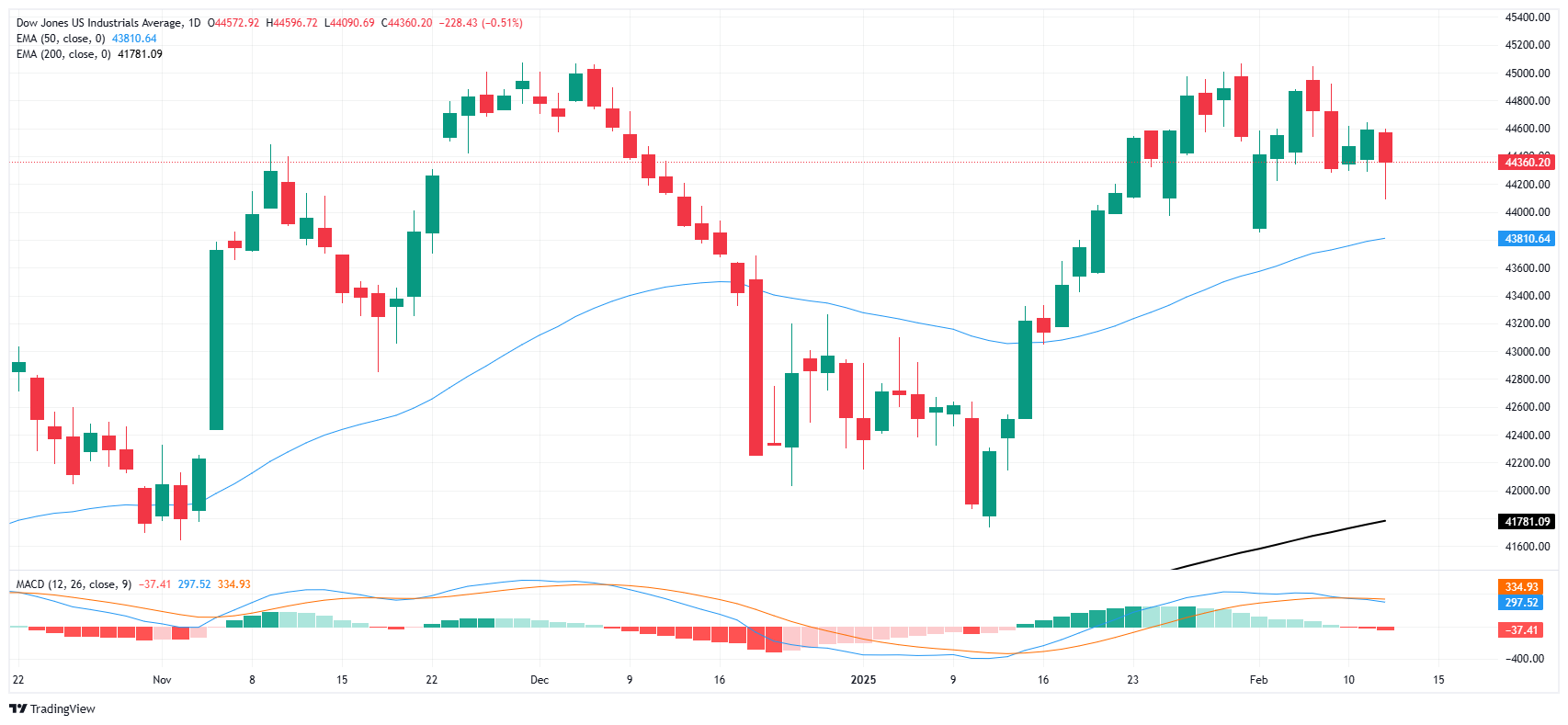
Economic Indicator
Consumer Price Index (MoM)
Inflationary or deflationary tendencies are measured by periodically summing the prices of a basket of representative goods and services and presenting the data as The Consumer Price Index (CPI). CPI data is compiled on a monthly basis and released by the US Department of Labor Statistics. The MoM figure compares the prices of goods in the reference month to the previous month.The CPI is a key indicator to measure inflation and changes in purchasing trends. Generally, a high reading is seen as bullish for the US Dollar (USD), while a low reading is seen as bearish.
Read more.Last release: Wed Feb 12, 2025 13:30
Frequency: Monthly
Actual: 0.5%
Consensus: 0.3%
Previous: 0.4%
Source: US Bureau of Labor Statistics
The US Federal Reserve has a dual mandate of maintaining price stability and maximum employment. According to such mandate, inflation should be at around 2% YoY and has become the weakest pillar of the central bank’s directive ever since the world suffered a pandemic, which extends to these days. Price pressures keep rising amid supply-chain issues and bottlenecks, with the Consumer Price Index (CPI) hanging at multi-decade highs. The Fed has already taken measures to tame inflation and is expected to maintain an aggressive stance in the foreseeable future.
Author

Joshua Gibson
FXStreet
Joshua joins the FXStreet team as an Economics and Finance double major from Vancouver Island University with twelve years' experience as an independent trader focusing on technical analysis.














