Dow Jones Industrial Average treads water ahead of Fed
- The Dow Jones remains stuck just below the 42,000 level on Wednesday.
- Markets are bracing for an update to the Fed’s dot plot of interest rate expectations.
- Investors remain hopeful, but dark turns in consumer data are getting hard to ignore.


The Dow Jones Industrial Average (DJIA) held steady within familiar territory on Wednesday, but holding a bullish stance as investors gear up for another showing from the Federal Reserve (Fed). The Fed’s latest rate call is broadly expected to be another hold on interest rates, but an update to the Federal Open Market Committee’s (FOMC) Summary of Economic Projections (SEP) will be drawing all market eyes.
The Fed’s SEP, or “dot plot” of interest rate expectations, could have huge ramifications for markets that have, up until this point, continued to tilt into hopes of continued rate cuts during the latter months of 2025. Fed policymakers tend to have a more accurate track record of estimating upcoming changes in policy rates, and the median of the dot plot will drive interest rate expectations accordingly.
Dow Jones price forecast
The Dow Jones is treading water just beneath the key 42,000 handle, and price action is being kept under a tight lid by the 200-day Exponential Moving Average (EMA). Chart watchers have seen the Dow take a sharp tumble in recent weeks, and candles could be due for another topside run as technical oscillators begin to climb out of oversold territory.
Dow Jones daily chart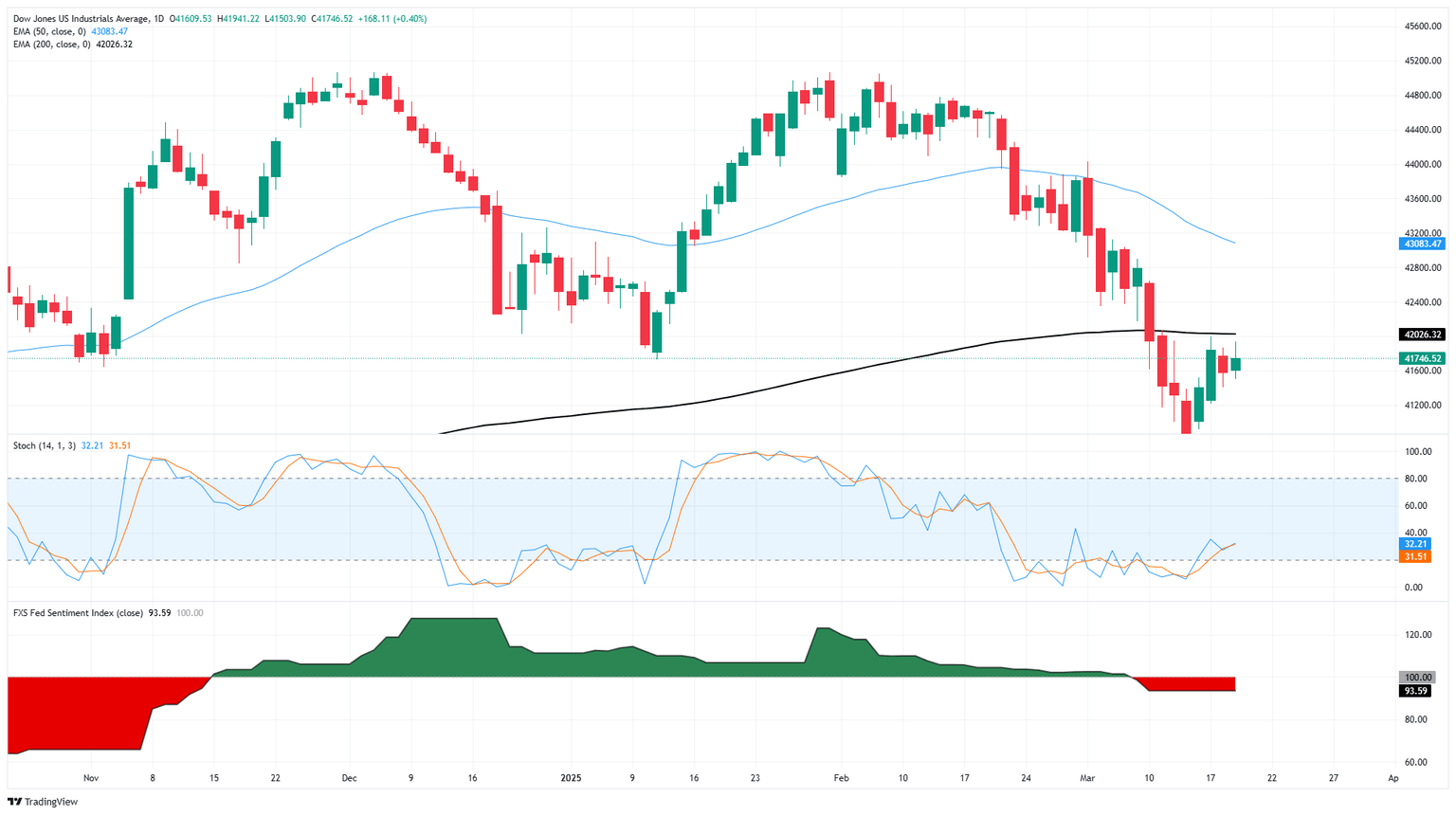
Dow Jones FAQs
The Dow Jones Industrial Average, one of the oldest stock market indices in the world, is compiled of the 30 most traded stocks in the US. The index is price-weighted rather than weighted by capitalization. It is calculated by summing the prices of the constituent stocks and dividing them by a factor, currently 0.152. The index was founded by Charles Dow, who also founded the Wall Street Journal. In later years it has been criticized for not being broadly representative enough because it only tracks 30 conglomerates, unlike broader indices such as the S&P 500.
Many different factors drive the Dow Jones Industrial Average (DJIA). The aggregate performance of the component companies revealed in quarterly company earnings reports is the main one. US and global macroeconomic data also contributes as it impacts on investor sentiment. The level of interest rates, set by the Federal Reserve (Fed), also influences the DJIA as it affects the cost of credit, on which many corporations are heavily reliant. Therefore, inflation can be a major driver as well as other metrics which impact the Fed decisions.
Dow Theory is a method for identifying the primary trend of the stock market developed by Charles Dow. A key step is to compare the direction of the Dow Jones Industrial Average (DJIA) and the Dow Jones Transportation Average (DJTA) and only follow trends where both are moving in the same direction. Volume is a confirmatory criteria. The theory uses elements of peak and trough analysis. Dow’s theory posits three trend phases: accumulation, when smart money starts buying or selling; public participation, when the wider public joins in; and distribution, when the smart money exits.
There are a number of ways to trade the DJIA. One is to use ETFs which allow investors to trade the DJIA as a single security, rather than having to buy shares in all 30 constituent companies. A leading example is the SPDR Dow Jones Industrial Average ETF (DIA). DJIA futures contracts enable traders to speculate on the future value of the index and Options provide the right, but not the obligation, to buy or sell the index at a predetermined price in the future. Mutual funds enable investors to buy a share of a diversified portfolio of DJIA stocks thus providing exposure to the overall index.
Author
Joshua Gibson
FXStreet
Joshua joins the FXStreet team as an Economics and Finance double major from Vancouver Island University with twelve years' experience as an independent trader focusing on technical analysis.