Dow Jones Industrial Average gains cautious ground as tariff recycle continues
- The Dow Jones found higher ground on Wednesday, but headline risks remain.
- The Trump administration is determined to appear tough on tariffs after another delay.
- The Fed’s latest Meeting Minutes showed a widening spread of internal rate cut expectations.

The Dow Jones Industrial Average (DJIA) gained some ground on Wednesday, paring away some of the week’s early losses, although equities remain down overall from Monday’s opening bids. The Trump administration has continued its step-up of firmer demands for trade deals from foreign countries, even as President Trump kicks the can down the road on his own self-imposed tariff deadlines. Elsewhere, Nvidia (NVDA) became the first company in history to reach a market cap of $4 trillion, while Amazon (AMZN) took a hit after Prime Day sales volume tumbled compared to the previous year.
Big tariffs coming, and this time we mean it
President Donald Trump announced another wave of double-digit tariff levels that will come into effect on August 1, alongside the “reciprocal” tariffs that were initially announced and immediately delayed in early April. The global tariff package was delayed until July 9 after Trump repeated his pattern of backing down from the majority of his own tariff threats, and the date has been pushed back to the beginning of August. The Trump administration is pushing hard for countries to come to the negotiating table and deliver trade deals that Trump finds acceptable, but progress has been slow. Despite Trump staffers teasing imminent trade deals like clockwork, very little progress on securing finalized trade terms has been made.
The Federal Reserve’s (Fed) latest Meeting Minutes showed the Fed remains buried deep in a wait-and-see stance, with central bank policymakers remaining apprehensive about the US’s economic outlook. According to the Fed’s internal rate discussions, headline inflation risks and job market downside factors have both diminished, but the latest rate meeting was held prior to this week’s batch of renewed tariff threats. The spread between individual policymakers on when to cut interest rates again has also widened, with several voting members of the Federal Open Market Committee (FOMC) disagreeing on whether a first rate cut should come in July, or get pushed out to sometime in 2026.
In a gold rush, sell shovels
Nvidia hit a $4 trillion market capitalization on Wednesday, taking the top spot as the first company in history to cross the valuation threshold. Nvidia has soared over several quarters, bolstered by the ongoing AI tech craze that has soon a metric ton of private equity capital pour into both shovel-seller Nvidia and gold-seeking AI startups looking to build first and ask revenue questions later. Elsewhere, solid-state EV battery maker QuantumScape (QS) is marching higher as the battery tech company achieves milestones on developing new power storage production methods.
Dow Jones price forecast
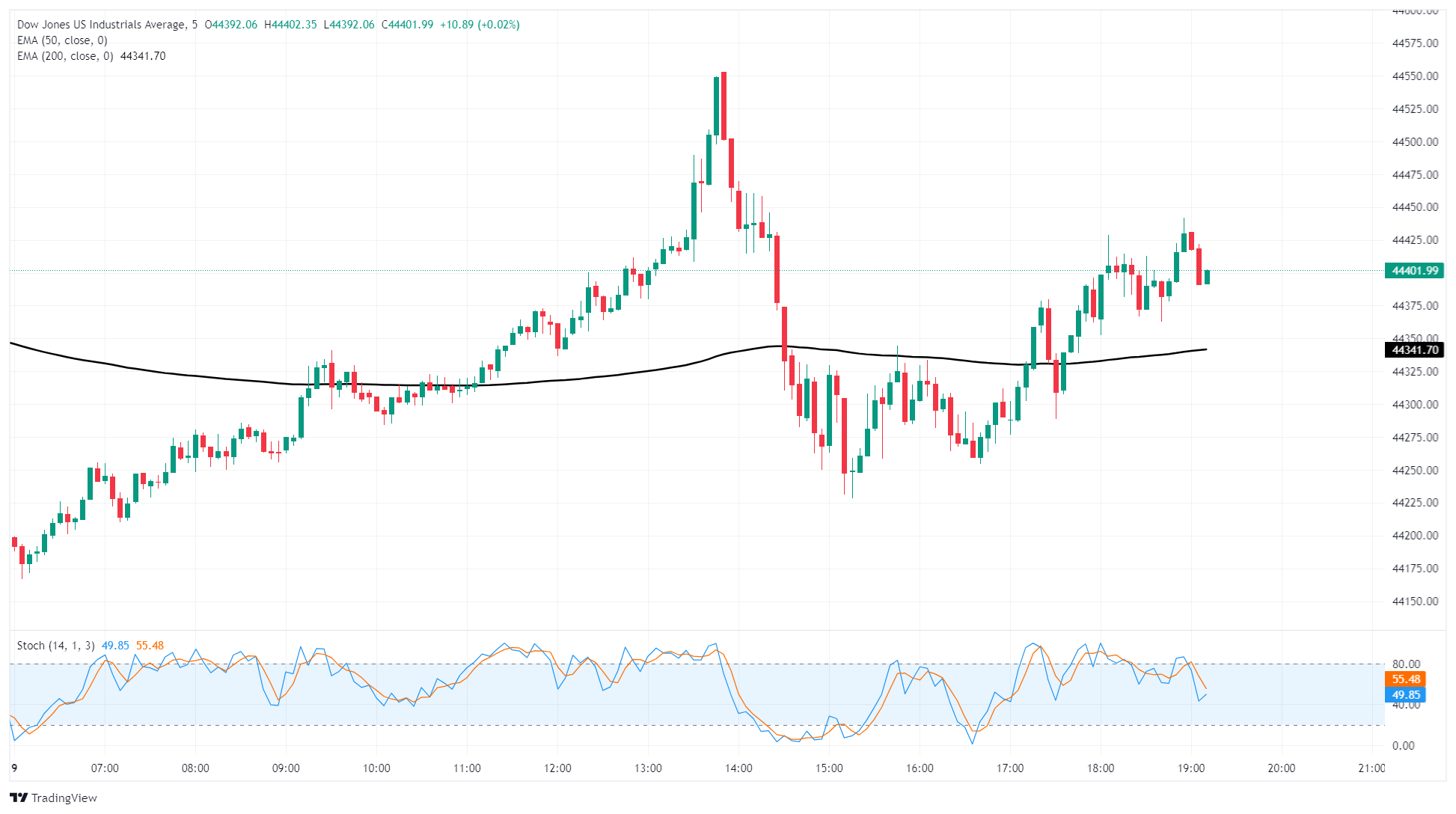
Wednesday was a choppy affair for the Dow Jones. Ongoing tech rallies and recovering investor sentiment briefly bolstered the major equity index into intraday highs near 44,560 before fresh tariff threats sent the Dow Jones into lows near 44,240. Despite intraday volatility, the Dow is trading on the high end of the day’s opening bids near 44,200.
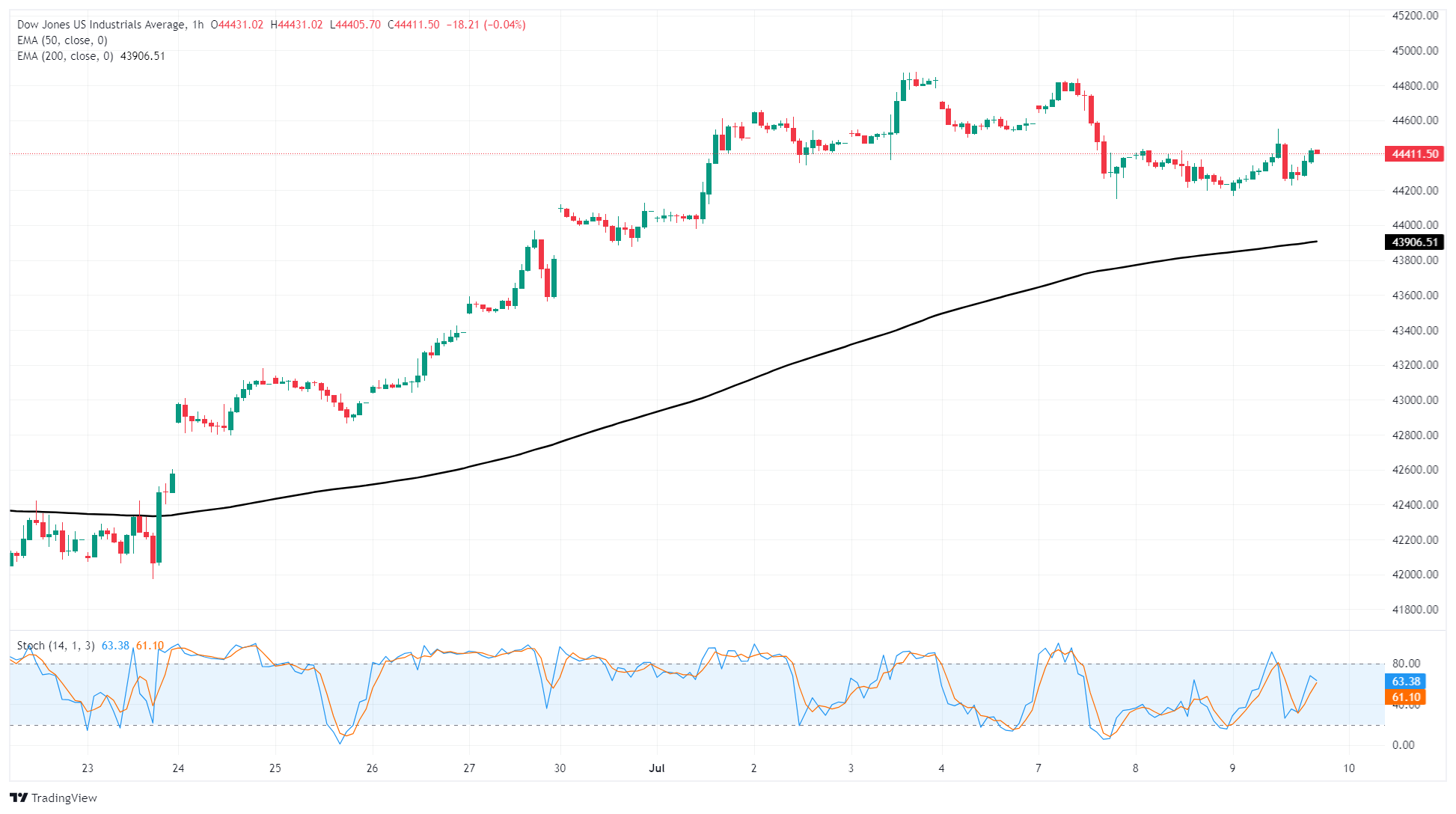
The Dow Jones is still on the low side of the week’s price action, skidding along a fresh technical floor near 44,250. The Dow is still on the north side of the 200-hour Exponential Moving Average (EMA) near the 44,000 handle, but near-term declines could accelerate if bullish momentum takes too long of a breather.
Dow Jones 5-minute chart
Dow Jones 1-hour chart
Tariffs FAQs
Tariffs are customs duties levied on certain merchandise imports or a category of products. Tariffs are designed to help local producers and manufacturers be more competitive in the market by providing a price advantage over similar goods that can be imported. Tariffs are widely used as tools of protectionism, along with trade barriers and import quotas.
Although tariffs and taxes both generate government revenue to fund public goods and services, they have several distinctions. Tariffs are prepaid at the port of entry, while taxes are paid at the time of purchase. Taxes are imposed on individual taxpayers and businesses, while tariffs are paid by importers.
There are two schools of thought among economists regarding the usage of tariffs. While some argue that tariffs are necessary to protect domestic industries and address trade imbalances, others see them as a harmful tool that could potentially drive prices higher over the long term and lead to a damaging trade war by encouraging tit-for-tat tariffs.
During the run-up to the presidential election in November 2024, Donald Trump made it clear that he intends to use tariffs to support the US economy and American producers. In 2024, Mexico, China and Canada accounted for 42% of total US imports. In this period, Mexico stood out as the top exporter with $466.6 billion, according to the US Census Bureau. Hence, Trump wants to focus on these three nations when imposing tariffs. He also plans to use the revenue generated through tariffs to lower personal income taxes.
Author

Joshua Gibson
FXStreet
Joshua joins the FXStreet team as an Economics and Finance double major from Vancouver Island University with twelve years' experience as an independent trader focusing on technical analysis.

















