Dow Jones Industrial Average recovers from backslide, but still down over 150 points
- The Dow Jones tripped on Tuesday, falling to 42,850 before stabilizing.
- Geopolitical tensions jilted equities as Russia bristles as Ukraine.
- Markets broadly recovered their footing, but the Dow Jones remains down on the day.

The Dow Jones Industrial Average (DJIA) took a knee early Tuesday, backsliding to 42,850 during the early US market session after Russia lowered its threshold for nuclear weapon use after Ukraine deployed US-provided weapons within Russia’s borders. Equity market broadly recovered their stance for the day, however the Dow Jones remains hobbled, stuck roughly 150 points below the day’s opening bids.
Russian President Vladimir Putin warned global markets that Russia’s self-imposed threshold for the use of nuclear weapons has been lowered after Ukraine forces deployed US-provided weapons within Russia’s borders as the small European country continues to fight back against Russia’s invasion. Brandishing nuclear weapons spooked investors, sparking a brief risk-off bid before flows normalized once again. Russia’s planned three-day invasion of Ukraine that began late February of 2022 is about to enter its thousandth day.
US economic data releases remain thin in the front half of the trading week. Mid-tier Initial Jobless Claims are due on Thursday, and expected to show a slight uptick in the number of new unemployment benefits seekers for the week ended November 15. US S&P Purchasing Managers Index (PMI) activity figures will be the number to watch this week, but won’t be dropping on investors until Friday.
Dow Jones news
A broad-market recovery in equities following geopolitical jitters didn’t quite penetrate the Dow Jones fully. A little under half of the major index’s listed securities are in the green for Tuesday, but most meaningful gains are contained within a few key companies. Walmart (WMT) jumped 4% to $87.50 per share after reporting a better-than-expected third-quarter performance and raising its annual earnings outlook. Nvidia (NVDA) also rose 3.8% to $145.50 per share ahead of its earnings call after market close on Wednesday; investors expect the chipmaker’s recent pivot further into AI-focused GPU chips known as Blackwell to help hoist the silicon stamping company to $33 billion in 3Q revenue, an 83% increase YoY.
Dow Jones price forecast
The Dow Jones explored further downside on Tuesday, dipping to an intraday low of 42,850 before recovering back into the day’s opening range just north of 43,200. The major equity index is poised to close lower for a fourth straight trading day as stocks continue to cool off from the post-election frenzy that sent bids into fresh record highs.
Dow Jones price action is still trading on the high side of the 50–day Exponential Moving Average (EMA) near 42,500, and it’s down to a coin toss on whether bearish momentum will continue to drag prices even lower or if bulls will gather their feet and send the DJIA into fresh highs above 44,400.
Dow Jones daily chart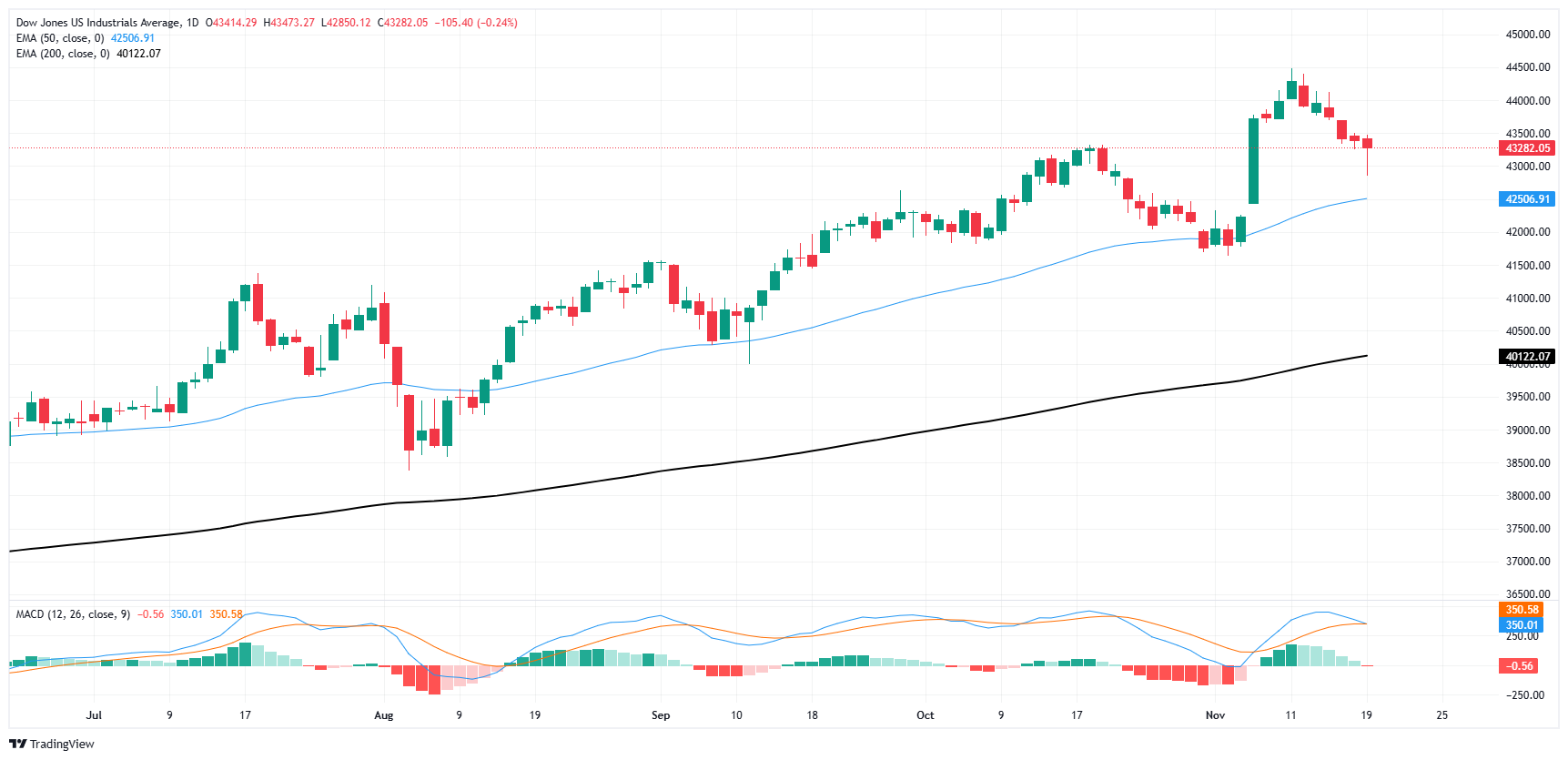
Risk sentiment FAQs
In the world of financial jargon the two widely used terms “risk-on” and “risk off'' refer to the level of risk that investors are willing to stomach during the period referenced. In a “risk-on” market, investors are optimistic about the future and more willing to buy risky assets. In a “risk-off” market investors start to ‘play it safe’ because they are worried about the future, and therefore buy less risky assets that are more certain of bringing a return, even if it is relatively modest.
Typically, during periods of “risk-on”, stock markets will rise, most commodities – except Gold – will also gain in value, since they benefit from a positive growth outlook. The currencies of nations that are heavy commodity exporters strengthen because of increased demand, and Cryptocurrencies rise. In a “risk-off” market, Bonds go up – especially major government Bonds – Gold shines, and safe-haven currencies such as the Japanese Yen, Swiss Franc and US Dollar all benefit.
The Australian Dollar (AUD), the Canadian Dollar (CAD), the New Zealand Dollar (NZD) and minor FX like the Ruble (RUB) and the South African Rand (ZAR), all tend to rise in markets that are “risk-on”. This is because the economies of these currencies are heavily reliant on commodity exports for growth, and commodities tend to rise in price during risk-on periods. This is because investors foresee greater demand for raw materials in the future due to heightened economic activity.
The major currencies that tend to rise during periods of “risk-off” are the US Dollar (USD), the Japanese Yen (JPY) and the Swiss Franc (CHF). The US Dollar, because it is the world’s reserve currency, and because in times of crisis investors buy US government debt, which is seen as safe because the largest economy in the world is unlikely to default. The Yen, from increased demand for Japanese government bonds, because a high proportion are held by domestic investors who are unlikely to dump them – even in a crisis. The Swiss Franc, because strict Swiss banking laws offer investors enhanced capital protection.
Author

Joshua Gibson
FXStreet
Joshua joins the FXStreet team as an Economics and Finance double major from Vancouver Island University with twelve years' experience as an independent trader focusing on technical analysis.