Dow Jones Industrial Average declines 330 points as sentiment shudders
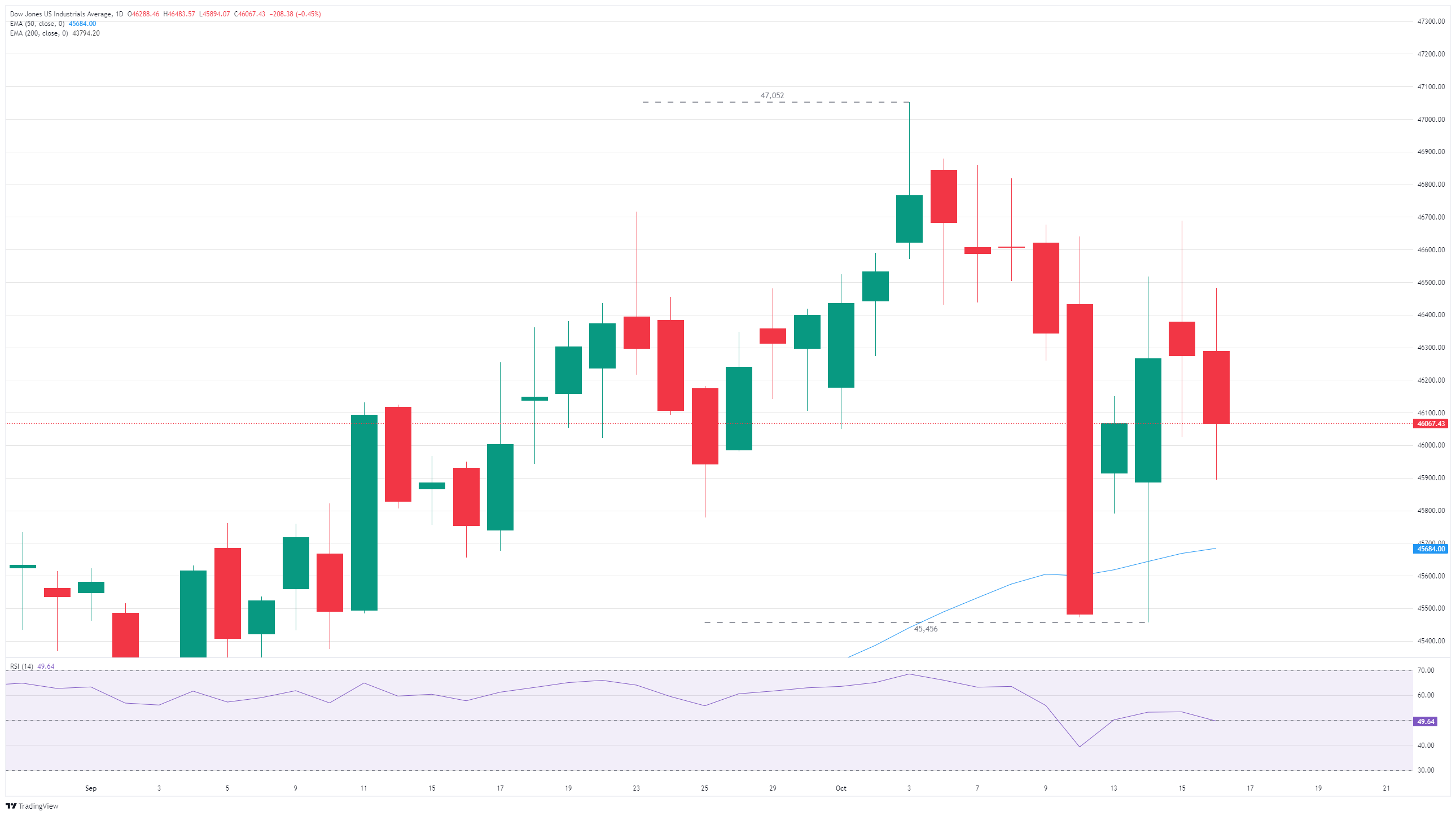
- The Dow Jones has found a fresh consolidation patch in the 46,200 region.
- Earnings weeks, despite opening on a strong note, has given way to additional investor concerns.
- Market headwinds are starting to pile up as traders see cracks forming everywhere.

The Dow Jones Industrial Average (DJIA) grappled in the middle of a deepening consolidation zone on Thursday, churning on both sides of 46,200 before declining around 330 points on the day. Investors are still tilting toward the bullish side on expectations that current political and structural issues will eventually be resolved, but market sentiment continues to take regular hits as fissures grow wider. The US government shutdown remains an ongoing issue that looms over investors, and traders caught a fresh bout of risk-off jitters amid rising concerns of risky loans on bank balance sheets.
Big banks up, small banks down
Investment bank earnings bolstered broad-market sentiment during the midweek, but now regional and smaller-scale lenders are dragging investor confidence lower. Regional banks including Zions (ZION) and Western Alliance (WAL) tumbled on Thursday on faulty loans and concerns of borrower fraud. An undercurrent of weakness in regional banks adds onto growing market fears of the clear-as-mud private credit industry, which saw two auto-industry lending companies collapse recently.
US-China trade tensions are still simmering in the background, and investors are awaiting some sort of resolution from the Trump administration. US President Donald Trump threatened a new wave of triple-digit tariffs on China after China played a strong hand in the ongoing tariff dispute, imposing strict export controls on rare earth minerals produced in China, which remain a critical resource for many of the US’s key industries, especially tech and computing hardware.
Everything is fine
The US government shutdown continues to roll on with little sign of a fix, and official US datasets remain dark for the time being. The Federal Reserve (Fed), lacking a consistent flow of inflation-sensitive datasets, has little else to do but hold steady on its current pace of interest rate cuts. Rate markets have fully priced in two more rate cuts before the end of the calendar year, with another rate cut expected next March.
Dow Jones daily chart
Dow Jones FAQs
The Dow Jones Industrial Average, one of the oldest stock market indices in the world, is compiled of the 30 most traded stocks in the US. The index is price-weighted rather than weighted by capitalization. It is calculated by summing the prices of the constituent stocks and dividing them by a factor, currently 0.152. The index was founded by Charles Dow, who also founded the Wall Street Journal. In later years it has been criticized for not being broadly representative enough because it only tracks 30 conglomerates, unlike broader indices such as the S&P 500.
Many different factors drive the Dow Jones Industrial Average (DJIA). The aggregate performance of the component companies revealed in quarterly company earnings reports is the main one. US and global macroeconomic data also contributes as it impacts on investor sentiment. The level of interest rates, set by the Federal Reserve (Fed), also influences the DJIA as it affects the cost of credit, on which many corporations are heavily reliant. Therefore, inflation can be a major driver as well as other metrics which impact the Fed decisions.
Dow Theory is a method for identifying the primary trend of the stock market developed by Charles Dow. A key step is to compare the direction of the Dow Jones Industrial Average (DJIA) and the Dow Jones Transportation Average (DJTA) and only follow trends where both are moving in the same direction. Volume is a confirmatory criteria. The theory uses elements of peak and trough analysis. Dow’s theory posits three trend phases: accumulation, when smart money starts buying or selling; public participation, when the wider public joins in; and distribution, when the smart money exits.
There are a number of ways to trade the DJIA. One is to use ETFs which allow investors to trade the DJIA as a single security, rather than having to buy shares in all 30 constituent companies. A leading example is the SPDR Dow Jones Industrial Average ETF (DIA). DJIA futures contracts enable traders to speculate on the future value of the index and Options provide the right, but not the obligation, to buy or sell the index at a predetermined price in the future. Mutual funds enable investors to buy a share of a diversified portfolio of DJIA stocks thus providing exposure to the overall index.
Author

Joshua Gibson
FXStreet
Joshua joins the FXStreet team as an Economics and Finance double major from Vancouver Island University with twelve years' experience as an independent trader focusing on technical analysis.
















