Dow Jones Industrial Average recovers ground on shaky legs
- The Dow Jones recovered 150 points on Friday but still remains down on the week.
- Equities broadly recovered after US PCE inflation came in as expected.
- Coming up next week: maybe, maybe not tariffs and another NFP print.

The Dow Jones Industrial Average (DJIA) recovered some lost ground on Friday, rebounding about 150 points to remain in contention with the 43,400 level. Despite Friday’s bullish attempt, the major equity index remains down from Monday’s opening prices. US President Donald Trump got in a row with Ukrainian President Volodymyr Zelenskyy after the Ukrainian leader declined to sign Donald Trump’s defense agreement without asking questions or seeking expanded clarification on the contents of President Trump’s much-desired “rare earths deal”.
Read more: US President Trump, Ukrainian President Zelenskyy exchange barbs over defense deal
Despite a recent uptick in headline inflation figures, US Personal Consumption Expenditure Price Index (PCEPI) inflation data still came in broadly as expected, helping to soothe some frayed investor nerves. January’s core PCE Price Index eased to 2.6% YoY from a revised 2.9% YoY, matching median market forecasts. Despite the overall upbeat tone of Friday’s inflation print, market exuberance is unlikely to stretch too far: US inflation factors remain volatile in the face of inconsistent trade policy from the White House, and core metrics continue to run hotter than the Federal Reserve’s (Fed) ideal target of 2%.
A recent uptick in hostile trade language from US President Donald Trump has stepped up investor concerns this week. Markets have generally gotten used to brushing off Donald Trump’s trade tariff bluster after several walkbacks on his own arbitrary timelines for imposing widespread tariffs on most of the US’ closest trading partners. However, President Trump revamped his recent tariff threats, pivoting on his latest delay and declaring that a 25% tariff package on both Canada and Mexico would be coming into effect on March 4.
Adding to market pressures next week, a fresh iteration of US Nonfarm Payrolls (NFP) data looms ahead next Friday. Recent economic data has tilted toward the downside, making investors increasingly concerned about a potential slowdown. Recent jobless figures also accelerated, raising concerns that the US labor market may be showing cracks. Next week’s NFP print will carry additional weight, outside of the usual heavy-hitter it tends to be.
Dow Jones news
The Dow Jones is trading roughly half-and-half on Friday, with winners and losers hung across the middle. 3M (MMM) gained 1.7%, climbing to $153 per share, while IBM (IBM) fell 2%, slipping below $250 per share.
Dow Jones price forecast
The Dow Jones continues to churn lower into bear country, trading on the south side of the 50-day Exponential Moving Average (EMA) near 43,840. The major equity index is still holding above the 200-day EMA at the 42,000 handle, but that particular bull run is growing long in the tooth with the Dow entirely outrunning its own 200-day EMA for over two years. Bullish momentum has certainly faded, but time is running out for sellers as technical oscillators grind into oversold territory, and the DJIA is barely down 4% from its last swing high near 45,000.
Dow Jones daily chart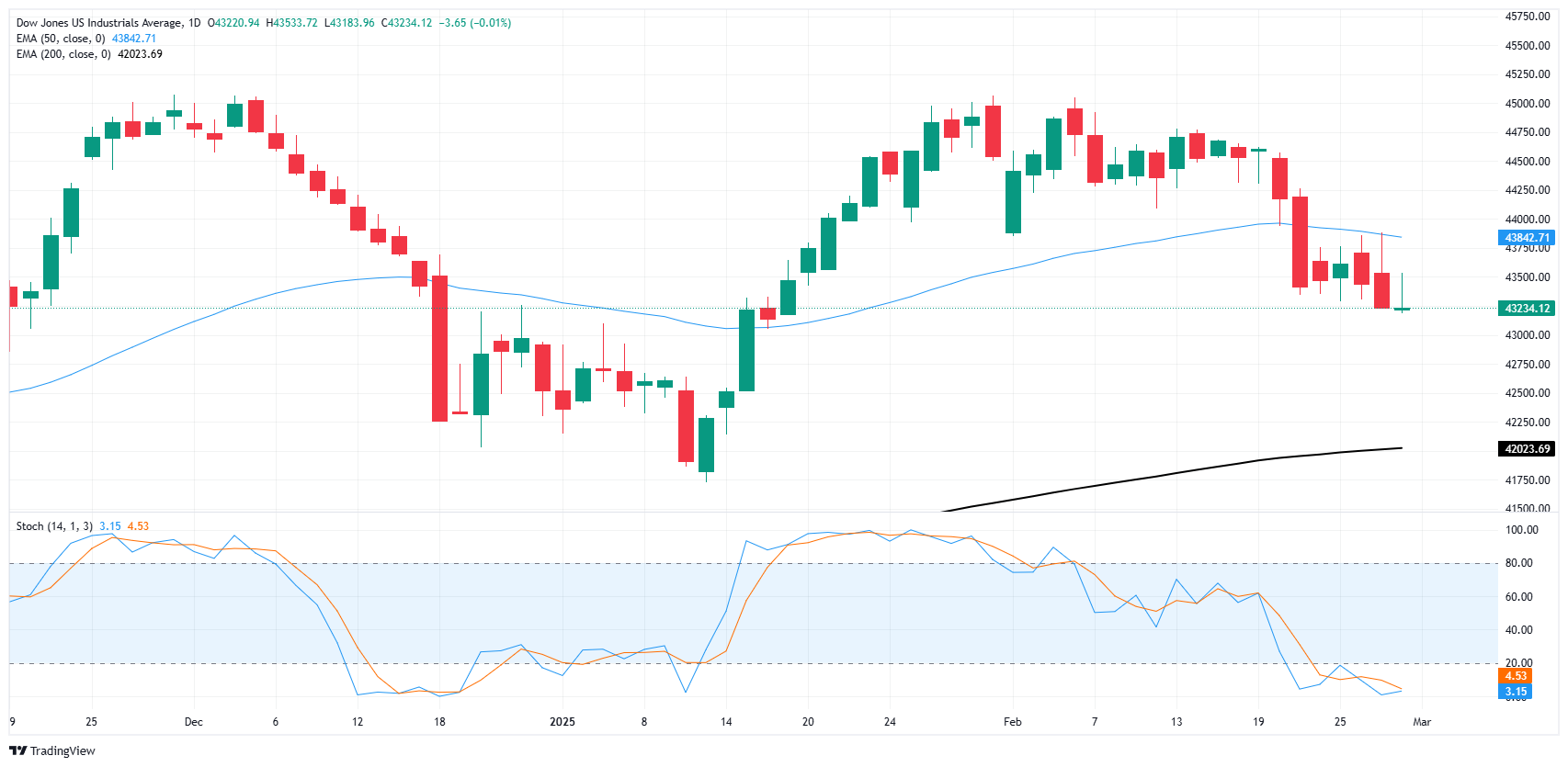
Tariffs FAQs
Tariffs are customs duties levied on certain merchandise imports or a category of products. Tariffs are designed to help local producers and manufacturers be more competitive in the market by providing a price advantage over similar goods that can be imported. Tariffs are widely used as tools of protectionism, along with trade barriers and import quotas.
Although tariffs and taxes both generate government revenue to fund public goods and services, they have several distinctions. Tariffs are prepaid at the port of entry, while taxes are paid at the time of purchase. Taxes are imposed on individual taxpayers and businesses, while tariffs are paid by importers.
There are two schools of thought among economists regarding the usage of tariffs. While some argue that tariffs are necessary to protect domestic industries and address trade imbalances, others see them as a harmful tool that could potentially drive prices higher over the long term and lead to a damaging trade war by encouraging tit-for-tat tariffs.
During the run-up to the presidential election in November 2024, Donald Trump made it clear that he intends to use tariffs to support the US economy and American producers. In 2024, Mexico, China and Canada accounted for 42% of total US imports. In this period, Mexico stood out as the top exporter with $466.6 billion, according to the US Census Bureau. Hence, Trump wants to focus on these three nations when imposing tariffs. He also plans to use the revenue generated through tariffs to lower personal income taxes.
Author

Joshua Gibson
FXStreet
Joshua joins the FXStreet team as an Economics and Finance double major from Vancouver Island University with twelve years' experience as an independent trader focusing on technical analysis.