Dow Jones Industrial Average climbs 250 points as rate cut hopes continue
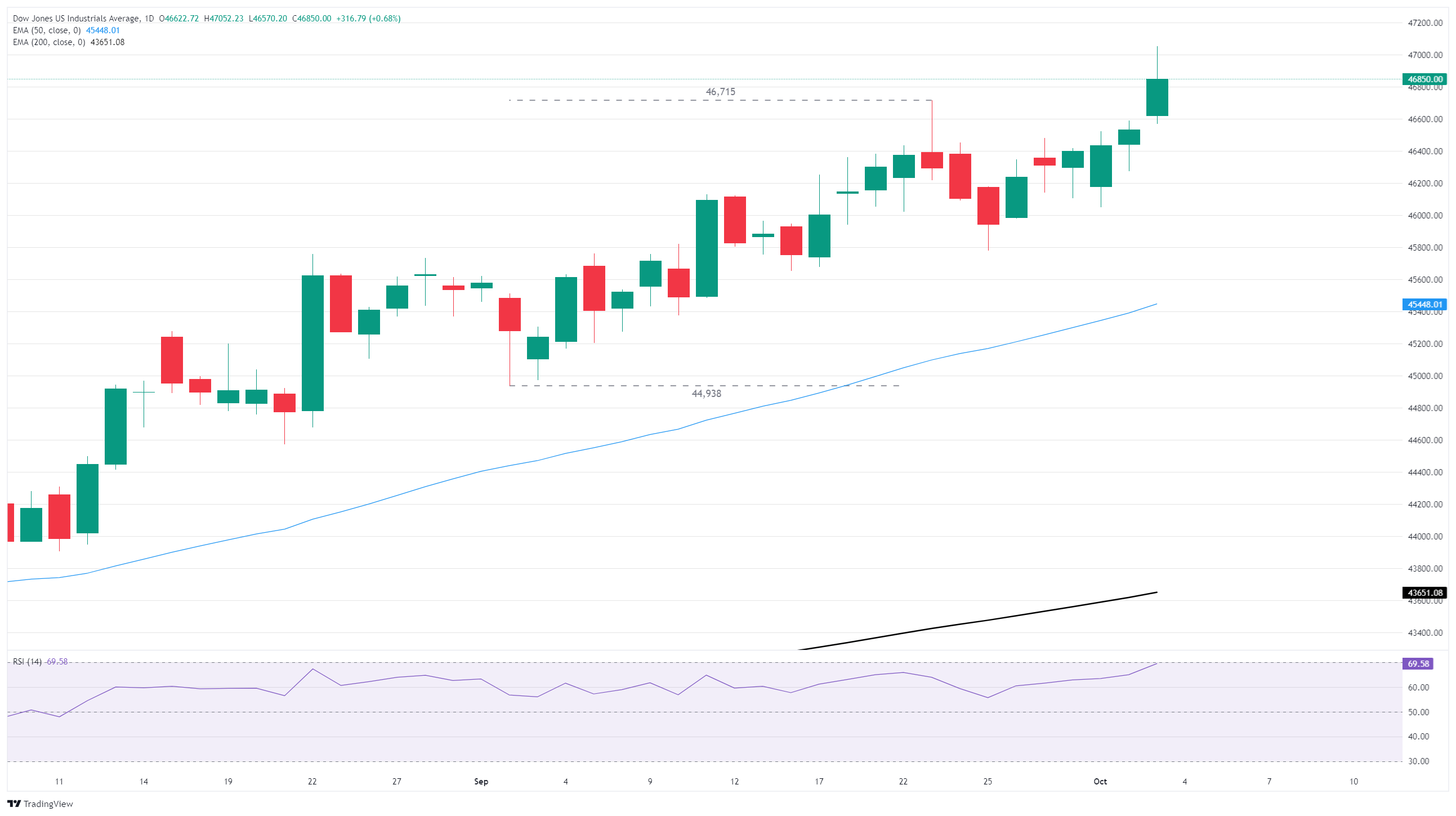
- The Dow Jones hit a fresh all-time high on Friday, clipping 47,000.
- Late-session profit-taking trimmed the Dow’s bullish momentum, but the index still remains firmly in the green.
- Investors are shrugging off the ongoing US government shutdown for the time being as NFP delay bolsters rate cut hopes.

The Dow Jones Industrial Average (DJIA) caught a firm bid on Friday, rising 482 points, or 1.04%, bottom-to-top. The Dow briefly pierced the 47,000 major price handle for the first time ever, before easing back to a more sedate +250 points (0.55%) on the day. Broad-market index gains were trimmed by a late-session pullback in familiar tech names such as Palantir (PLTR), Tesla (TSLA), and Nvidia (NVDA).
Equities climb despite key data going dark
The Dow has chalked up another bullish week, closing flat or in the green for a fourth consecutive trading week as bullish investor sentiment continues. Markets are shaking off the US government’s ongoing budget shutdown, with investors confident that the federal closure will be short-lived. In the meantime, the absence of key official labor data has limited the available pool of data that the Federal Reserve (Fed) can use to inform its interest rate decisions, reinforcing investor expectations that the Fed will deliver a follow-up quarter-point interest rate cut on October 29.
The Trump administration is chomping at the bit to use the federal shutdown as an opportunity to shutter and terminate entire departments of federal workers within the government, a policy move that could put further pressure on the labor market, ostensibly in a move to trim overspending at the federal level. After the DOGE experiment headed up by former Trump frontman Elon Musk failed to generate the outsized cost savings that were promised at the beginning of Donald Trump’s second term, the federal government has overspent on its budget every single month since Trump took office in January.
Lacking NFP, labor market appears to be weakening, bolstering rate cut odds
The Trump administration’s moves to further cut federal employment amidst the government shutdown bode poorly after ADP Employment Change figures posted earlier this week saw the datapoint’s steepest single-month decline in over two years. The latest Nonfarm Payrolls (NFP) report has been suspended until the government shutdown ends, and investors expect that the missing datapoint will limit the amount of data that the Fed could use to avoid further interest rate cuts through the remainder of the year.
Dow Jones daily chart
Economic Indicator
ISM Services PMI
The Institute for Supply Management (ISM) Services Purchasing Managers Index (PMI), released on a monthly basis, is a leading indicator gauging business activity in the US services sector, which makes up most of the economy. The indicator is obtained from a survey of supply executives across the US based on information they have collected within their respective organizations. Survey responses reflect the change, if any, in the current month compared to the previous month. A reading above 50 indicates that the services economy is generally expanding, a bullish sign for the US Dollar (USD). A reading below 50 signals that services sector activity is generally declining, which is seen as bearish for USD.
Read more.Last release: Fri Oct 03, 2025 14:00
Frequency: Monthly
Actual: 50
Consensus: 51.7
Previous: 52
Source: Institute for Supply Management
The Institute for Supply Management’s (ISM) Services Purchasing Managers Index (PMI) reveals the current conditions in the US service sector, which has historically been a large GDP contributor. A print above 50 shows expansion in the service sector’s economic activity. Stronger-than-expected readings usually help the USD gather strength against its rivals. In addition to the headline PMI, the Employment Index and the Prices Paid Index numbers are also watched closely by investors as they provide useful insights regarding the state of the labour market and inflation.
Author

Joshua Gibson
FXStreet
Joshua joins the FXStreet team as an Economics and Finance double major from Vancouver Island University with twelve years' experience as an independent trader focusing on technical analysis.
















