Dow Jones Industrial Average falls back as investors brace for US-China trade talks
- The Dow Jones shed around 150 points on Friday, falling back to 41,225.
- Investors are bracing for geopolitical tensions as the US and China head for initial trade talks.
- Even a social media post from President Trump pondering 80% tariffs could bolster market sentiment.

The Dow Jones Industrial Average (DJIA) followed the broader market lower on Friday, falling below 41,250 as investors gear up for a tense weekend. The United States (US) and China are headed for opening trade talks in Switzerland this weekend, but policymakers from both administrations have cautioned that talks will be strictly preliminary. Chinese delegates have specifically warned that a definitive deal could be months away.
US President Donald Trump hit social media early on Friday, publicly musing about a potential walkback of tariffs on Chinese goods that currently stand at an eye-watering 145%. Donald Trump floated the idea of reducing Chinese tariffs to 80%. An 80% tariff on Chinese goods is indistinguishable from 145%, as both levels are so high that they functionally represent an embargo on cheap trade, which the entire US economy is wholly dependent on.
Middling Fed remains apprehensive of rate adjustments
The Federal Reserve (Fed) hit a firm wait-and-see tone this week, after holding interest rates steady in May. A slew of Fed policymakers made public appearances on Friday, but they all put significant effort into avoiding speaking directly on monetary policy. The Fed looks set to continue shrugging its shoulders at the uncertainty from lopsided trade policy rendering it impossible to accurately forecast economic outcomes, leaving the data-dependent Fed planted firmly on the sidelines.
According to the CME’s FedWatch Tool, rate traders are still pricing in better-than-even odds of the Fed being forced to deliver another quarter-point rate cut in July, but bets have been bleeding back toward another rate hold. At the current cut, rate markets are pricing in a 40% chance that the Fed won’t cut in July either, up from the 20% to 30% odds were floating around earlier this week.
Dow Jones price forecast
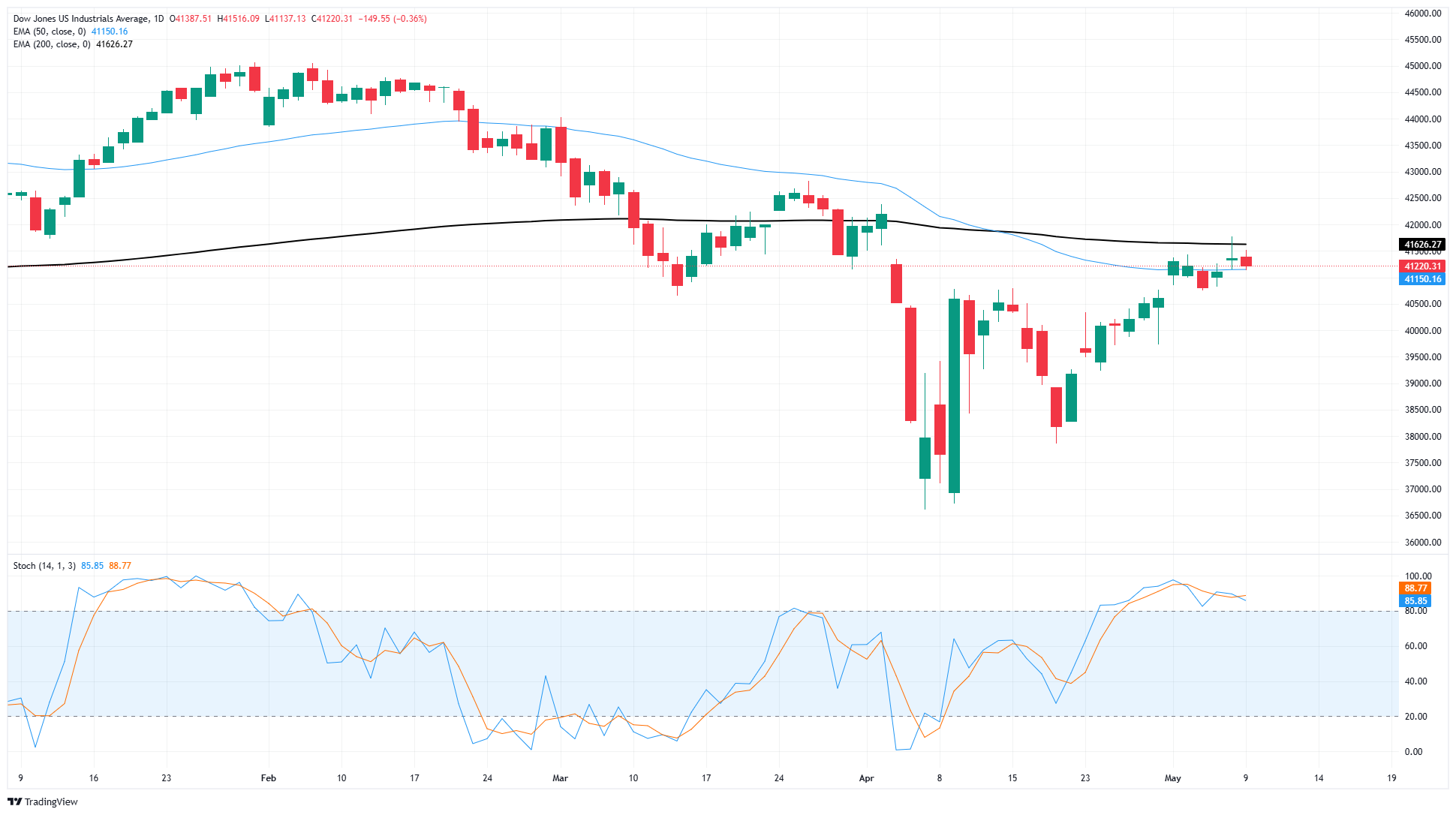
The Dow Jones is poised for an extended backslide after flubbing a bullish run at the 200-day Exponential Moving Average (EMA) near 41,600 this week. Price action is easing back down from the key moving average, but near-term technical support is getting priced in at the 50-day EMA near 41,150.
Despite dark technical clouds gathering overhead, momentum still rests firmly in the hands of bidders. The Dow Jones has recovered over 12.5% from April’s plunge below 37,000, and bids have continued to grind higher as market sentiment recovers.
Dow Jones daily chart
Dow Jones FAQs
The Dow Jones Industrial Average, one of the oldest stock market indices in the world, is compiled of the 30 most traded stocks in the US. The index is price-weighted rather than weighted by capitalization. It is calculated by summing the prices of the constituent stocks and dividing them by a factor, currently 0.152. The index was founded by Charles Dow, who also founded the Wall Street Journal. In later years it has been criticized for not being broadly representative enough because it only tracks 30 conglomerates, unlike broader indices such as the S&P 500.
Many different factors drive the Dow Jones Industrial Average (DJIA). The aggregate performance of the component companies revealed in quarterly company earnings reports is the main one. US and global macroeconomic data also contributes as it impacts on investor sentiment. The level of interest rates, set by the Federal Reserve (Fed), also influences the DJIA as it affects the cost of credit, on which many corporations are heavily reliant. Therefore, inflation can be a major driver as well as other metrics which impact the Fed decisions.
Dow Theory is a method for identifying the primary trend of the stock market developed by Charles Dow. A key step is to compare the direction of the Dow Jones Industrial Average (DJIA) and the Dow Jones Transportation Average (DJTA) and only follow trends where both are moving in the same direction. Volume is a confirmatory criteria. The theory uses elements of peak and trough analysis. Dow’s theory posits three trend phases: accumulation, when smart money starts buying or selling; public participation, when the wider public joins in; and distribution, when the smart money exits.
There are a number of ways to trade the DJIA. One is to use ETFs which allow investors to trade the DJIA as a single security, rather than having to buy shares in all 30 constituent companies. A leading example is the SPDR Dow Jones Industrial Average ETF (DIA). DJIA futures contracts enable traders to speculate on the future value of the index and Options provide the right, but not the obligation, to buy or sell the index at a predetermined price in the future. Mutual funds enable investors to buy a share of a diversified portfolio of DJIA stocks thus providing exposure to the overall index.
Author

Joshua Gibson
FXStreet
Joshua joins the FXStreet team as an Economics and Finance double major from Vancouver Island University with twelve years' experience as an independent trader focusing on technical analysis.