Dow Jones Industrial Average holds steady as investors watch government shutdown commence
- The Dow Jones continues to hold close to 46,500 despite a US government shutdown.
- ADP jobs data showed a steep contraction in hiring, counterintuitively bolstering risk appetite.
- Despite holding steady, investors remain apprehensive about what comes next from the Trump administration.

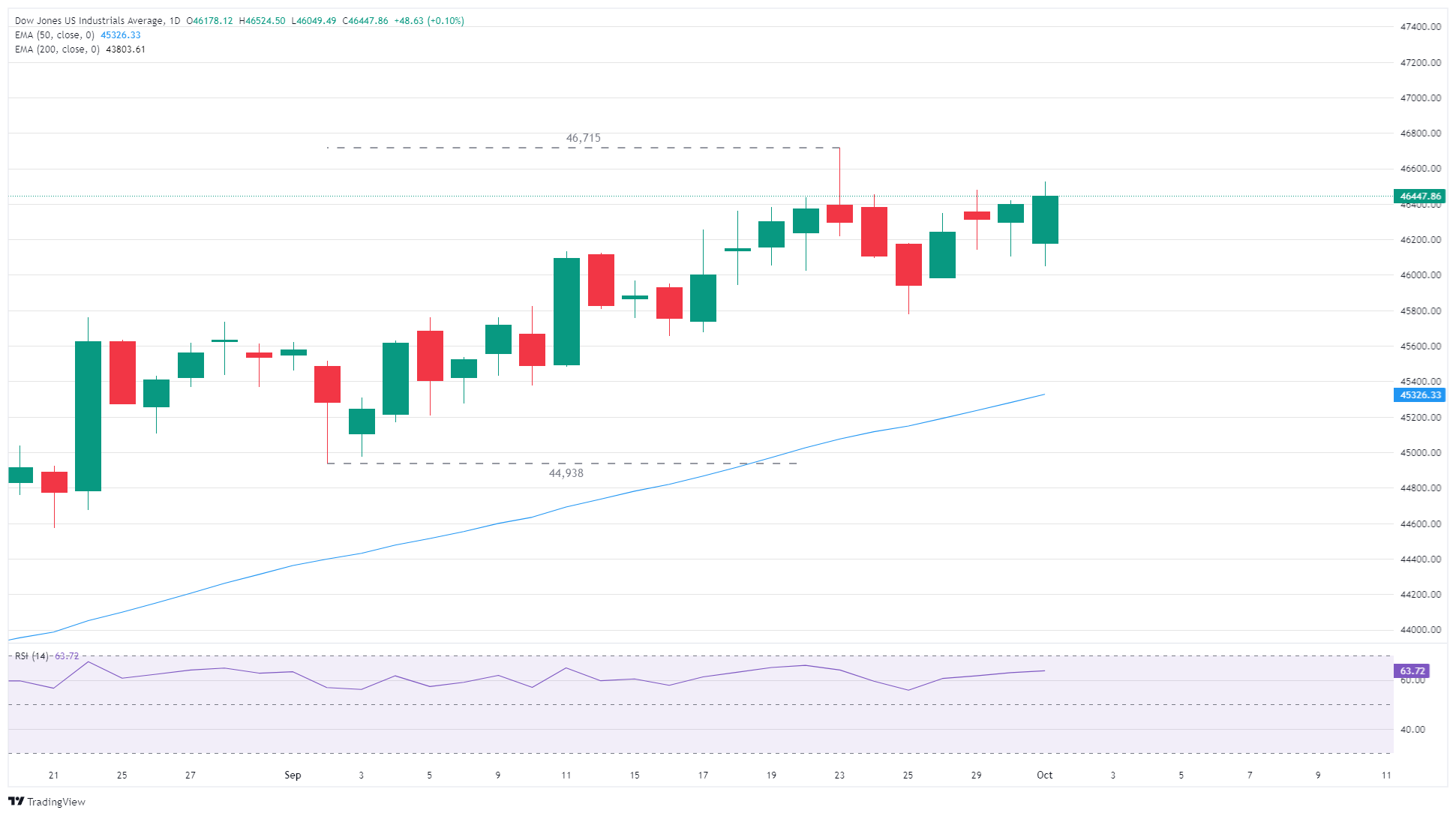
The Dow Jones Industrial Average (DJIA) churned the chart paper on Wednesday, facing pre-market and early hour losses before recovering its stance enough to hold close to the 46,500 level. The Dow has remained in the same neighborhood since punching out new record highs a little over a week ago, keeping downside momentum at bay.
The US federal government is now in shutdown mode, with Congress unable to muscle a budget spending bill across the line before the regular start of the fiscal year on October 1, which occurs every single year and should come as no surprise to policymakers in Washington. Democrats have introduced two separate budget reconciliation bills this week, but House Republicans responded by skipping all budget meetings and remaining absent during two separate bill readings that would have provided a stopgap funding solution while a larger budget bill is considered.
Investors getting used to weathering shutdown storms
Federal shutdowns have almost become the norm rather than the exception during Trump's presidency: This will be the fourth federal shutdown over budget disagreements that Trump has presided over across his two terms. The last federal shutdown, which occurred in 2018, lasted for 35 consecutive days and remains the longest government closure in US history. Donald Trump has a long-standing history of stating that any government shutdown is the fault of the president, as he declared in 2013 and 2011 by saying, “problems start from the top, and they have to get solved from the top and the president's the leader… he’s got to get everybody in the room and he’s got to lead.”
ADP Employment Change figures came in much lower than the street expected, showing a contraction of -32K in September versus the expected 50K. August’s initial print of 54K was also revised sharply lower to -3K. ADP jobs figures suffer from constant revisions, but the figure has generally missed expectations for all but three of the monthly figures published since the start of 2025.
ADP gains importance as NFP print gets thrown into question
The Bureau of Labor Statistics (BLS) is poised to delay or suspend the release of September’s Nonfarm Payrolls (NFP) jobs report that was slated for this week. Initially due on Friday, the closure of the US federal government has made it difficult, if not impossible, for official data services to conduct regular operations. The NFP suspension comes at a time when markets are closely watching official labor data to suss out the Federal Reserve’s (Fed) expected pace of rate cuts through the remainder of the year.
With the NFP print in jeopardy, investors are leaning further on private data such as ADP. According to the CME’s FedWatch Tool, rate trader bets of another quarter-point interest rate cut on October 29 surged to 99% post-ADP on Wednesday. Rate markets are also pricing in nearly 90% odds of a third-straight rate trim on December 10, and a further 93% that the Fed will deliver a fourth interest rate cut by next April at the absolute latest.
Dow Jones daily chart
Dow Jones FAQs
The Dow Jones Industrial Average, one of the oldest stock market indices in the world, is compiled of the 30 most traded stocks in the US. The index is price-weighted rather than weighted by capitalization. It is calculated by summing the prices of the constituent stocks and dividing them by a factor, currently 0.152. The index was founded by Charles Dow, who also founded the Wall Street Journal. In later years it has been criticized for not being broadly representative enough because it only tracks 30 conglomerates, unlike broader indices such as the S&P 500.
Many different factors drive the Dow Jones Industrial Average (DJIA). The aggregate performance of the component companies revealed in quarterly company earnings reports is the main one. US and global macroeconomic data also contributes as it impacts on investor sentiment. The level of interest rates, set by the Federal Reserve (Fed), also influences the DJIA as it affects the cost of credit, on which many corporations are heavily reliant. Therefore, inflation can be a major driver as well as other metrics which impact the Fed decisions.
Dow Theory is a method for identifying the primary trend of the stock market developed by Charles Dow. A key step is to compare the direction of the Dow Jones Industrial Average (DJIA) and the Dow Jones Transportation Average (DJTA) and only follow trends where both are moving in the same direction. Volume is a confirmatory criteria. The theory uses elements of peak and trough analysis. Dow’s theory posits three trend phases: accumulation, when smart money starts buying or selling; public participation, when the wider public joins in; and distribution, when the smart money exits.
There are a number of ways to trade the DJIA. One is to use ETFs which allow investors to trade the DJIA as a single security, rather than having to buy shares in all 30 constituent companies. A leading example is the SPDR Dow Jones Industrial Average ETF (DIA). DJIA futures contracts enable traders to speculate on the future value of the index and Options provide the right, but not the obligation, to buy or sell the index at a predetermined price in the future. Mutual funds enable investors to buy a share of a diversified portfolio of DJIA stocks thus providing exposure to the overall index.
Author

Joshua Gibson
FXStreet
Joshua joins the FXStreet team as an Economics and Finance double major from Vancouver Island University with twelve years' experience as an independent trader focusing on technical analysis.