Dow Jones Industrial Average takes one last bullish swing for the week
- The Dow Jones clawed back around 240 points on Friday.
- Investors are shrugging off a recent downturn in regional banking and lending stocks.
- President Trump floated a softball hint that China tariffs might get walked back eventually.

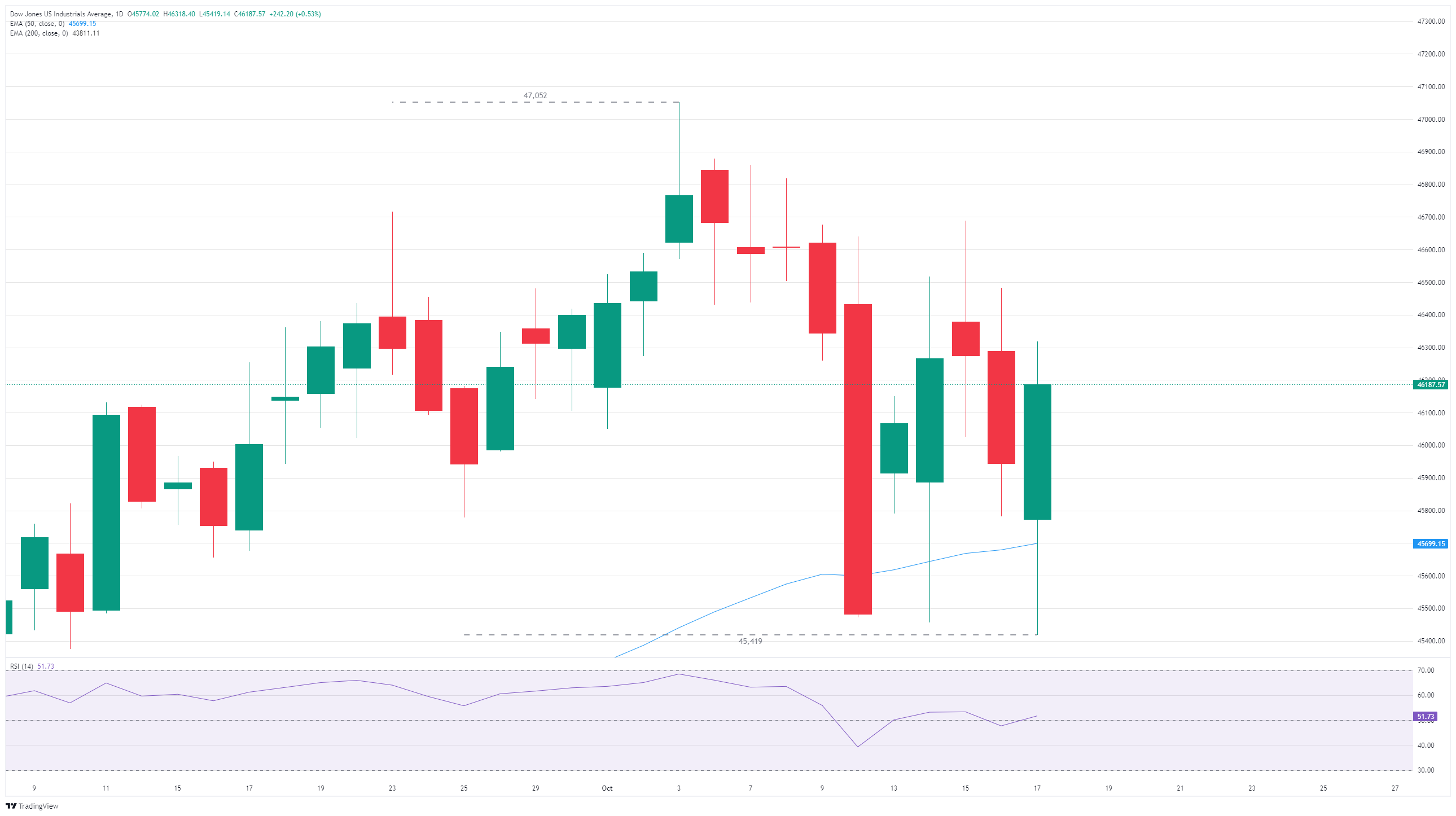
The Dow Jones Industrial Average (DJIA) found a near-term foothold to wrap up the trading week, rebounding around 240 points from recent lows and fighting to stay on the high side of key moving averages. Equities took a hit this week after multiple entities in the lending and banking sectors went bankrupt or flashed warnings about debt quality, sparking a brief period of wobbly sentiment. Investors recovered their footing to end the week.
Friday rebound takes Dow back from the brink
Friday’s equity market recovery was partly driven by hope of an easing in trade tensions after US President Donald Trump soft-balled the idea that his administration could eventually explore reducing tariffs on China. The Trump administration continues to appear more apprehensive about following through on its own threats to ramp up retaliatory tariffs on China, and investors are continuing to bank on a protracted cooling period in sweeping tariffs threatened or imposed by the Trump administration throughout 2025.
After a brief spat of angry social media posts and pulling out of planned sideline talks with China’s President Xi Jinping, President Trump has dragged himself back to the negotiating table. Fresh trade talks between Donald Trump and Xi Jinping are now expected in the coming weeks, along with meetings between US Treasury Secretary Scott Bessent and Chinese Vice Premier He Lifeng.
The US government shutdown continues to roll onward with little sign of a quick resolution. Official datasets remain suspended or delayed, but this can only be good news for markets that remain hinged largely on impending interest rate cuts from the Federal Reserve (Fed). With official data running dark amid a federal funding freeze, Fed officials will have very limited access to data that could knock the US central bank off its path toward two quarter-point interest rate cuts before the end of the year.
Dow Jones daily chart
Dow Jones FAQs
The Dow Jones Industrial Average, one of the oldest stock market indices in the world, is compiled of the 30 most traded stocks in the US. The index is price-weighted rather than weighted by capitalization. It is calculated by summing the prices of the constituent stocks and dividing them by a factor, currently 0.152. The index was founded by Charles Dow, who also founded the Wall Street Journal. In later years it has been criticized for not being broadly representative enough because it only tracks 30 conglomerates, unlike broader indices such as the S&P 500.
Many different factors drive the Dow Jones Industrial Average (DJIA). The aggregate performance of the component companies revealed in quarterly company earnings reports is the main one. US and global macroeconomic data also contributes as it impacts on investor sentiment. The level of interest rates, set by the Federal Reserve (Fed), also influences the DJIA as it affects the cost of credit, on which many corporations are heavily reliant. Therefore, inflation can be a major driver as well as other metrics which impact the Fed decisions.
Dow Theory is a method for identifying the primary trend of the stock market developed by Charles Dow. A key step is to compare the direction of the Dow Jones Industrial Average (DJIA) and the Dow Jones Transportation Average (DJTA) and only follow trends where both are moving in the same direction. Volume is a confirmatory criteria. The theory uses elements of peak and trough analysis. Dow’s theory posits three trend phases: accumulation, when smart money starts buying or selling; public participation, when the wider public joins in; and distribution, when the smart money exits.
There are a number of ways to trade the DJIA. One is to use ETFs which allow investors to trade the DJIA as a single security, rather than having to buy shares in all 30 constituent companies. A leading example is the SPDR Dow Jones Industrial Average ETF (DIA). DJIA futures contracts enable traders to speculate on the future value of the index and Options provide the right, but not the obligation, to buy or sell the index at a predetermined price in the future. Mutual funds enable investors to buy a share of a diversified portfolio of DJIA stocks thus providing exposure to the overall index.
Author

Joshua Gibson
FXStreet
Joshua joins the FXStreet team as an Economics and Finance double major from Vancouver Island University with twelve years' experience as an independent trader focusing on technical analysis.