Dow Jones Industrial Average rebounds 300 points as markets recover footing
- The Dow Jones rebounded on Wednesday, climbing from 47,200.
- The week’s brief but severe AI plunge has recovered for the time being.
- US ISM Services PMI results and ADP labor data gave investors a confidence boost.

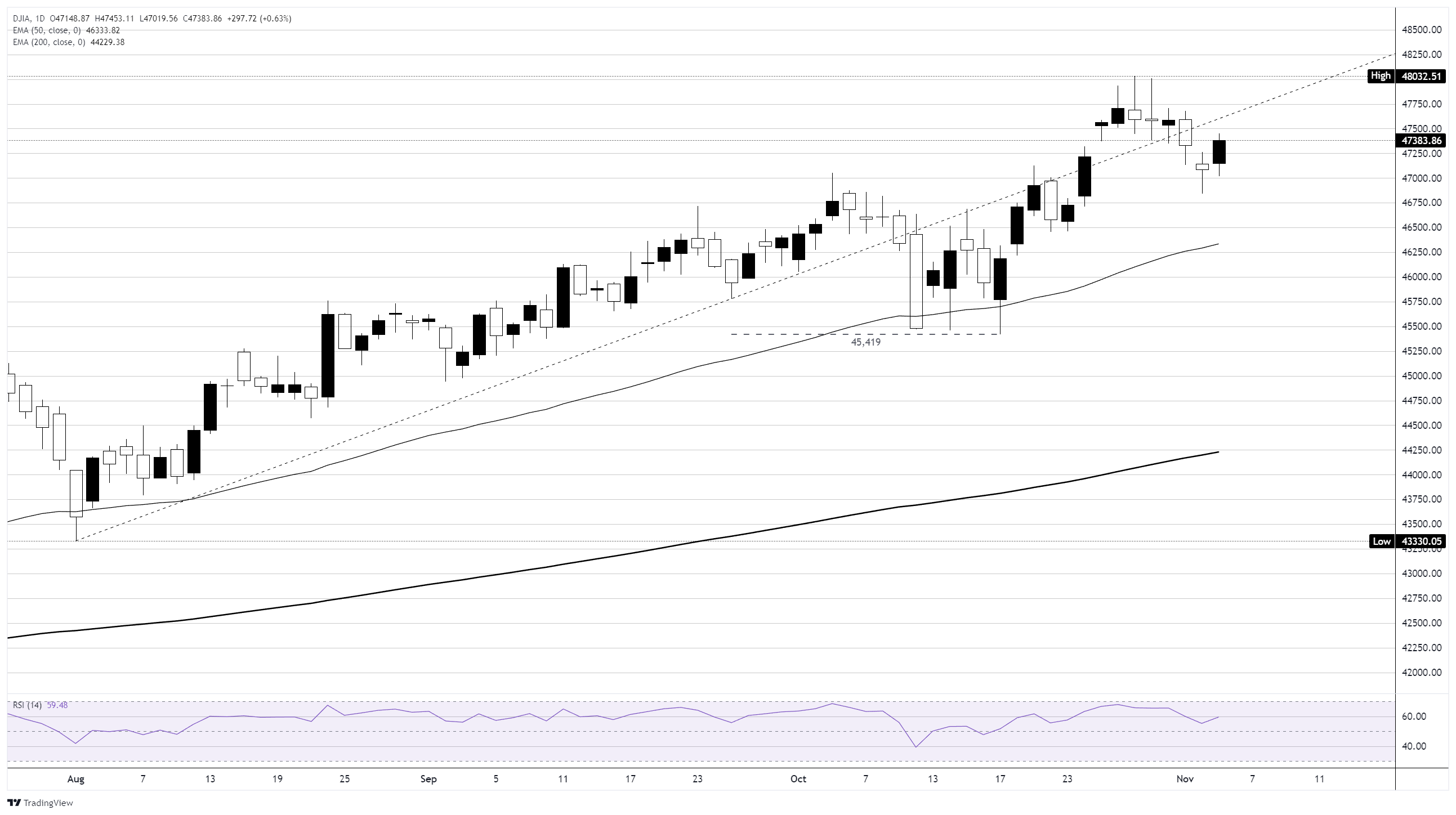
The Dow Jones Industrial Average (DJIA) crimped bearish flows on Wednesday, finding a near-term foothold near the 47,200 level and rising 300 points as equity markets recover following an early-week plunge in the heavily concentrated AI and tech infrastructure segments. US Purchasing Managers Index (PMI) and ADP Employment Change data prints helped to soothe investor fears about a potential economic downturn. However, several cautionary flags bear mention on Wednesday’s data docket.
AI sell-off recovers quickly
A steep sell-off in key stocks in the AI scene earlier this week sent equity markets broadly lower, briefly revealing to investors just how much of the investment world has become concentrated in a few key tech players, knocking on market sentiment even further. Palantir (PLTR) extended its mid-week decline, shedding further weight on Wednesday after falling a stunning 8% on Tuesday despite beating analyst earnings expectations. Elsewhere across the market, investor sentiment is back on the rebound, keeping indexes bid back into the green, though the Dow Jones remains down for the week.
ADP Employment Change numbers came in higher than expected, showing an estimated net gain of 42K new jobs in October compared to the previous month’s print of -29K. ADP figures have a poor track record of accurately correlating to official datasets from one release to the next, but with the US federal government in full shutdown mode with no end in sight, investors are placing additional significance on volatile private data.
PMIs up, but at what cost
The Institute for Supply Management’s (ISM) latest Services PMI showed a healthy uptick in service sector business sentiment in October, but here too lies the same volatility problem: response rates to private surveys tend to range from low to abysmal, frequently missing much of the key elements gleaned from large-scale official datasets.
October’s ISM Services PMI rose to 52.4 from 50.0, indicating an overall improvement in business activity sentiment. However, the internals of the report show rising pressure in supplier deliveries, and the inventories index contracted for a second straight month, implying service providers are struggling to get their hands on additional merchandise and materials, which could eventually show up as additional price inflation pressure further down the line.
Dow Jones daily chart
Economic Indicator
ADP Employment Change
The ADP Employment Change is a gauge of employment in the private sector released by the largest payroll processor in the US, Automatic Data Processing Inc. It measures the change in the number of people privately employed in the US. Generally speaking, a rise in the indicator has positive implications for consumer spending and is stimulative of economic growth. So a high reading is traditionally seen as bullish for the US Dollar (USD), while a low reading is seen as bearish.
Read more.Last release: Wed Nov 05, 2025 13:15
Frequency: Monthly
Actual: 42K
Consensus: 25K
Previous: -32K
Source: ADP Research Institute
Traders often consider employment figures from ADP, America’s largest payrolls provider, report as the harbinger of the Bureau of Labor Statistics release on Nonfarm Payrolls (usually published two days later), because of the correlation between the two. The overlaying of both series is quite high, but on individual months, the discrepancy can be substantial. Another reason FX traders follow this report is the same as with the NFP – a persistent vigorous growth in employment figures increases inflationary pressures, and with it, the likelihood that the Fed will raise interest rates. Actual figures beating consensus tend to be USD bullish.
Author

Joshua Gibson
FXStreet
Joshua joins the FXStreet team as an Economics and Finance double major from Vancouver Island University with twelve years' experience as an independent trader focusing on technical analysis.

















