Dow Jones Industrial Average fumbles bullish attempt
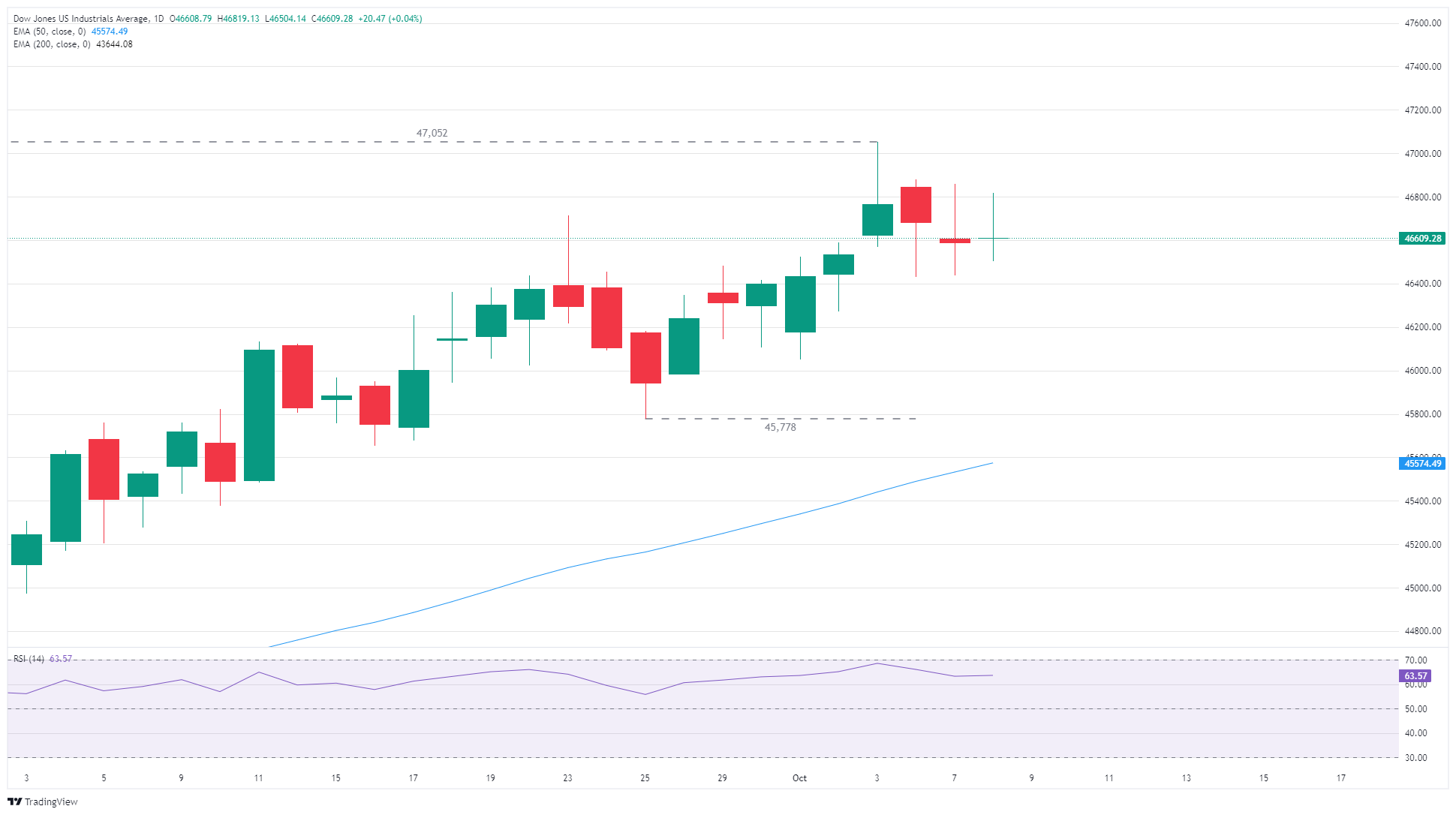
- The Dow Jones rebounded on Wednesday, briefly tapping 46,800.
- Equities are struggling to shake off a brief spat of risk aversion over the ongoing US shutdown.
- The AI rally continues to cough and sputter, but key hardware providers for the LLM segment still defy gravity.

The Dow Jones Industrial Average (DJIA) briefly tilted back into the bullish side on Wednesday, recovering recently lost ground and retesting the 46,800 level as major indexes look to reestablish their top-heavy stance. Investors continue to shrug off the ongoing US government shutdown; however, several failed attempts to jumpstart federal operations on the Senate floor on Wednesday kept investor apprehension close to the surface.
The Dow stumbled back into Wednesday's opening bids near 46,600 through the American market session as investor sentiment spoils back into tepid territory.
The Federal Reserve’s (Fed) latest meeting Minutes confirmed that several Fed officials have indeed shifted lower on the dot plot, with policymakers generally acknowledging “downside risks” on the labor side of the Fed’s dual mandate. Despite a steeper curve in rate cut expectations from Fed voters, the Fed’s Gross Domestic Product (GDP) outlook through 2028 was revised higher.
According to the CME’s FedWatch Tool, interest rate expectations shifted slightly lower after the release of the meeting Minutes from the Fed’s interest rate decision in September. Rate markets are still pricing in over 92% odds of a follow-up interest rate cut on October 29, however widespread market hopes for a third straight interest rate trim on December 10 have come under threat. Fed Funds futures still see over 75% odds that the Fed will do a third straight cut in December, but odds are even higher that a third cut could be pushed out to January 2026.
With the Fed’s meeting Minutes out of the way, and the US government’s shutdown continuing to grind onward, investors will be looking ahead to this week’s University of Michigan (UoM) Consumer Sentiment Index update due on Friday. The UoM survey index is expected to tick down to 54.2 from 55.1, and traders will be keenly watching UoM 1-year and 5-year Consumer Inflation Expectations for any signs that inflation worries may become entrenched.
Dow Jones daily chart
Fed FAQs
Monetary policy in the US is shaped by the Federal Reserve (Fed). The Fed has two mandates: to achieve price stability and foster full employment. Its primary tool to achieve these goals is by adjusting interest rates. When prices are rising too quickly and inflation is above the Fed’s 2% target, it raises interest rates, increasing borrowing costs throughout the economy. This results in a stronger US Dollar (USD) as it makes the US a more attractive place for international investors to park their money. When inflation falls below 2% or the Unemployment Rate is too high, the Fed may lower interest rates to encourage borrowing, which weighs on the Greenback.
The Federal Reserve (Fed) holds eight policy meetings a year, where the Federal Open Market Committee (FOMC) assesses economic conditions and makes monetary policy decisions. The FOMC is attended by twelve Fed officials – the seven members of the Board of Governors, the president of the Federal Reserve Bank of New York, and four of the remaining eleven regional Reserve Bank presidents, who serve one-year terms on a rotating basis.
In extreme situations, the Federal Reserve may resort to a policy named Quantitative Easing (QE). QE is the process by which the Fed substantially increases the flow of credit in a stuck financial system. It is a non-standard policy measure used during crises or when inflation is extremely low. It was the Fed’s weapon of choice during the Great Financial Crisis in 2008. It involves the Fed printing more Dollars and using them to buy high grade bonds from financial institutions. QE usually weakens the US Dollar.
Quantitative tightening (QT) is the reverse process of QE, whereby the Federal Reserve stops buying bonds from financial institutions and does not reinvest the principal from the bonds it holds maturing, to purchase new bonds. It is usually positive for the value of the US Dollar.
Author

Joshua Gibson
FXStreet
Joshua joins the FXStreet team as an Economics and Finance double major from Vancouver Island University with twelve years' experience as an independent trader focusing on technical analysis.

















