Dow Jones Industrial Average climbs as markets bet on easing US-China trade tensions
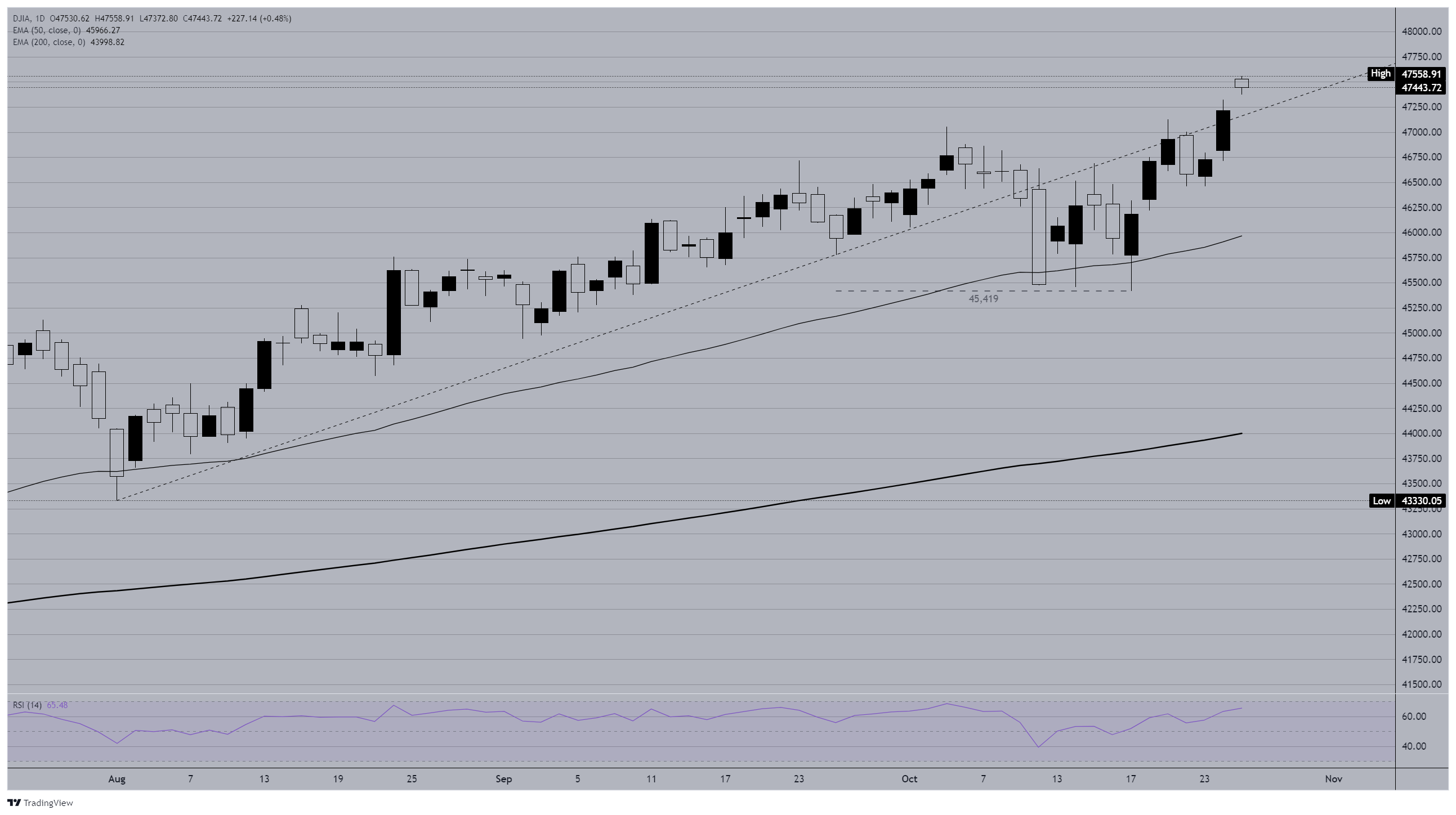
- The Dow Jones poked its way into a new all-time high in early US trading on Monday.
- Investors are banking on a pressure release on US-China trade tensions.
- This week is packed with another Fed interest rate call and key tech earnings reports.

The Dow Jones Industrial Average (DJIA) climbed into a fresh record high in early Monday trading, poking through 47,500 for the first time ever as investors continue to recover their sentiment footing. Markets are betting that another last-minute trade deal between the US and China will avert the worst of President Donald Trump’s threatened tariffs.
Trade deal again, maybe?
Threatening new, steep tariffs and then finding a reason to walk them back at the eleventh hour has become a dedicated habit for the Trump administration, giving investors plenty of reason to bank on another walkback of a fresh 100% (but sometimes 155%) tariff on China that is theoretically set to come into effect on November 1. There remains little evidence that China will be walking back its recent pivot into further restricting foreign access to domestic rare earth minerals markets, other than general lip service that the new policy will be reviewed following fresh trade discussions. Nor is there any word on removing a new port fee for foreign cargo ships that moor at Chinese docks.
Key tech companies will be releasing third-quarter earnings throughout the week as the latest earnings season continues to grind on. Five of the 'Magnificent Seven' are on deck for earnings releases this week, including Google parent Alphabet (GOOG), Amazon (AMZN), Apple (AAPL), Facebook parent Meta (META), and Windows publisher Microsoft (MSFT).
Fed rate call in the crosshairs
The key event this week will be the Federal Reserve’s (Fed) latest interest rate decision, slated for Wednesday. A follow-up quarter-point interest rate cut is functionally a done deal as far as rate markets are concerned, and the key highlights from this week’s rate call will be how interested the Fed sounds in delivering a third straight rate cut at its subsequent rate meeting in December.
Dow Jones daily chart
Dow Jones FAQs
The Dow Jones Industrial Average, one of the oldest stock market indices in the world, is compiled of the 30 most traded stocks in the US. The index is price-weighted rather than weighted by capitalization. It is calculated by summing the prices of the constituent stocks and dividing them by a factor, currently 0.152. The index was founded by Charles Dow, who also founded the Wall Street Journal. In later years it has been criticized for not being broadly representative enough because it only tracks 30 conglomerates, unlike broader indices such as the S&P 500.
Many different factors drive the Dow Jones Industrial Average (DJIA). The aggregate performance of the component companies revealed in quarterly company earnings reports is the main one. US and global macroeconomic data also contributes as it impacts on investor sentiment. The level of interest rates, set by the Federal Reserve (Fed), also influences the DJIA as it affects the cost of credit, on which many corporations are heavily reliant. Therefore, inflation can be a major driver as well as other metrics which impact the Fed decisions.
Dow Theory is a method for identifying the primary trend of the stock market developed by Charles Dow. A key step is to compare the direction of the Dow Jones Industrial Average (DJIA) and the Dow Jones Transportation Average (DJTA) and only follow trends where both are moving in the same direction. Volume is a confirmatory criteria. The theory uses elements of peak and trough analysis. Dow’s theory posits three trend phases: accumulation, when smart money starts buying or selling; public participation, when the wider public joins in; and distribution, when the smart money exits.
There are a number of ways to trade the DJIA. One is to use ETFs which allow investors to trade the DJIA as a single security, rather than having to buy shares in all 30 constituent companies. A leading example is the SPDR Dow Jones Industrial Average ETF (DIA). DJIA futures contracts enable traders to speculate on the future value of the index and Options provide the right, but not the obligation, to buy or sell the index at a predetermined price in the future. Mutual funds enable investors to buy a share of a diversified portfolio of DJIA stocks thus providing exposure to the overall index.
Author

Joshua Gibson
FXStreet
Joshua joins the FXStreet team as an Economics and Finance double major from Vancouver Island University with twelve years' experience as an independent trader focusing on technical analysis.