Dow Jones Industrial Average trims early gains, softens on Tuesday
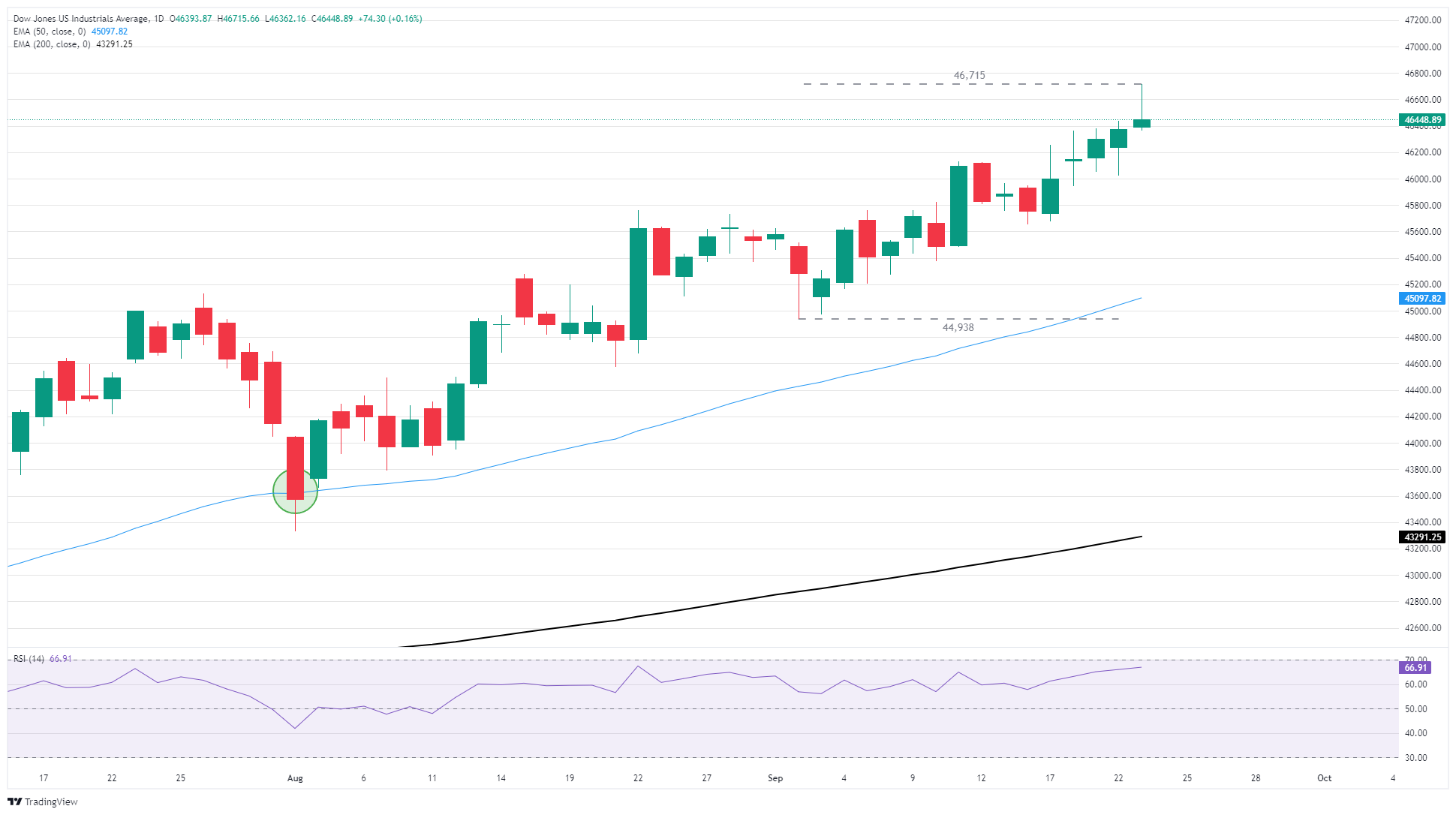
- The Dow Jones touched 46,700 for the first time ever on Tuesday.
- Despite equity indexes tilted into record highs, topside momentum remains thin.
- US PMI figures came in more or less as expected, but headline figures still declined.

The Dow Jones Industrial Average (DJIA) clipped another record intraday high on Tuesday, peaking near 46,715 for the first time. The Dow is tilted into the bullish side this week, teasing an extension into a fifth straight green session. However, gains reversed course as market concerns continue to lurk just out of eyesight.
The Dow was driven into fresh record highs by a general rise in the energy sector, followed by firm gains in real estate and health services. Consumer discretionary stocks fell back on Tuesday, with the tech sector giving back some of the week’s early gains.
UnitedHealth (UNH) and Boeing (BA) drove the Dow Jones higher with UNH climbing around 3% on the day as investors step back into the health services and insurance giant. A looming investigation for Medicare fraud appears to have blown over for UnitedHealth, giving markets free run to continue bidding UNH shares back over $350.
Boeing rose over 2% on Tuesday, climbing back into $216.50 after Uzbekistani President Shavkat Mirziyoyev inked a deal with the airplane manufacturer worth over $8 billion. Boeing gained further ground after rumors accelerated that the US and China could be heading toward a “huge” deal around Boeing purchases.
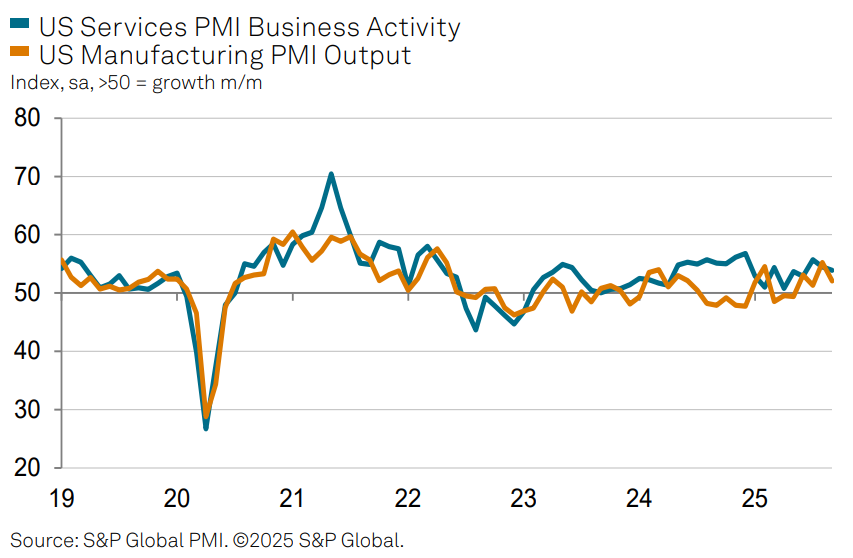
US Purchasing Managers Index (PMI) survey results eased back in September, but headline figures came in near expectations, crimping the intraday fallout. S&P Global Manufacturing PMI data from September fell to 52.0 from 53.0, as investors expected, while the Services PMI component slipped to the forecast of 53.9 from 54.5. American businesses that bothered to respond to the survey noted that overall output through September remained high, putting the US economy on pace to grow by around 2.2% on an annualized basis. However, the pace of hiring is also expected to slow in the coming months in the face of easing demand conditions, and businesses are growing uneasy about a still-growing overhang in inventory growth as signs of disappointing sales trends in the future continue to calcify.
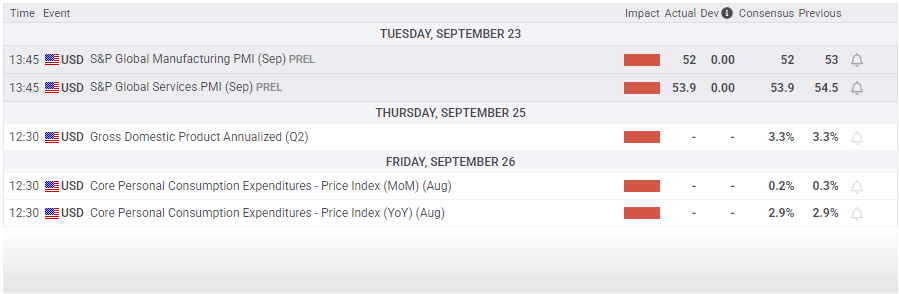
The US’s latest round of Personal Consumption Expenditures Price Index (PCE) inflation is due on Friday, and investors will be looking to see if enough businesses are letting themselves get squeezed out of their own profit margins to avoid passing on too much of tariff costs directly onto consumers too quickly.
Dow Jones daily chart
Dow Jones FAQs
The Dow Jones Industrial Average, one of the oldest stock market indices in the world, is compiled of the 30 most traded stocks in the US. The index is price-weighted rather than weighted by capitalization. It is calculated by summing the prices of the constituent stocks and dividing them by a factor, currently 0.152. The index was founded by Charles Dow, who also founded the Wall Street Journal. In later years it has been criticized for not being broadly representative enough because it only tracks 30 conglomerates, unlike broader indices such as the S&P 500.
Many different factors drive the Dow Jones Industrial Average (DJIA). The aggregate performance of the component companies revealed in quarterly company earnings reports is the main one. US and global macroeconomic data also contributes as it impacts on investor sentiment. The level of interest rates, set by the Federal Reserve (Fed), also influences the DJIA as it affects the cost of credit, on which many corporations are heavily reliant. Therefore, inflation can be a major driver as well as other metrics which impact the Fed decisions.
Dow Theory is a method for identifying the primary trend of the stock market developed by Charles Dow. A key step is to compare the direction of the Dow Jones Industrial Average (DJIA) and the Dow Jones Transportation Average (DJTA) and only follow trends where both are moving in the same direction. Volume is a confirmatory criteria. The theory uses elements of peak and trough analysis. Dow’s theory posits three trend phases: accumulation, when smart money starts buying or selling; public participation, when the wider public joins in; and distribution, when the smart money exits.
There are a number of ways to trade the DJIA. One is to use ETFs which allow investors to trade the DJIA as a single security, rather than having to buy shares in all 30 constituent companies. A leading example is the SPDR Dow Jones Industrial Average ETF (DIA). DJIA futures contracts enable traders to speculate on the future value of the index and Options provide the right, but not the obligation, to buy or sell the index at a predetermined price in the future. Mutual funds enable investors to buy a share of a diversified portfolio of DJIA stocks thus providing exposure to the overall index.
Author

Joshua Gibson
FXStreet
Joshua joins the FXStreet team as an Economics and Finance double major from Vancouver Island University with twelve years' experience as an independent trader focusing on technical analysis.