Dow Jones Industrial Average Forecast: DJIA closes higher following Fed rate pause
- US Treasury refunding of $112 billion sent yields lower.
- Federal Reserve keeps rates unchanged at FOMC meeting.
- Dow Jones Industrial Average has gained about 2% this week after crashing over the past two weeks.
- Amgen, Caterpillar already posted results this week, while Apple arrives on Thursday.

The Dow Jones Industrial Average (DJIA) closed up 0.67% on Wednesday following the Federal Reserve's (Fed) decision to keep the fed funds rate unchanged in a range between 5.25% to 5.5%. The tone of the central bank's FOMC statement was moderate, but the Fed did say, "inflation remains elevated" and left the door open to a future rate hike. The statement also said the bank would continue its policy of selling Treasuries, which could send yields higher and thus hurt equity prices over the near term.
That part of the statement did not hurt the equity market, however, and the S&P 500 and NASDAQ Composite both closed more than 1% higher. During his presser, Fed Chair Jerome Powell admitted that, "The question of rate cuts just hasn't come up." This confirms that the central bank is serious about keeping rates high well into 2024.
The DJIA dealt with the collapse of both Caterpillar (CAT) and Amgen (AMGN) stocks on Tuesday and still managed to close up 0.38%. The index now looks ahead to Apple (AAPL) earnings on Thursday, which will directly determine which direction the index breaks.
Dow Jones News: Treasury refunding sends yields lower, stocks higher
The US Treasury announced on Wednesday that it will issue $112 billion in new bonds and bills to repay $102.2 billion in debt due on November 15. The new issuance will result in $9.8 billion in funding for the US government.
Yields on the 2, 5, 10 and 30-year bonds all dropped more than 1% on the news. The market consensus called for $114 billion in this refunding round.
As is common, US equities are moving broadly higher on the reduction in Treasury yields. US Treasury yields are used as discount rates for equities, so as they drop stocks typically rise.
The Treasury will auction 3, 10 and 30-year bonds next week, and Secretary of the Treasury Janet Yellen says that coupons will likely rise for one more quarter.
Apple earnings in view as Amgen, Caterpillar disappoint
The Dow Jones index only has 30 stocks, so every earnings call from a component usually has an outsized effect. Dow members Caterpillar and Amgen both released quarterly results on Tuesday that failed to entice the market.
Amgen (5.1% of the Dow index) beat earnings consensus for the third quarter by $0.28 with $4.96 in adjusted earnings per share (EPS). Revenue was the sore spot, however, as it rose 4% YoY but misses consensus by $50 million. For the full year, Amgen said it will earn between $18.20 and $18.80 in adjusted EPS.
With adjusted EPS of $5.52 on $16.8 billion in sales for the third quarter, Caterpillar (4.5% of the Dow index) would have been predicted to see a climbing share price. The heavy equipment manufacturer beat on top and bottom lines, but the market flagged it for uncertain future growth prospects. Most of its 12% YoY increase in sales stemmed from higher prices rather than volumes.
Apple is the major player providing an earnings update this week though. Wall Street expects $1.39 in EPS on $89.42 billion in sales for its fiscal fourth quarter. CEO Tim Cook’s electronics megalith is widely expected to beat consensus, but recent news suggests that demand may be waning for its iPhone 15.
Since Apple makes up just 3.4% of the index, the direct effect of earnings may be lower than expected. However, the entire equity market is likely to move alongside Apple since it is the largest US stock by market cap at $2.67 trillion.
Don’t count Apple out though, says Wedbush’s star analyst Dan Ives. “The overall sentiment of Apple on the Street is a negative ‘groupthink mentality,’” a team led by Ives wrote on Wednesday. The Wedbush note said that its research in Asia leads it to believe that Apple is more than capable of beating consensus on Thursday.
Dow Jones FAQs
What is the Dow Jones?
The Dow Jones Industrial Average, one of the oldest stock market indices in the world, is compiled of the 30 most traded stocks in the US. The index is price-weighted rather than weighted by capitalization. It is calculated by summing the prices of the constituent stocks and dividing them by a factor, currently 0.152. The index was founded by Charles Dow, who also founded the Wall Street Journal. In later years it has been criticized for not being broadly representative enough because it only tracks 30 conglomerates, unlike broader indices such as the S&P 500.
What factors impact the Dow Jones Industrial Average?
Many different factors drive the Dow Jones Industrial Average (DJIA). The aggregate performance of the component companies revealed in quarterly company earnings reports is the main one. US and global macroeconomic data also contributes as it impacts on investor sentiment. The level of interest rates, set by the Federal Reserve (Fed), also influences the DJIA as it affects the cost of credit, on which many corporations are heavily reliant. Therefore, inflation can be a major driver as well as other metrics which impact the Fed decisions.
What is Dow Theory?
Dow Theory is a method for identifying the primary trend of the stock market developed by Charles Dow. A key step is to compare the direction of the Dow Jones Industrial Average (DJIA) and the Dow Jones Transportation Average (DJTA) and only follow trends where both are moving in the same direction. Volume is a confirmatory criteria. The theory uses elements of peak and trough analysis. Dow’s theory posits three trend phases: accumulation, when smart money starts buying or selling; public participation, when the wider public joins in; and distribution, when the smart money exits.
How can I trade the DJIA?
There are a number of ways to trade the DJIA. One is to use ETFs which allow investors to trade the DJIA as a single security, rather than having to buy shares in all 30 constituent companies. A leading example is the SPDR Dow Jones Industrial Average ETF (DIA). DJIA futures contracts enable traders to speculate on the future value of the index and Options provide the right, but not the obligation, to buy or sell the index at a predetermined price in the future. Mutual funds enable investors to buy a share of a diversified portfolio of DJIA stocks thus providing exposure to the overall index.
What they said about the market – Piper Sandler
On Tuesday, Piper Sandler reiterated its call for the S&P 500 to rise some 15% to 4,825 by year-end. The sell-side firm said that about one-quarter of the S&P 500 is at oversold conditions based on the Relative Strength Index (RSI), and the firm does not think this pessimism is likely to hold.
“Given all the doom and gloom in this market lately, we believe this is not the time to stop believin’ in it. Instead, we expect more than just a relief rally to unfold from these extreme oversold breadth conditions, creating a meaningful 'Pop phase' into year-end that will likely surprise most investors.”
Dow Jones Industrial Average forecast
The Dow Jones Industrial Average has bounced off of its Friday low of 32,327 this week. Close above the 9-day Simple Moving Average on Tuesday, the DJIA has risen within striking distance of the 21-day SMA. A break higher than the 21-day SMA will confirm to many traders that a short-term rally is beginning at the very least.
Any close above 34,000 will tell the market that the three-month famine is over. In the mean time, the 32,500 to 33,000 demand zone should support the index while bulls pine for the 34,300 to 34,700 long-term resistance band.
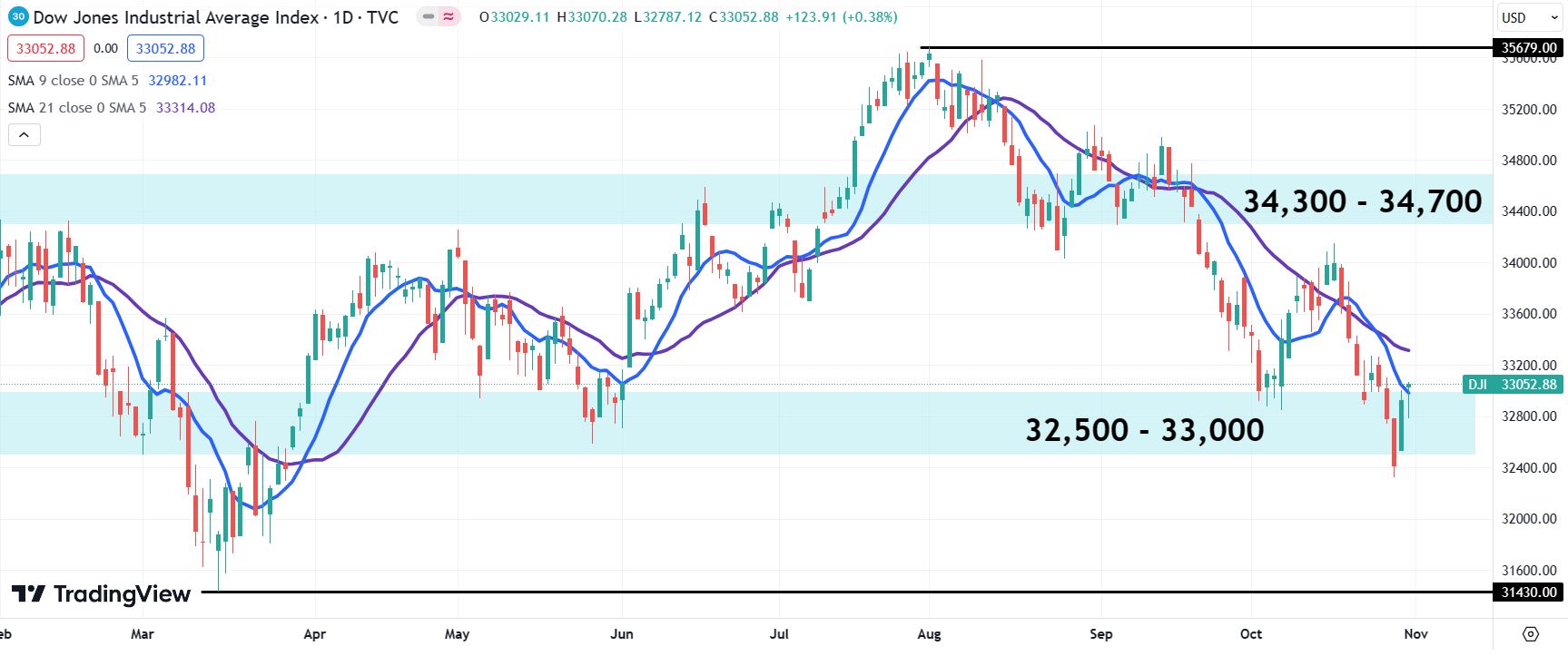
Dow Jones Industrial Average daily chart
Author

Clay Webster
FXStreet
Clay Webster grew up in the US outside Buffalo, New York and Lancaster, Pennsylvania. He began investing after college following the 2008 financial crisis.
















