Dow Jones Industrial Average News: DJI closing in on 34,000 as S&P 500 bear market ends
- The Dow Jones Industrial Average has gained for five of the past six sessions.
- The DJI is sitting below a major resistance band.
- On Thursday, higher Initial Jobless Claims resulted in the market expecting a rate pause at the Fed’s June 14 meeting.
- The S&P 500 ended its 18-month bear market on Thursday.

The Dow Jones Industrial Average (DJI) is up 0.23% at the time of writing, nearing the 34,000 mark as the trading week approaches its end. S&P 500 and NASDAQ 100 are also up on the day in what's another positive session in the US stock markets.
The index gained for the fifth time in the last six sessions on Thursday as the larger S&P 500 index broke out of its longest bear market since 1948. Both indices benefited, counterintuitively, from higher Initial Jobless Claims that presented the market with more ammunition for a rate pause by the Federal Reserve (Fed).
Dow Jones Index News: Higher jobless claims show Fed is getting results
The US Department of Labor released Initial Jobless Claims on Thursday that showed an increase of 28,000 layoffs in the week ending June 2. The 261K in unemployment claims was well above expectations for 235K and led the market to presume that the Fed would have an easier time pausing its rate hike cycle at the June 14 meeting.
That news came one week after the US Bureau of Labor Statistics reported that the Unemployment Rate in May rose from 3.4% to 3.7%. Additionally, recent data from both the ISM Manufacturing and Services PMIs show an economy that is slowing down somewhat. This is only good news if you are laser-focused on the Fed reaching its terminal rate sooner rather than later. Much of the institutional investing class is in that category.
The CME Group FedWatch Tool predicts interest rate changes based on price action in the 30-day fed funds futures market. Currently, the tool gives a 78% chance that interest rates remain flat at 5% to 5.25% and a 22% chance that the Fed hikes by 25 basis points at the June 14 meeting. Lower or stabilized interest rates should help corporations in need of financing and aid bank lending, which has receded of late due to the higher rate environment causing a reduction in deposits.
S&P 500 ends long bear market
The S&P 500 ended its 18-month-long bear market, the longest since 1948, on Thursday. The S&P 500 index closed at 4,293, just a little over one point above the point level that equates to a 20% gain from its low on October 13, 2022.
From its high on January 4, 2022, the S&P 500 index fell roughly 27% until its low on October 13. Advancing 20% off a low traditionally ends a bear market, although to be sure S&P Dow Jones Indices (which manages both the DJI and the S&P 500) does not consider a bear market to be over until a new high is achieved. That criterion would require the S&P 500 index to climb another 12% from here. Most of the market follows the traditional criteria though.
For its part, the Dow Jones Industrial Average has already broken its bear market. This happened just two months after its October 13 low on November 30. In that session the Dow ran up 2.18% to close at 34,589 – well above the 34,393 level needed.
Despite the end of the bear market, analysts at Société General are still bearish on the S&P 500:
We expect the S&P 500 to return to its trading range of 3,500-4,200 as 2H should see slowing profit margins, credit weakness and rising inflation uncertainty as the impact of easy base effects dissipates.
– SocGen
Dow Jones forecast
Since then, however, the DJI has been in a bit of a funk. On December 13, 2022, the DJI index ran to a 11-month high at 34,712 but then sold off to end the session at a loss. For the past six months, DJI has been floating in a holding pattern primarily between 31,600 and 34,000.
A range of resistance between 34,257 and 34,590 has been pushing rallies down for months at this point. Closing above that 34,590 level, therefore, should result in the beginning of a new rally for the Dow Jones index. This is why 34,600 is the first major price level to break and a primary price target for bulls. The Moving Average Convergence Divergence (MACD) indicator has crossed over bullishly of late, so a rally up to this target should be in the cards.
If not and more support is required, the 32,500 to 32,800 demand zone should come in handy in the case of any major downdrafts. That range has worked as support on a number of occasions all year long.
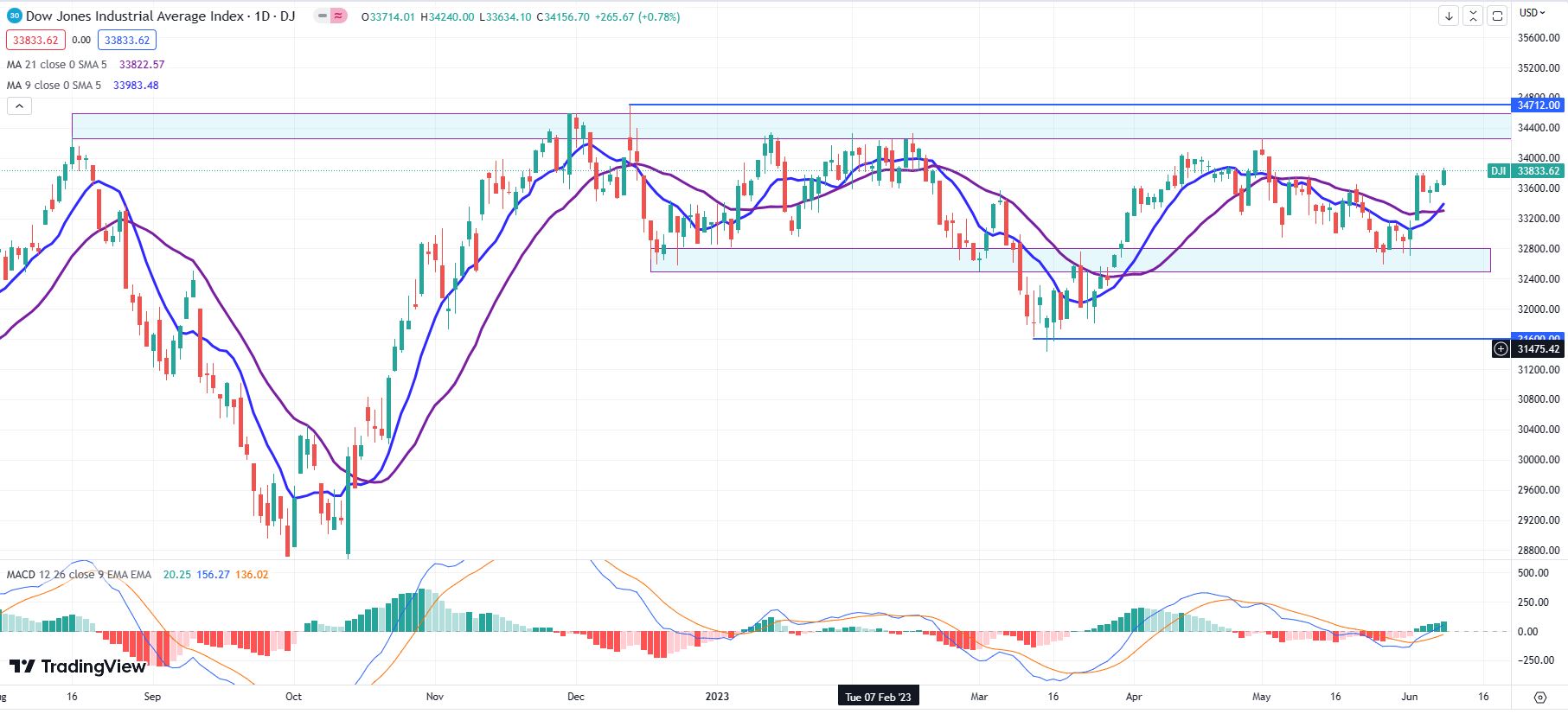
DJI daily chart
Author

Clay Webster
FXStreet
Clay Webster grew up in the US outside Buffalo, New York and Lancaster, Pennsylvania. He began investing after college following the 2008 financial crisis.