Dow Jones Industrial Average grapples with shaky consumer sentiment
- The Dow Jones fell another 200 points on Friday as equities retreat on multiple fronts.
- The AI-centric tech segment is facing further declines in the face of high AI spend and low revenues.
- US consumer sentiment took a worrying turn, dragging market sentiment even lower.

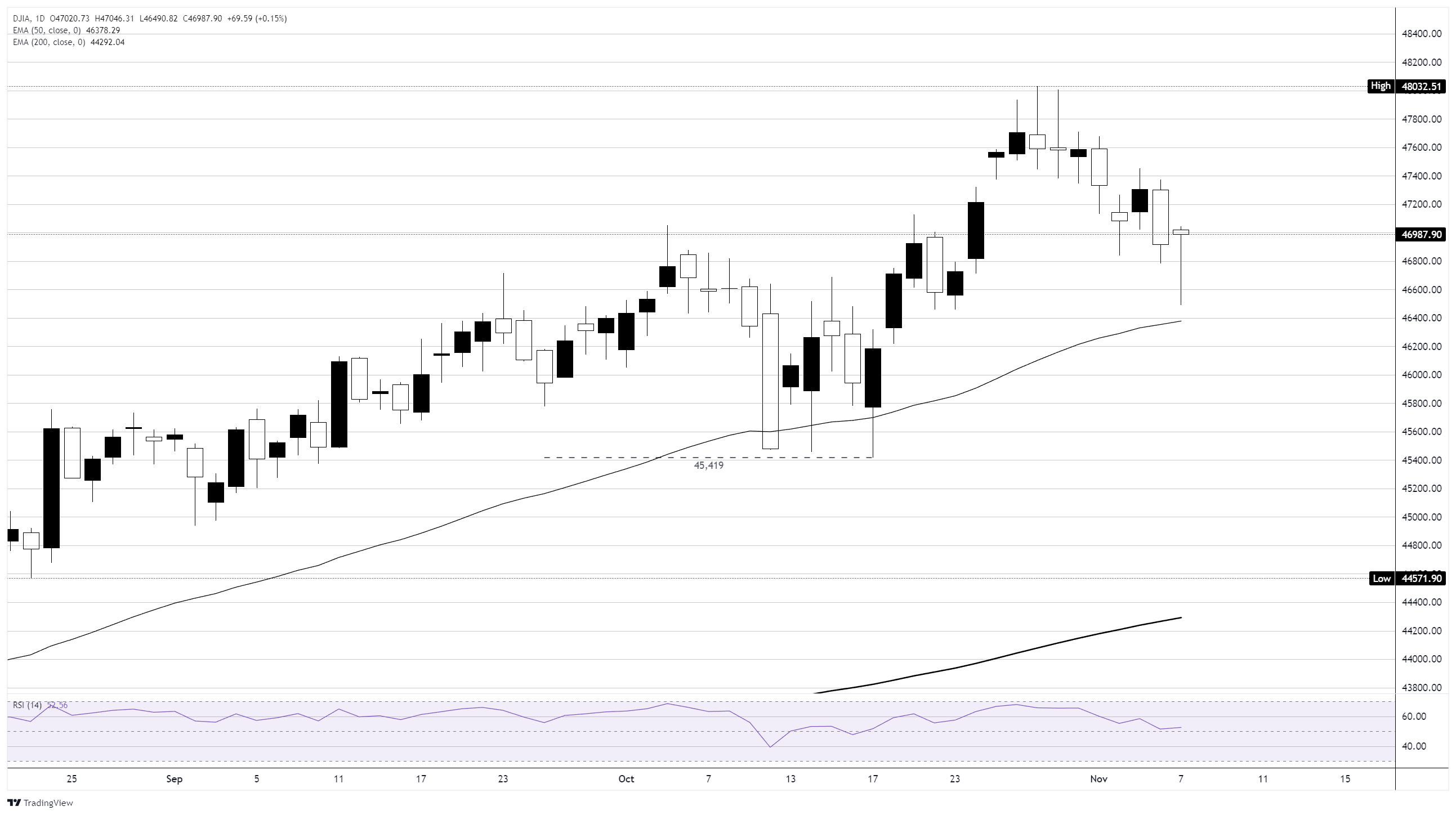
The Dow Jones Industrial Average (DJIA) took another leg lower on Friday, testing below the 46,800 level for the first time in almost three weeks before barely managing to squeeze back to flat for the day as an AI stock pullback and withering consumer survey results drag down both sides of the investment-consumption equation. Friday would have seen the release of the latest US Nonfarm Payrolls (NFP) jobs report, but the ongoing US government shutdown, which is officially the longest shutdown in US history, is crimping the flow of official data, leaving investors to grapple with volatile private data, and putting deep question marks where key inflation and employment numbers should be.
US Senate Democrats prepared a minibus government funding solution for House Republicans to accept, which Republicans promptly rejected before headlines could even be written. Democrats were willing to suspend Affordable Care Act (ACA) healthcare provisions for an entire year in order to get the US government started back up, but Donald Trump's Republican supporters within the US government remain unwilling to reopen federal government services unless Democrats are fully willing to allow between 15 and 40 million Americans lose access to critical healthcare coverage. Supplemental Nutrition Assistance Program benefits, also known as the SNAP program, have also been shuttered during this federal closure, marking the first time in US history that SNAP has been withdrawn during a government shutdown. SNAP provides food benefits for over 9% of American households, 80% of which contain children. Donald Trump's administration has waffled severely on SNAP funding, stating that they will be fully, partially, or not funded depending on the day or who is asking the question.
Consumer sentiment takes a knee
University of Michigan (UoM) Consumer Sentiment survey results showed that US spenders and earners are far more bitter about worsening economic conditions than previously expected by investors. The UoM’s Consumer Sentiment Index and Consumer Expectations Index both declined to some of their lowest levels on record, with the Sentiment Index falling to 50.3 from 53.6, and the Expectations Index slumping to 49 from 50.3. The steep declines highlight the deteriorating economic outlook for consumers, who have been facing worse employment, income, and hiring conditions through the second half of the year. Markets struggled to grasp deteriorating conditions at the surface level of consumer data, with the upper ranks of income earners covering inflation and job cut holes with outsized consumption spending power in the post-COVID economic era.
The UoM’s 1-year and 5-year Consumer Inflation Expectations survey results also showed a steepening of the consumer expectations curve, with 1-year inflation expectations rising to 4.7% from 4.6% and the 5-year outlook falling to 3.6% from 3.9%. A tightening inflation expectations curve implies that consumer-level economic concerns are shifting from general malaise to growing fears of a near-term deterioration.

Fed consumer sentiment results differ, but overall message remains the same
Fears of a 'K-shaped' economy, where a few high-income earners are outspending the lower portions of the income ladder just enough to paper over threats of steep economic downturns, have been growing through the year among academic circles, and now K-shaped data sources have been appearing to further complicate the issue. According to the Federal Bank of New York (Fed), consumer inflation expectations were relatively unchanged in October, with the New York Fed reporting a slight decline in 1-year inflation expectations to 3.2% from 3.4% and an unchanged 5-year inflation outlook at 3.0%. Despite the comparatively cooler data, even the New York Fed had to begrudgingly acknowledge that October’s household labor market outlook was “mostly negative”, while consumer perceptions of both current and future financial conditions worsened appreciably.
Shutdowns are the president's fault, except when they're not
The US government shutdown continues to roll on into record territory, and US President Donald Trump has the dubious honor of helming the federal government during the two longest shutdowns in US history, and also stands tall as the US President in office for the most federal closures. With official datasets frozen due to defunding, investors have been forced to pivot into sniffing out private datasets to try and estimate where inflation and labor market shifts are hitting, and the figures are not looking good. According to figures from DataWeave, major retailers Target (TGT) and Walmart (WLMT) have seen their average prices rise 5.5% and 5.3%, respectively, a stark reminder that inflation figures tend to be a collection of assumptions, estimates, and averages, and can frequently mask steep, unbalanced price hikes that pummel a large number of lower-income consumers’ wallets.
Donald Trump’s personal solution to growing concerns about an affordability crisis was to take to social media and make a post demanding that everyone “STOP LYIN”, and instead claiming that his administration has actually “whipped” inflation. In 2013, Donald Trump was an aspiring political candidate who claimed via a social media post that “a shutdown means the president is weak.” However, that was before Donald Trump was personally at the helm of the two longest government shutdowns ever.
Dow Jones daily chart
Economic Indicator
Michigan Consumer Sentiment Index
The Michigan Consumer Sentiment Index, released on a monthly basis by the University of Michigan, is a survey gauging sentiment among consumers in the United States. The questions cover three broad areas: personal finances, business conditions and buying conditions. The data shows a picture of whether or not consumers are willing to spend money, a key factor as consumer spending is a major driver of the US economy. The University of Michigan survey has proven to be an accurate indicator of the future course of the US economy. The survey publishes a preliminary, mid-month reading and a final print at the end of the month. Generally, a high reading is bullish for the US Dollar (USD), while a low reading is bearish.
Read more.Last release: Fri Nov 07, 2025 15:00 (Prel)
Frequency: Monthly
Actual: 50.3
Consensus: 53.2
Previous: 53.6
Source: University of Michigan
Consumer exuberance can translate into greater spending and faster economic growth, implying a stronger labor market and a potential pick-up in inflation, helping turn the Fed hawkish. This survey’s popularity among analysts (mentioned more frequently than CB Consumer Confidence) is justified because the data here includes interviews conducted up to a day or two before the official release, making it a timely measure of consumer mood, but foremost because it gauges consumer attitudes on financial and income situations. Actual figures beating consensus tend to be USD bullish.
Author

Joshua Gibson
FXStreet
Joshua joins the FXStreet team as an Economics and Finance double major from Vancouver Island University with twelve years' experience as an independent trader focusing on technical analysis.